Abdus Salam shared the 1979 Nobel Prize in Physics for his contributions to unifying the weak and electromagnetic forces, but has been unusually overlooked by his homeland, as Matin Durrani explains

The facts are simple enough.
Abdus Salam shared the 1979 Nobel Prize in Physics with Sheldon Glashow and Steven Weinberg for “their contributions to the theory of the unified weak and electromagnetic interaction between elementary particles, including, inter alia, the prediction of the weak neutral current”.
What Salam had done was to incorporate the Higgs mechanism – co-discovered by his colleague at Imperial College London Tom Kibble – into electroweak theory, which unifies the electromagnetic and weak forces.
As the Imperial theorist Claudia de Rham said in a 2024 interview with Physics World, Salam’s work “changed the way we see the world by underlining the importance of symmetry and by showing how some forces – which may appear different – are actually linked”.
But Salam, who died in 1996 after suffering from a cruel neurodegnerative disease, did more than unify the weak and electromagnetic interactions. He also became the first – and so far the only – person from Pakistan to win a science-related Nobel prize, yet for a long time remained overlooked in his homeland.
Great minds
Salam was born on 29 January 1926 in the Punjabi city of Jhang in what was then British India. A child genius, he studied mathematics at Government College, Lahore, completing his master’s degree in 1946 with record marks (getting 765/850 or 90%).
Later that year Salam moved to the UK after winning a scholarship to study at St John’s College, Cambridge, studying initially mathematics and then physics, gaining a double first-class honours in 1949.
Back home, India was in turmoil, with a growing demand for independence from the British and the Muslims seeking a homeland for themselves.
How long did it take for countries to claim a Nobel laureate?
As a Muslim himself, Salam would no doubt have celebrated when Pakistan was created during the partition of India, with the country coming in to existence at the stroke of midnight (0.00 a.m.) on 14 August 1947.
After completing his PhD in quantum electrodynamics at Cambridge in 1951, Salam therefore returned to Pakistan, taking up a teaching post at Government College, keen to establish a research base in the fledgling country. But lacking journals, colleagues or any proper scientific infrastructure in Pakistan, Salam realized he would have to go abroad again.
“Either I must leave my country or leave physics,” he said. “And with great anguish I chose to leave my country.”
In 1954, Salam went back to Cambridge for three years before appointed a professor of applied mathematics at Imperial in 1957. He later switched to Imperial’s physics department, where he set up a renowned theoretical-physics group that he led for much of the rest of his life.
In 1964 Salam also founded the International Centre for Theoretical Physics (ICTP) in Trieste, Italy, to help support physicists from developing nations.
Home at heart
But Pakistan was always in his heart. Salam served for 13 years as presidential science adviser in Pakistan and in the 1970s also played a slighly murky role in the country’s nuclear-weapon programme.
Upon winning a Nobel prize in 1979, Pakistan had existed for only 32 years, meaning it, along with Austria, is the joint 13th quickest nation to win a Nobel Prize in Physics, according to our Physics World infographic.
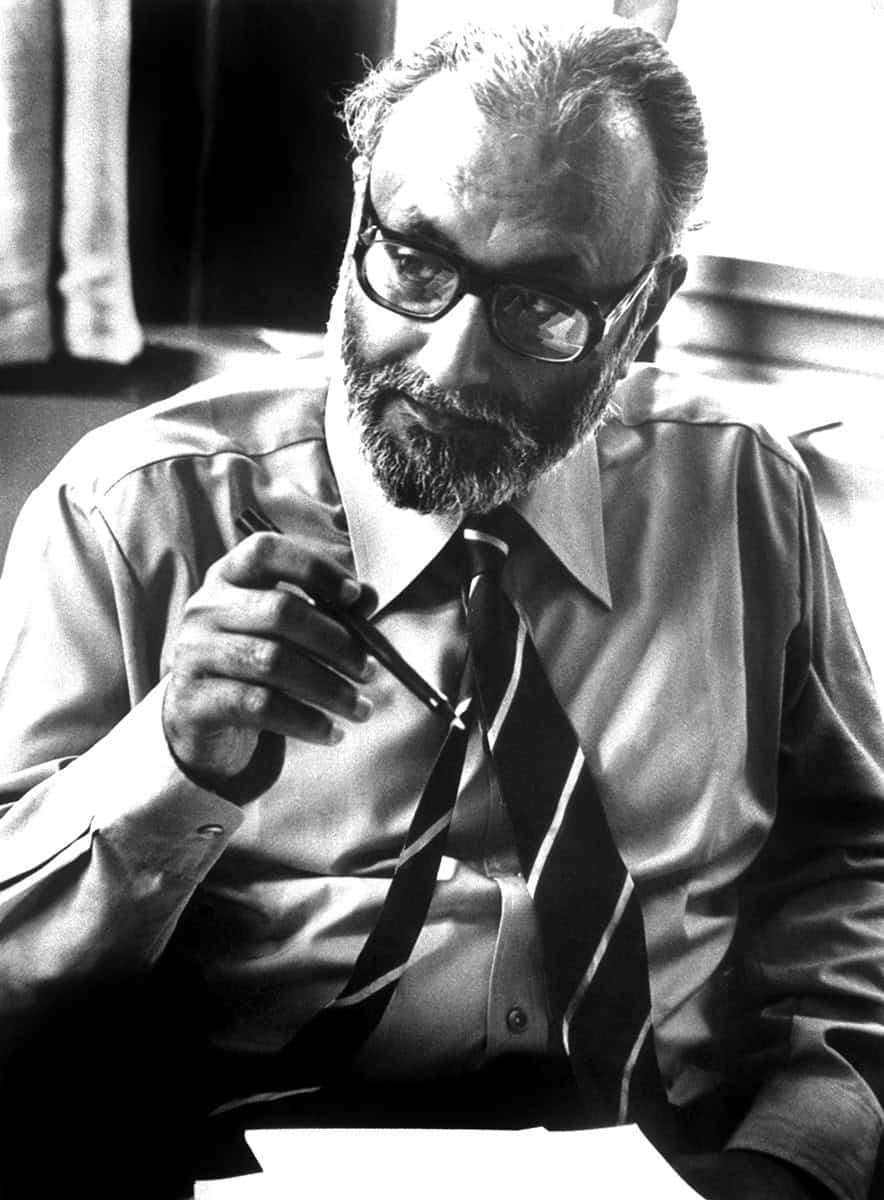
At the official Nobel banquet in Stockholm on 10 December 1979, Salam thanked the Nobel Foundation and the Royal Swedish Academy of Sciences. “Pakistan,” he declared, “is deeply indebted to you for this”.
Yet back home, little was made of Salam’s impressive award. Most Pakistanis are Sunnis but Salam was an Ahmadi, part of a minor Islamic movement founded in the late 19th century by the religious leader Mirzā Ghulām Ahmad (1835–1908).
Such was the opposition in Pakistan to the Ahmadis that in 1974 the country’s parliament declared them non-Muslims – heretics essentially – and the constitution was altered to reflect that fact.
Pakistan’s decision to outcast the Ahmadis profoundly affected him. As Salam wrote in his diary: “Declared non Muslim. Cannot cope.” Having previously been largely a “cultural Muslim”, Salam now saw his religious beliefs re-awakened.
Belatedly, Pakistan did offer some formal recognition in the form of a two rupee stamp in 1998, but it is surprising the country has not done much more. In 2016 Physics World reported that then Pakistani prime minister Nawaz Sharif was going to renamed the National Centre for Physics at Quaid-i-Azam University in Islamabad as the Professor Abdus Salam Centre for Physics – but, as far as I can tell, that has not taken place.
Imperial in contrast renamed its main library in honour of Salam in 2023 and this year has been celebrating the centenary of his birth. The ICTP was also renamed after him in 1997.
A few years ago Zakir Thaver and Omar Vandal produced a wonderful documentary film called Salam: the First ****** Nobel Laureate. Directed by the physicist Anand Kamalakar, it explores in detail the strange relationship between Salam and Pakistan, which surely should have done more to honour its greatest physicist.
I can’t imagine other countries doing so little for their first Nobel-prize winners as Pakistan has for Salam.