Open-cell metallic structures are widely employed in the aerospace industry and in biomedical applications that require materials to be extremely light as well as strong. In marine infrastructure, however, their usefulness is limited because water quickly fills their interconnected open pores, preventing them from floating even though their bulk density is much lower than that of water.
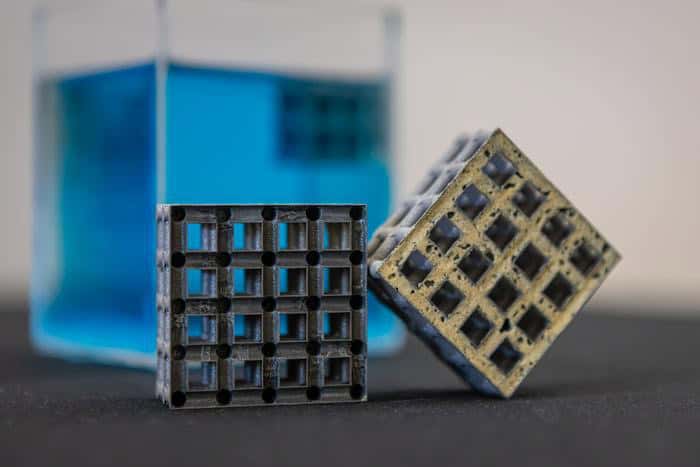
Engineers in Australia and France have now developed a way around this problem. By combining so-called architected metals with a lightweight polymer foam, they created lightweight, strong, open-cell titanium structures that can float in water, overcoming the density limitation of previous materials while retaining structural performance.
“The innovation opens a new design space for marine structures, vehicles and rescue equipment where we need strength, low weight and buoyancy all at the same time,” says Ma Qian, a materials engineer at the RMIT University in Melbourne who co-led the research.
Beyond Archimedes
According to Archimedes’ principle, an object will float if its effective average density is lower than that of the fluid surrounding it. With open-cell materials, however, it’s more complicated. Because these interconnected frameworks of struts, thin plates or curved surfaces contain interconnected open voids that can fill with water as well as closed voids that cannot, they may fail to float even when their bulk densities (ρbulk) are well below that of water.
In the new work, which is detailed in Advanced Materials, Qian and colleagues at RMIT’s Centre for Additive Manufacturing and the Conservatoire National des Arts et Métiers in France developed an alternative measure of density that incorporates only the water-excluding parts of a structure. If the value of this “skeletal density” ρskeletal is lower than that of the surrounding liquid, then the structure will float even when water flows through all its interconnected open pores.
The team used this new measure to design a structure based on a recently-developed type of metallic open-lattice metamaterial called a hollow-strut lattice (HSL). Unlike conventional solid-strut designs, HSLs contain millimetre- or sub-millimetre-sized channels within their struts. These channels make them stronger than conventional solid-strut lattice materials of the same density, but that isn’t their only attraction. The presence of such channels also means that materials can be injected into them without compromising the HSL’s open-cell architecture – something that is impossible in traditional structures. Thanks to this feature, Qian explains, appropriately designed hybrid HSLs can float in water while remaining permeable.
Foam and titanium
The researchers made their open-cell hybrid lattice metamaterial by injecting expandable polyurethane (PU) foam, which has a density of 0.08–0.11 g/cm3, into a HSL structure made from a titanium alloy, Ti-6Al-4V. At the macro level, Qian explains that the foam completely fills the hollow titanium struts, and microscopic analyses reveal continuous, defect-free interfacial bonding between the foam and the inner walls of the struts, while the foam’s own heterogeneous, closed-cell microstructure incorporates pores ranging from ∼10 µm to 200 µm in size. “The closed-cell PU foam limits water ingress into the internal strut channels while the external open-cell architecture remains permeable, so safeguarding marine buoyancy without notable density gain,” Qian says.
The RMIT team submerged both unfilled and foam-filled titanium alloy HSLs in freshwater for more than two months. As expected, all the unfilled HSLs sank when immersed, regardless of strut diameter. The researchers then immersed the materials in natural seawater (which has a measured density of 1.03 g/cm3, slightly higher than the 0.997 g/cm3 they measured for freshwater) over a period of two weeks. They found that the hybrid structures stayed afloat over the experimental period and lost only about 0.15 % of their mass, suggesting they are resistant to corrosion. They also found that the foam-filled HSLs have a higher specific strength than commonly employed marine materials such as high‑density polyethylene and 316L stainless steel.
Saving the Titanic: the science of icebergs and unsinkable ships
While the most immediate uses for these new materials will be in seafaring vehicles, lightweight floating structures and rescue equipment, Qian thinks they could have wider applications. “The open-cell architecture allows different materials to be integrated within the same structure,” he tells Physics World. “For example, a biodegradable magnesium scaffold could potentially be combined with a hydrogel containing growth factors for controlled therapeutic delivery during bone regeneration. And in aerospace applications, a hollow-strut titanium lattice might be integrated with a carbon-fibre-reinforced polymer to create lightweight, stiff hybrid structures.”
The researchers now plan to further develop their technology and are seeking collaborations with potential commercial partners. “We want to assess its viability for larger marine applications, including autonomous underwater vehicles and floating platforms and investigate long-term performance under realistic marine conditions,” Qian says. “We also plan to introduce our concepts into our advanced manufacturing and design courses at RMIT to help engineering students and researchers develop new ideas in this emerging field.”