Two independent teams have realized the first clocks based on transitions within atomic nuclei. The new nuclear clocks represent the culmination of more than 20 years of research and could become vital tools in precision tests of fundamental physics.
Today’s most accurate clocks “tick” whenever an electron transitions between two specific hyperfine levels in the ground state of an atom. These atomic clocks form a vital part of technologies such as satellite navigation and telecommunications networks. They also contribute to fundamental research in dark matter searches and gravitational wave detection.
Traditionally, the hyperfine levels used in atomic clocks are separated by gaps with frequencies in the microwave range. However, more modern atomic clocks use higher-frequency optical transitions. Known as optical clocks, they are more precise because they “tick” more often within a given period, enabling finer measurements of time passing.
Clocks based on atomic nuclei could, in principle, be more precise still. First proposed in the late 1990s, they are less prone to disturbances from electromagnetic fields, and they exploit transitions at even higher (ultraviolet) frequencies. Getting such clocks to work, however, proved no easy feat, because driving these narrow nuclear transitions requires highly stable lasers with extremely small bandwidths.
It’s about time
Two independent teams are now reporting a breakthrough in this field. Writing in Nature, they describe realizing working nuclear clocks based on transitions in nuclei of thorium-229.
Members of the first team, which is led by Ekkehard Peik at the Physikalisch-Technische Bundesanstalt (PTB) in Germany and Thorsten Schumm from TU Wien in Austria and includes colleagues in Germany, Austria and Czechia, had previously made several key advances. Peik and Schumm’s group were the first to demonstrate laser excitation of the thorium-229 nuclear transition. They were also the first to embed thorium-229 within crystals of calcium fluoride (CaF2), creating a solid-state device which, unlike (optical) atomic clocks, does not use trapped atoms or ions.
The second team, led by Shiqian Ding from Tsinghua University and including collaborators at 13 other institutions across China, has likewise chalked up notable achievements, including a demonstration of the first continuous-wave narrow-linewidth UV laser at the crucial wavelength of 148.4 nm. Because China has limited access to thorium-229, Ding and colleagues also developed an approach for growing small single crystals that requires only 1.4 μg of the isotope.
Running like clockwork
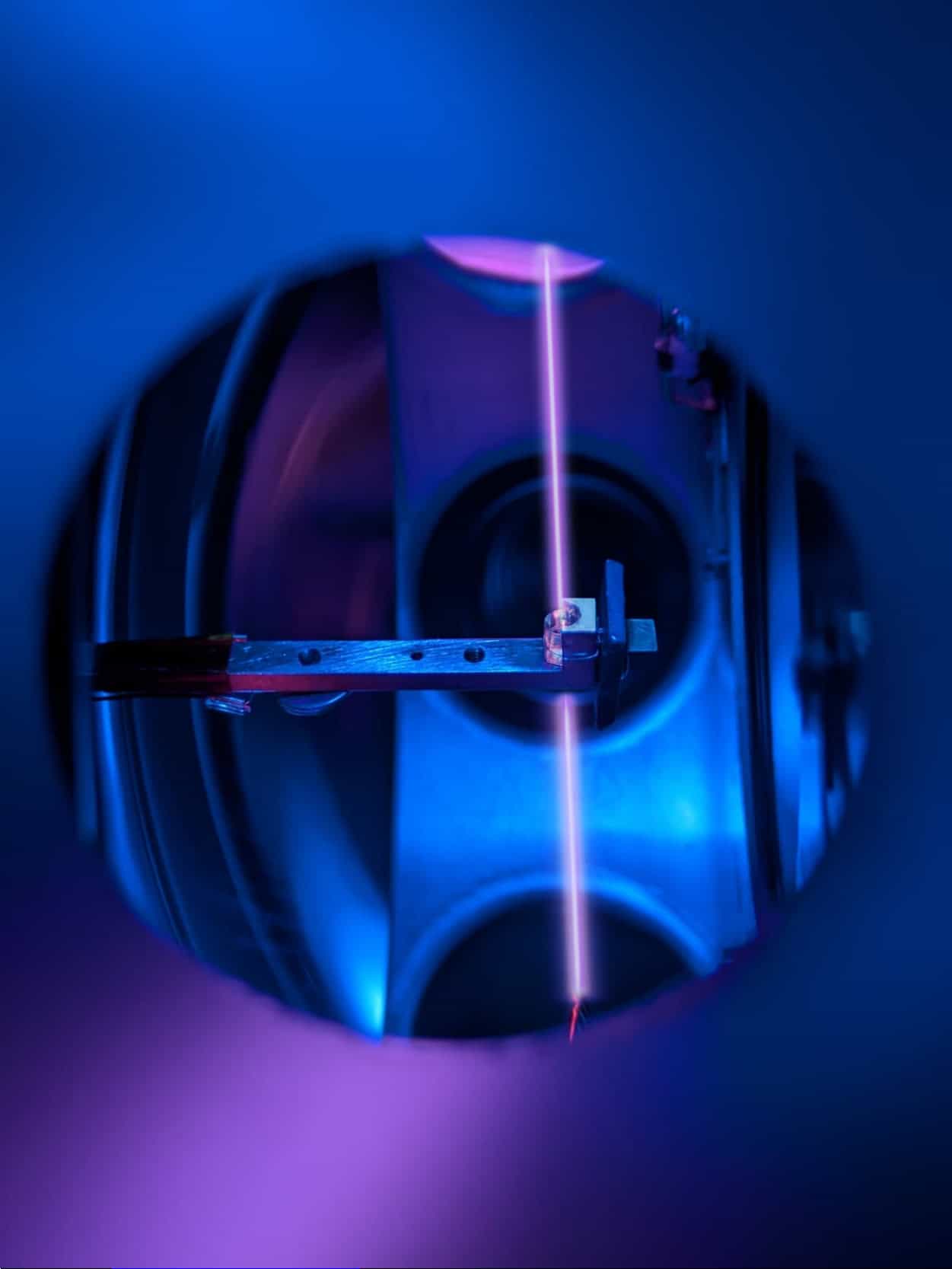
In the latest work, both teams used thorium-229 embedded in millimetre-sized CaF2 crystals and driven by narrow-linewidth, continuous-wave UV lasers, although the nonlinear processes used to generate the laser light were different. They also both used direct absorption spectroscopy through the crystal to monitor how well they were exciting the nuclear resonance, plus a feedback loop to lock the laser frequency onto the desired transition. They thus created stabilized nuclear clocks that they could compare continuously to frequency standards derived from atomic clocks.
At this point, the teams’ efforts diverged. Whereas Schumm and colleagues were able to embed more thorium-229 into their CaF2 crystals, Ding and colleagues generated laser light at higher powers. Both features tend to produce more stable clocks with a higher signal-to-noise ratio, although the fractional frequency instability in the Tsinghua device was lower, at 5 x 10-13/√τ/s (where τ is the averaging time), compared to 3 x 10-12/√τ/s in the PTB-TU Wien collaboration.
The PTB-TU Wien team applied their nuclear clock to fundamental physics, using it to search for ultralight scalar dark matter couplings and constrain fluctuations/drifts in the nuclear transition energy. Their results set limits on how dark matter can couple to photons and the strong nuclear force that are comparable to those derived from today’s best atomic clocks.
The primary focus of Ding and colleagues’ work was on technical aspects such as high-power vacuum ultraviolet (VUV) interrogation, clock performance, inter-crystal reproducibility and metrological consistency. The clock transition frequencies they measured in two independently fabricated crystals agreed both with each other and with previous measurements of the thorium-229 transition made using VUV frequency combs at JILA in the US.
Heading for higher precision
Peik says that he and his team are now working on boosting their laser power, improving the signal-to-noise ratio in their detectors, and studying the structure of the thorium dopant in their crystal to understand what determines the linewidth of the nuclear resonance within it. “We have now seen 30 kHz linewidth, but the natural linewidth should be way below 1 Hz, which would enable more stable clock operation,” he tells Physics World.
Nuclear clock ticks ever closer
Ding says that an important next step for his team is to develop better host crystals than CaF2, which could lead to a substantially narrower nuclear transition and improve both stability and accuracy. He is also interested in creating a trapped-ion thorium nuclear clock that would be more isolated from its environment and could re-use many of the quantum control techniques developed for atomic and ion clocks. “It is technically much more difficult, but I think this route may ultimately provide the highest accuracy,” he says.
Victor Flambaum, a theorist from the University of New South Wales, Australia who was not involved in either project, calls the teams’ devices the “first prototypes of nuclear clocks”. He is excited by their potential for uncovering new physics effects, such as those produced by dark matter, which are expected to be very small. “We have shown that in nuclear clocks these effects are strongly enhanced,” he says.