Researchers in the Netherlands have shown that they can turn off the dipole moment of molecules that are normally polar, drastically altering the molecules’ behaviour in low-energy collisions. The discovery – which was only possible after the team cleared a major experimental hurdle – has implications for ultracold chemistry and could also lead to a better understanding of polarity, with benefits for quantum simulation and computation.
Chemical reactions are full of complexity and chaos, making them hard to study at the atomic and molecular level. Before attempting to do so, scientists typically cool the reactants to just above absolute zero, which restricts their movement and vibrations. Despite these restrictions, however, interactions between ultracold molecules remain poorly understood, especially when the molecules have an electric dipole moment.
In 2023 experimental physicist Bas van de Meerakker and theorist colleagues at the Radboud University Nijmegen in the Netherlands shone a ray of light on this murky area by studying the collision cross-section (that is, the likelihood that collisions will take place) between molecules of ammonia (NH3) at low energies. Their simulations showed that this cross-section falls off sharply as the energy decreases. This contradicts the classical picture of polarity, which suggests that the cross-section should continuously increase.
A big turn off
The Radboud team explained this discrepancy by noting that in the classical picture, polar molecules such as ammonia have a permanently asymmetric charge distribution – a dipole moment – due to the arrangement of the bonds between their constituent atoms. The quantum mechanical picture, in contrast, depicts an isolated molecule in a specific quantum state as having a definite parity, or symmetry. Because of this symmetry, the molecule’s net dipole moment in the lab frame is exactly zero.
According to this quantum picture, collisions between polar molecules at high speeds (high energies) cause these opposite parity states to mix via interactions between the molecules’ electrostatic fields. In the process, they essentially “turn on” each other’s dipole moments, causing them to attract each other and increasing the collision cross-section. At low speeds, however, the molecules cannot get close enough to trigger this mutual mixing. As a result, their dipole moments effectively switch off, and their collision rates drop drastically.
On a collision course
The Radboud team’s next step was to prove experimentally that this is indeed what happens. However, colliding cold molecules generally requires using electric fields to merge two molecular beams. When molecules in the two beams have very similar dipole moments, this is very difficult, because using an electric field to steer one beam automatically affects the path of the other. The risk is that the beams never overlap at all.
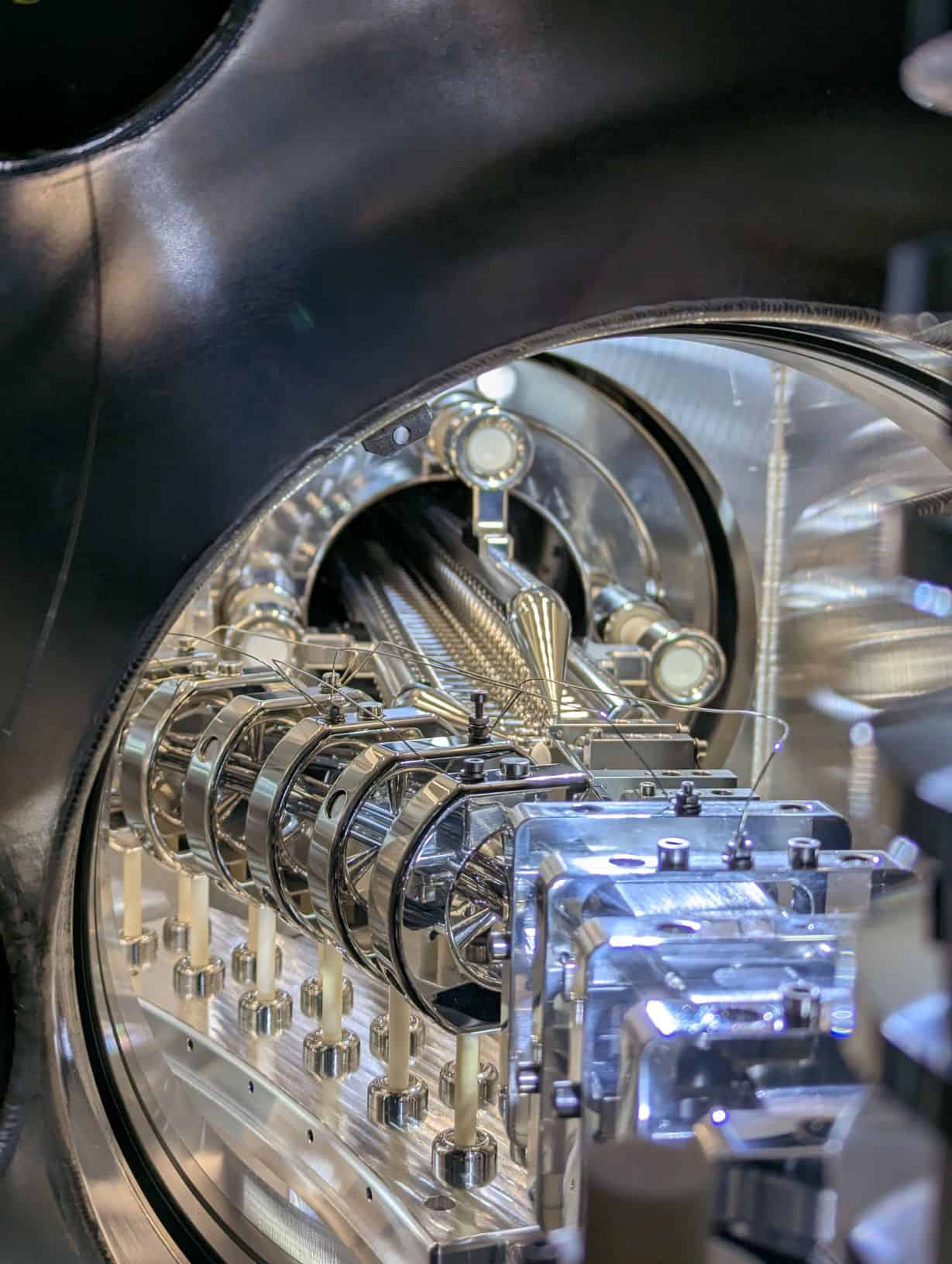
To overcome this obstacle, van de Meerakker and colleagues combined a 2.6 m Stark decelerator, a curved hexapole guide and a merged quadrupole/hexapole trap into a device that can overlap the beams at just the right position, with minimal angle between them. In this way, they achieved sufficient overlap to observe low-energy collisions. They then experimentally verified the predicted energy-dependent changes in cross-section for NH3-NH3 collisions, while also showing that this dependence is different when they replace hydrogen atoms with deuterium (NH3-ND3 or ND3-ND3 collisions).
Under control
According to van de Meerakker, the fact that cross sections drop at low energies could make it hard to perform experiments that require scattering to take place in crossed or merged beams. On the other hand, experiments in which dipolar molecules are stored in traps could benefit, as lower inelastic cross-sections mean fewer molecules are lost from the trap.
As for future work, van de Meerakker says the team plans to add a controlled electric field to the beam overlap region. The mechanism they discovered is expected to respond extremely sensitively to this field, with even small electric fields changing cross sections by orders of magnitude and thereby providing a “knob” with which to control collision outcomes. “It was exactly this type of control that sparked our interest in cold and ultracold molecules two decades ago, and it is very exciting that this is now within reach in our scattering experiments,” van de Meerakker tells Physics World.
Quantum superchemistry emerges in the laboratory

Tim Langen, a physicist at Austria’s Vienna University of Technology who was not involved in this research, describes it as important because it provides experimental evidence for a phenomenon that had mainly been discussed theoretically. In his view, the results support the idea that effective dipolar interactions become strongly suppressed at low collision energies. He also finds the experimental approach “impressive” as it enables measurements in a regime that was previously difficult to access. “Overall, I find the work convincing and expect it to be of broad interest to researchers working on cold and ultracold molecules,” Langen concludes.
The research is published in Nature Chemistry.