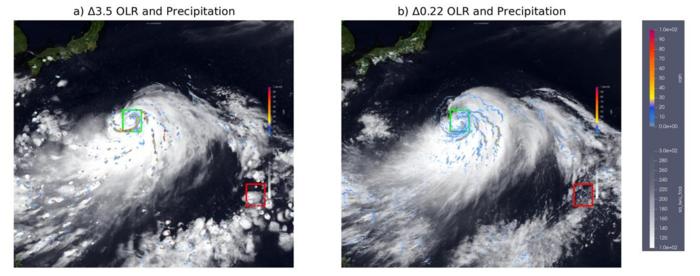
A new climate model successfully reproduces the behaviour of Earth’s atmosphere at a horizontal resolution of just 220 metres – a record for global simulations. By reducing the erroneous “popcorn-like” rainstorms that repeatedly marred less fine-grained models, the new model could shed light on processes occurring in convective clouds, which play an important role in extreme rainfall, tropical weather and the climate in general.
Strong storms are becoming more common as climate change takes hold, and being able to predict them helps reduce the risks they pose to life and infrastructure. Traditional global climate models aren’t very good at this, though, because they divide the Earth’s atmosphere into a grid with sections that span tens or even hundreds of kilometres. This is far too big to yield insights into localized storms. However, thanks to recent advances in supercomputing, a new generation of Global Storm-Resolving Models (GSRMs) is giving scientists a much more detailed picture, with grid sizes falling to 10 km or even 1 km.
A new large eddy simulation
In the latest work, scientists led by Shuhei Matsugishi at the Atmosphere and Ocean Research Institute of the University of Tokyo, Japan, improved this resolution still further with a large eddy simulation that covers just 220 metres per section. “This is fine enough to explicitly represent the detailed internal structure of convective clouds, including individual updrafts and downdrafts,” says Matsugishi. “That is not possible in conventional global atmospheric models.”
The researchers tested their Nonhydrostatic Icosahedral Atmospheric Model via a series of simulations on the Fugaku supercomputer, which is one of the world’s fastest. Since previous work indicated that horizontal resolution should have a larger impact on cloud optical properties than vertical resolution, they defined horizontal grid spacings of 0.44, 0.87, 1.7, and 3.5 km while keeping the vertical resolution fixed in a 78-layer configuration similar to one employed in a previous study. Physical processes represented in the model included light radiation, cloud microphysics, surface air fluxes and sub-grid-scale turbulence.
As detailed in Geophysical Research Letters, Matsugishi and colleagues found that the increased resolution in their model changes how it represents rainfall and clouds. One important effect is a reduced concentration of very intense bursts of rainfall over small, localized areas. This inaccurate “popcorn-like” rainfall, as it is known, has been a bane of current-generation GRSM models, cropping up across many simulations.
The Tokyo team also observed that representations of rainfall and clouds depend on how atmospheric turbulence is modelled. “This is exciting because it allows us to study how individual convective clouds interact with each other and with the large-scale atmospheric circulation,” says Matsugishi. “Such interactions are important for understanding extreme rainfall, tropical weather systems and the role of clouds in the climate system.”
Enormous computational cost
The main drawback of the work, Matsugishi says, is that running the team’s model comes with an enormous computational cost. “Our global simulation at 220-m resolution requires nearly one trillion grid points and an unprecedented amount of memory and data storage,” he says.
Though the team was able to optimize the model so that it could run simultaneously on a large number of processors, Matsugishi acknowledges that it is much too expensive for routine weather forecasting or long-term climate projections. However, he says it could serve as a valuable reference for evaluating and improving coarser-resolution models.
Physics-based models still beat AI for predicting extreme weather events
The researchers now plan to use their model to study convective clouds in much greater detail. Future tasks include examining how the size and organization of these clouds, as well as changes in vertical air motion within them, varies with increasing model resolution. The researchers will then evaluate how realistically their model represents these characteristics. Another goal is to better understand how turbulence, cloud microphysics and other small-scale processes should be represented as global atmospheric models move from kilometre-scale to several-hundred-metre resolution.
“Through these investigations, we hope to identify the improvements needed for the next generation of global weather and climate models,” Matsugishi tells Physics World.