The first direct images of how identical electrical charges arrange themselves on a sphere have been obtained by physicists in Austria and the UK. This comes 122 years after the British physicist J J Thomson first pondered the arrangement in relation to his long-defunct model of the atom – which was a ball of positive charge studded with electrons.
“Electrical repulsion pushes [the charges] apart as far as possible and the arrangement corresponds to a minimum-energy configuration,” says Paul Scheier of the University of Innsbruck in Austria, who led the new study with Shengfu Yang of the University of Leicester in the UK.
“The atomic model that inspired the problem is obsolete, but the underlying physics remains relevant to many systems, from curved crystals to nanoscale assemblies,” says Yang. The same question crops up in the protein shells of spherical viruses and in cage-like carbon molecules called fullerenes.
No general solution
The problem has no general solution. “Rigorous solutions exist for only a limited number of cases, including the tetrahedron for four charges, octahedron for six and icosahedron for twelve,” says Yang. Computer searches have found the likely best arrangements for up to a few thousand charges. “As the number of charges grows, there are increasingly many competing configurations, and proving that none has a lower energy becomes extremely difficult,” Yang explains.
Until now, the Thomson problem remained “a classical physics puzzle that had only ever been tackled by computation,” says Nadine Halberstadt of the French National Centre for Scientific Research (CNRS), who was not involved in the study. Experiments are difficult because in most liquid droplets charges spread throughout the volume instead of staying on the surface.
Superfluid helium offers a way around this. In 2024 Halberstadt and colleagues calculated that multiple charges can sit stably just below the surface of a helium droplet.
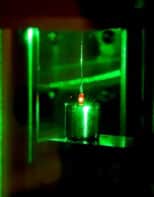
To achieve this, Yang and colleagues fire an electron beam at a stream of helium droplets, leaving each droplet with multiple positive charges. “The positive charge centres adopt Thomson configurations since they are highly mobile,” says Scheier.
Clumping gold
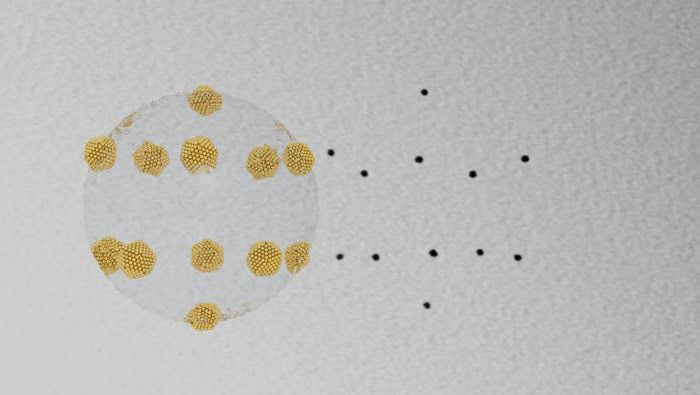
The droplets then pass through gold vapour, picking up atoms that are drawn to the nearest charge. The gold clumps into nanoparticles of about 700 atoms, each carrying a single charge. “Nanoparticles that contain a few hundred gold atoms are large enough that they can be seen in an electron microscope,” Scheier explains.
Finally, the droplets crashed into a thin carbon film leaving a 2D imprint of the nanoparticles that can be inspected using a transmission electron microscope. “By comparing these imprints with calculated projections, we can obtain information about the original spherical arrangements,” explains Yang.
Scheier adds, “Up to 36 charges, the experimental imprints are in perfect agreement with projections of computed solutions of the Thomson problem”.
The largest droplets were about 2 micron across and carried hundreds of charges. On a flat surface, these charges would settle into a regular pattern in which each has six evenly spaced neighbors. That pattern cannot cover a sphere, just as a ball cannot be stitched from hexagons alone, so some charges must make do with five neighbours. “In larger systems, we observe hexagonal ordering interrupted by fivefold defects,” says Yang. “What fascinates me is that the same simple electrical repulsion produces both precise arrangements of a few particles and collective crystalline order.”
Closing the loop
Halberstadt says, “This experiment closes the loop between prediction and observation. It opens a new experimental platform for studying how charges organize on curved surfaces.”
The technique did not work as well for droplets with large numbers of charges, but there was some qualitative agreement with theory.
“Experiments cannot provide a mathematical proof, but they can reveal something calculations alone cannot: which configurations a real physical system actually selects,” says Yang. “The mathematically lowest-energy arrangement is not necessarily the one that will form.”
As the number of charges rises, so does the number of near-optimal arrangements in which charges could get stuck. Scheier says that his first goal is to test simulated solutions for more than 1000 charges. Larger droplets tend to distort upon impact, so future experiments could involve slowing the droplets before they strike the target.
Nearly identical in size
The nanoparticles produced by the technique are nearly identical in size and Scheier believes this could be used to create 2D lattices of nanoparticles. He is now trying to develop a way of making nanoparticles of chosen sizes.
Static electricity: mysteries lurk within this everyday phenomenon

Halberstadt points out that it would be interesting to study spinning helium droplets, which can assume non-spherical shapes, which would “stimulate both experimental and theoretical work on charge ordering confined to curved surfaces”.
Yang’s own ambitions go further. “More fundamentally, I would like to move beyond identifying the lowest-energy configuration,” Yang says. “Can we predict which structure will actually form and, eventually, choose the preparation conditions that favour a particular outcome? That would take us from observing self-organization towards controlling it.”
The research also involved scientists at the UK’s Durham University and University of Cambridge and is described in Physical Review Letters.