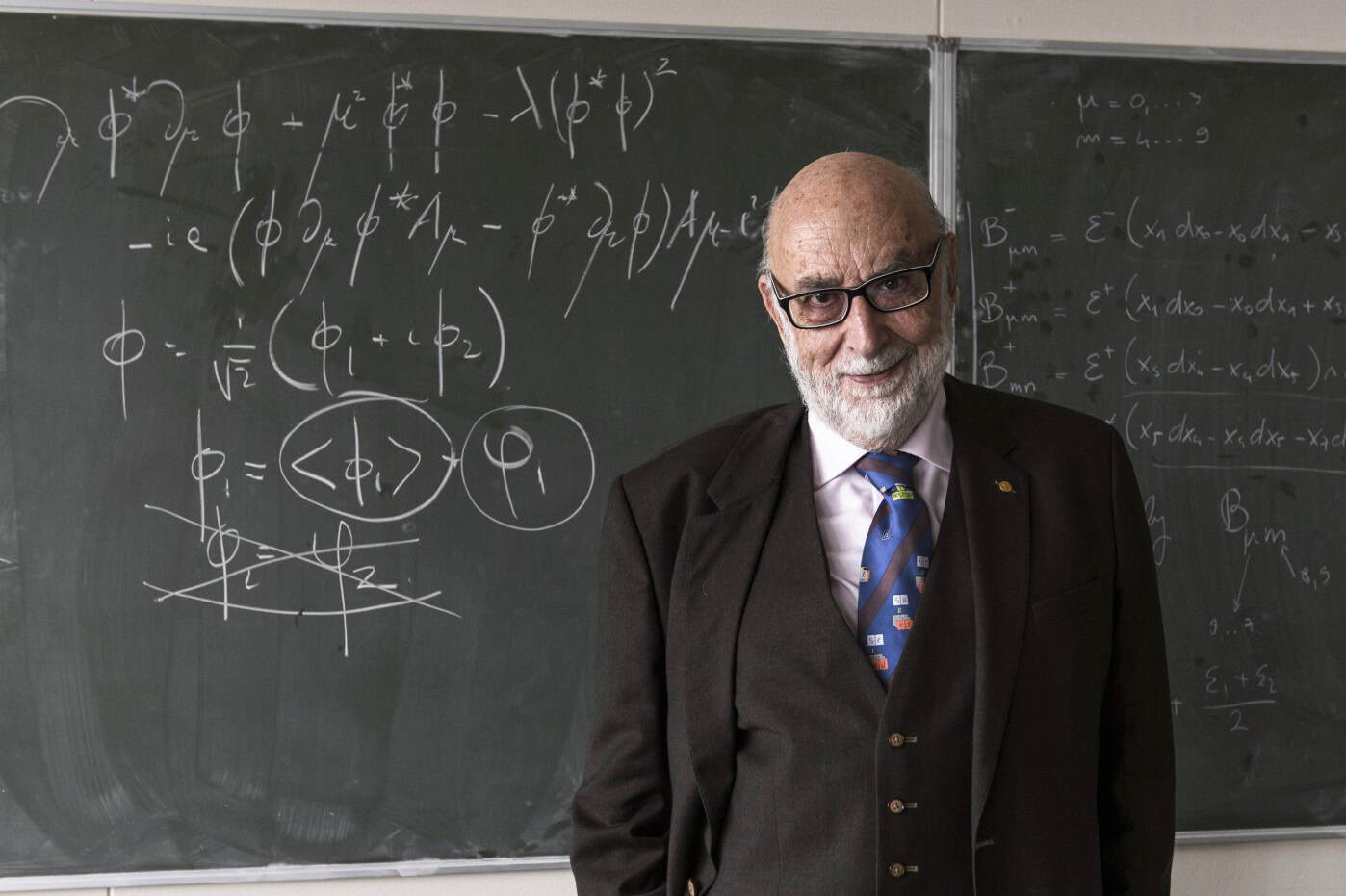
The Nobel-prize-winning Belgian theoretical physicist François Englert, whose work led to the discovery of the Higgs boson, died on 18 June at the age of 93.
Englert’s studies, which he carried out in the early 1960s with his colleague Robert Brout, demonstrated that fundamental particles can acquire mass by interacting with a field that permeates the universe. The work set in motion a decades-long hunt for the Higgs boson, which was finally discovered at the CERN particle-physics lab near Geneva in 2012.
For the work, Englert shared half of the 2013 Nobel Prize for Physics together with the British theoretical physicist Peter Higgs, who died in 2024.
Born in Brussels, Belgium, on 6 November 1932, Englert studied electrical engineering at the Free University of Brussels (ULB) before switching to physics and completing a PhD at the university in 1959.
For two years he then worked at Cornell University before returning to ULB in 1961, where he remained for the rest of his career.
New particle
“Spontaneous symmetry breaking” is a well-known concept in condensed-matter physics where it had been used to explain how, for example, unordered regions of a magnetic material could suddenly align themselves in a specific direction.
In the early 1960s, the Japanese–American particle physicist Yoichiro Nambu adapted the phenomenon into quantum field theory.
Working at the ULB, Englert and Brout took inspiration from Nambu’s work and in 1964 the pair proposed that the weak and electromagnetic interactions could be united by spontaneous symmetry breaking.
Higgs, who independently came to the same conclusion as Brout and Englert, showed that the particles that carried the weak force acquired their mass through interactions with an all-pervasive field, now known as the Higgs field with the interactions occurring via the Higgs boson. Peter Higgs: Nobel-prize-winning particle theorist dies aged 94
In 2012 at CERN’s Large Hadron Collider, physicists working on the LHC’s giant ATLAS and CMS detectors discovered the Higgs boson with a mass of about 125 GeV.
The following year, Englert shared half of the 2013 Nobel Prize in Physics with Higgs “for the theoretical discovery of a mechanism that contributes to our understanding of the origin of mass of subatomic particles, and which recently was confirmed through the discovery of the predicted fundamental particle, by the ATLAS and CMS experiments”.
Brout died in 2011 so was not given the Nobel prize as it is not awarded posthumously.
As well as the Nobel prize, Englert won many other awards including the Francqui Prize, awarded by the Francqui Foundation in 1982, the Wolf Prize in Physics (2004) and the American Physical Society J J Sakurai Prize (2010). In 2013, he was ennobled a baron by King Albert II of Belgium.
Particle physicist John Ellis from King’s College London, who has spent most of his career at CERN, told Physics World that he will remember Englert for his “his modest and polite demeanour, despite his evident and justified pride in his ground-breaking work”.
“His memory lives on as one of the founders of the Standard Model and an originator of one of its greatest puzzles, the Brout-Englert-Higgs mechanism for breaking symmetries and generating particle masses,” adds Ellis. “How long will it be before we understand this remarkable, yet crucial, aspect of Nature?”