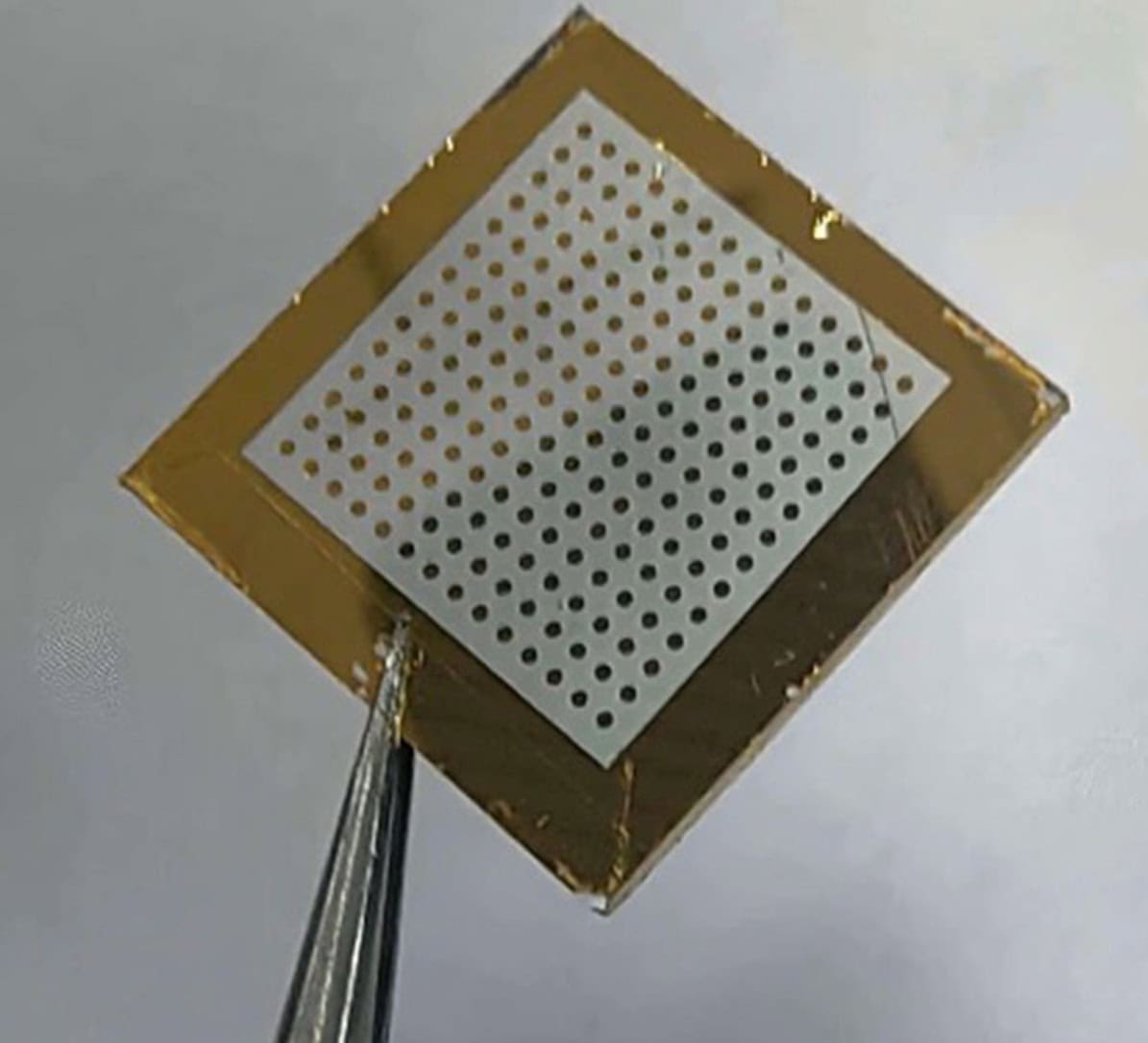
Artificial vision is employed in applications ranging from self-driving cars to advanced robotics. However, most “artificial eyes” do not work well in complex real-world conditions, such as sudden strong glare, dimness or uneven light levels. Such devices also rely on complex and rigid electronic circuitry to adjust their sensitivity to light and on post-algorithmic processing for accurate image recognition. A research team headed up at the University of Electronic Science and Technology of China and Penn State in the US has now developed a new adaptive photomemristor structure that does not suffer from any of these problems, allowing for machine vision that truly adapts to natural and complex light fluctuations, just like human eyes.
Sight is one of our most important senses: we acquire over 80% of the information from our environment through our eyes. Indeed, the human eye is so sensitive that it can process visual information under varied lighting levels with a photodetection dynamic range of more than 160 dB. This allows us to watch a film in a dark room or drive in the glare of oncoming headlights. Until now, however, artificial eyes have lacked this so-called dynamic self-adaptation.
Memristors for improving light adaptation
In recent years, researchers have been looking into neuromorphic devices that mimic the way biological structures work. These devices can be engineered to behave very much like neurons in the human brain, which learn by reconfiguring the strengths of the connections (synapses) between neurons. Memristors (or memory resistors) are excellent in this respect because they can bring this learning functionality to the connections in electronic circuits.
Rather than being fixed, the resistance of memristors changes depending on the current or voltage previously applied to them. This means that specific resistances can be programmed into the devices and subsequently stored. Importantly, the “remembered” value of the resistive state persists even when the power is switched off, making it a non-volatile form of electronic memory.
Photomemristors are a type of memristor that can change their resistance in response to both voltage/current and light and could therefore be used in advanced optical systems.
Reversible water absorption and desorption
In the new work, reported in Nature Communications, a team led by materials scientist Jia Zhu made a highly adaptive optoelectronic synapse from the composite material TiO₂/PEDOT:PSS. The TiO2 absorbs light, converting it into a photocurrent that then passes through the conductive surface of the PEDOT:PSS polymer. This intrinsic photothermal effect, explains Zhu, triggers reversible water absorption and desorption on the polymer surface, which in turn impacts the device’s conductivity.
“This process allows the device to automatically suppress the photoresponse under intense bright light and amplify its sensitivity under dim weak light,” he says. “In extreme strong-light conditions, its photocurrent can even drop below the dark current level, allowing for an ultralow-sensitivity state similar to human eye pupil constriction.”
A high image recognition accuracy
Zhu tells Physics World that when integrated with artificial neural networks, the new adaptive vision system achieves a high image recognition accuracy of 91.3% in dynamically changing mixed-light scenarios, including glare, dim shadow and alternating brightness. It also eliminates the need for bulky auxiliary circuits and complex real-time computing algorithms, reducing power consumption and hardware volume.
The new work is a first step towards making next-generation neuromorphic vision systems that could be used in practical applications. “Our adaptive photomemristor vision system can effectively resist strong glare from oncoming vehicle headlights, accurately identify pedestrians, lane lines and traffic signals in complex day–night alternating light environments, so greatly improving the safety of autonomous driving,” Zhu explains.
Nanofluidic memristors compute in brain-inspired logic circuits

The technology could also be widely applied to humanoid robots, outdoor intelligent monitoring equipment, aerial reconnaissance and portable intelligent vision terminals, he adds.
Looking ahead, the researchers will now focus on optimizing the material formula of the compound studied in this work and improve its fabrication. They will also be working on complete system-level integration, including array device packaging, signal readout modules and adaptive control units, with the aim of constructing a fully functional bionic artificial eye prototype. “We will then verify whether this biomimetic dynamic regulation strategy can be extended to other oxide/polymer composite memristor systems to develop a universal design principle for high-performance light-adaptive neuromorphic devices,” says Zhu.