Proton therapy plays an increasingly important role in cancer treatments, targeting tumours with high precision while sparing nearby healthy tissues. Proton irradiation can, however, also produce secondary neutrons due to nuclear interactions of the therapeutic beam. In modern pencil-beam scanning proton therapy, neutrons generated inside the patient are the main source of out-of-field dose – unwanted radiation that could potentially contribute to secondary cancer risks.
A research team headed up at Clínica Universidad de Navarra in Spain has experimentally characterized the neutron field in a proton therapy treatment room using a range of different detectors. They used their findings to create a practical Python-based calculation tool to estimate neutron dose for arbitrary irradiations.
“The tool provides a fast first-order estimate of neutron doses anywhere in the treatment room using information from the treatment plan,” explains medical physicist Verónica Morán. “It could support radiation protection studies, workplace dose assessments, research projects, and the evaluation of neutron exposure in situations where direct measurements are not available.”
Neutron field characterization
For their study, reported in Physics in Medicine & Biology, Morán and colleagues employed a Hitachi PROBEAT-CR proton therapy system with pencil-beam scanning. They measured neutron dose using a range of devices, including two ambient detectors and four types of personal dosimeter: thermoluminescent dosimeters (TLDs); track-etch detectors; bubble detectors (BDs); and electronic personal dosimeters (EPDs).
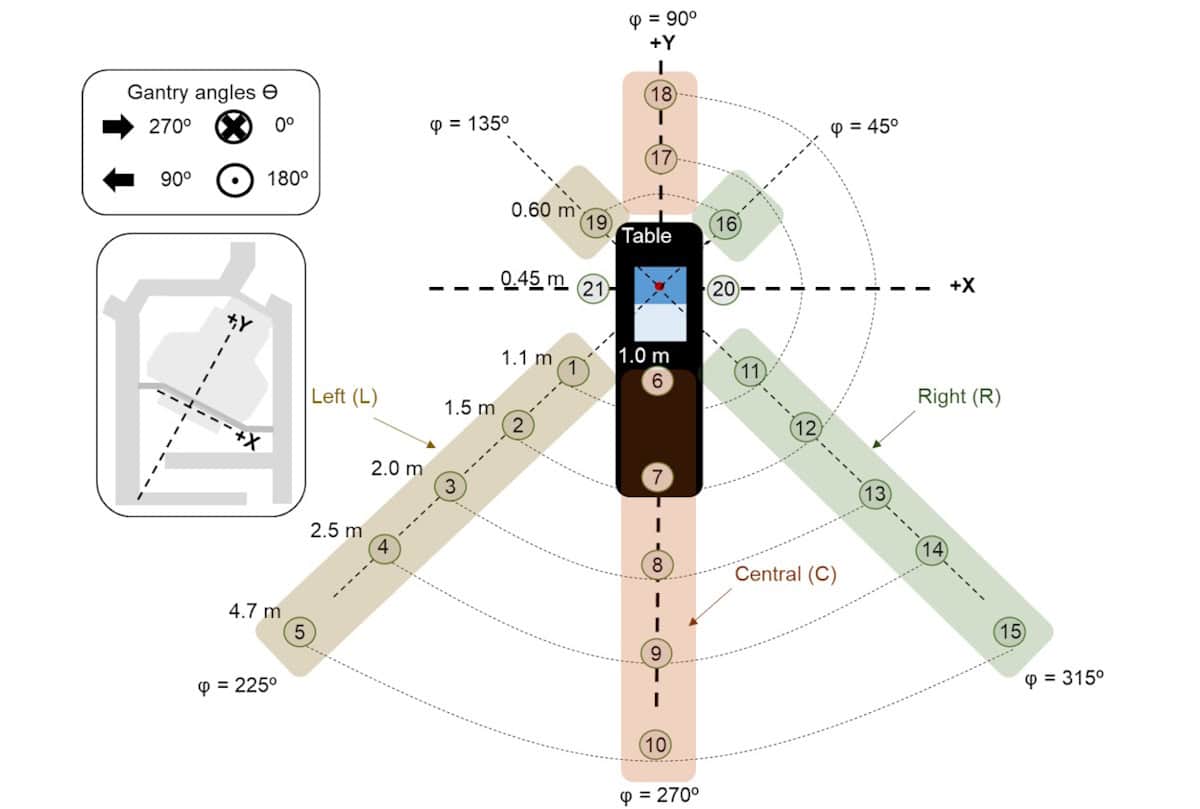
Using up to 21 measurement points within the treatment room, the team examined the dependence of out-of-field neutron dose on various beam and room parameters, including gantry angle, field size, proton energy and distance to isocentre.
At each measurement point, they assessed the neutron ambient dose equivalent, which is used to characterize the radiation field at a specific location, plus the personal dose equivalent, which estimates the dose that a person may receive while occupying that location. The ambient detectors performed the best, working as expected in a synchrotron-based facility, while the personal dosimeters exhibited clear variations in response.
To determine whether neutron doses measured on one side of the treatment room can predict doses at equivalent locations on the opposite side, the team investigated room symmetry. Measurements with the ambient detectors indicated that the treatment room was symmetric for the 270°–90° gantry pair, while for the 0°–180° pair, doses at 0° were on average 8% lower than at 180°.

“We found that the room was largely symmetric for certain gantry orientations,” notes Morán. “This reduces the number of measurements needed and helps extend the applicability of the dose calculation model.”
The measurements also showed that neutron doses created by a single spot field and a 10×10 cm field were similar (and can be regarded as interchangeable). The 20×20 and 30×30 cm fields differed by up to 22% relative to the single spot. Neutron dose dependence on proton energy followed the expected power law, with best fits for the ambient detectors, followed by the BDs and TLDs.
The researchers also delivered a clinical proton treatment comprising 27 energy layers (from 121.6 to 173.1 MeV) to a scattering phantom. They examined whether the total neutron dose from such an irradiation can be expressed as a weighted sum of contributions from the individual energy layers. If this assumption holds, the total neutron dose for an arbitrary plan could be reconstructed from measurements at discrete proton energies. Comparing calculated and measured neutron doses revealed that this linear superposition approach worked with the ambient detectors and the BDs, but not the EPDs.
A practical tool
The team then developed a Python-based tool to estimate neutron dose at any point in the treatment room for arbitrary irradiations and detectors (including ambient detectors, BDs and EPDs). As inputs, the tool requires the radiotherapy plan, detector data and calculation parameters including the gantry angle, and measurement distance and angle. It then outputs neutron dose estimates along with associated uncertainties.
The researchers verified the tool by assessing additional measurement points that weren’t used in its development. Comparisons of experimental and calculated dose values showed that the tool provided reliable and useful estimates for the ambient detectors and BDs, even at points where no prior measurements existed.
For the EPDs, however, the calculated intervals were often broad and the researchers suggest that EPD results should be interpreted with caution. They point out that such detectors were retained in the tool because “not all proton therapy centres have access to the same detector types, and approximate detector-specific estimates may still be of practical interest in such settings”.
Proton therapy could improve treatment options for dangerous heart rhythm disorder
The tool is thought to be the first to estimate out-of-field neutron dose based on treatment room measurements, and should also work at other clinical centres. “Because modern pencil-beam scanning proton therapy systems have been shown to generate similar neutron fields across different facilities, we believe the methodology behind the tool may be transferable to other centres using comparable technology,” says Morán.
The researchers are now extending the tool to include paediatric cases, and different proton energies, patient sizes and treatment configurations. “We are also investigating how these methods could be applied to estimate neutron doses received by patients, with the long-term goal of improving the characterization of out-of-field radiation exposure in proton therapy,” Morán tells Physics World.