Interfaces between air and water are omnipresent in nature and in industrial processes, but we understand surprisingly little about what goes on there. Researchers in Germany now report that a new spectroscopy technique could reshape our understanding of the molecular structure of these aqueous interfaces and the dynamical processes at play. Their discoveries could lead to better models of atmospheric processes and improved electrochemical devices such as batteries, to name but two examples.
When air and water meet, the interface between them strongly influences the behaviour of the first four layers of water. This interfacial water, as it is known, is only 7-8 angstroms thick, and the water below it behaves like a bulk liquid. To study interface effects, researchers therefore need to probe only these four layers and characterize the way their H2O molecules are oriented.
Probing the H-O-H bending vibration
One way to do this is to observe the bending vibration of the H-O-H structure, as this parameter approximately aligns with the water molecule’s dipole. In particular, one can analyse how the anisotropic bending mode changes with the thickness of the interfacial water. This can be calculated using a factor known as the depth-dependent second-order susceptibility, 𝜒(ଶ)(𝑧).
There is a problem with this approach, however, because it requires the H-O-H bending vibration to originate from the electric dipole of H2O and to contain only an interfacial dipolar signal. This is not always the case because electric quadrupolar signals from the bulk of the sample, as well as magnetic dipolar signals, can also contribute to the spectra.
These other signals do not provide any information on the orientations of the H2O dipole. Worse, they can mask the structural information that researchers are looking for. This means they either need to be ruled out or have their contributions to the overall signal removed.
A tuneable visible upconversion
The new technique, developed by Martin Thämer and colleagues in the Nonlinear Interfacial Spectroscopy Group of the Fritz-Haber Institute der Max-Planck-Gesellschaft, involves feeding the 800-nm-wavelenght light output from a Ti:sapphire laser into two independent optical parametric amplifiers. The first amplifier produces mid-infrared light through a process called difference frequency generation (DFG) and the second produces a signal beam that is subsequently doubled in frequency to produce a tuneable visible upconversion.
Hidden patterns found on the surface of water

Using these two beams, the researchers irradiated the surface of a water sample and excited nonlinear vibrations in the water molecules. This excitation generates two new light beams at different visible frequencies. By measuring the differences in the phase and amplitude of these beams, the team was able to isolate the vibrational response of the interfacial water layer and separate it from the bulk-water quadrupole term.
Thämer and colleagues then combined their spectra with high level molecular dynamics simulations developed by their colleagues at the Frei Universität Berlin to determine the precise orientations of the water molecules in the interfacial region.
Traditional description is insufficient
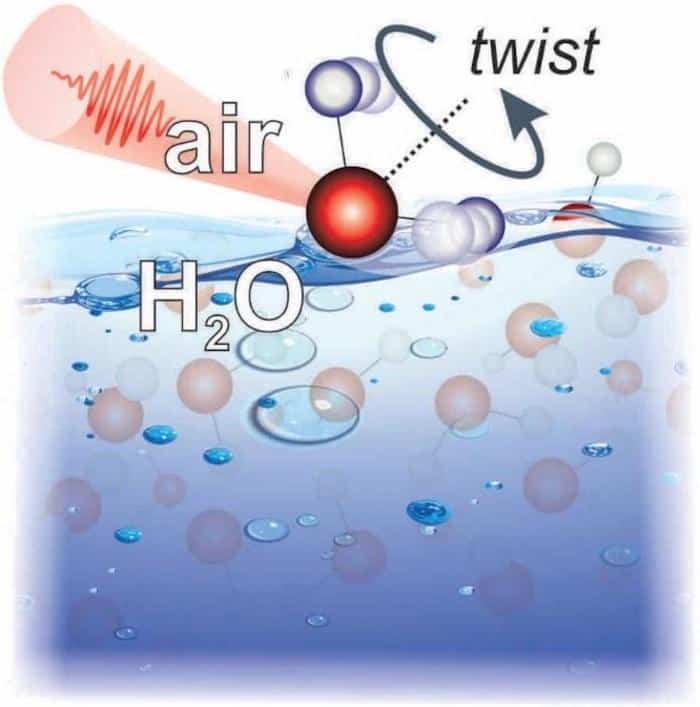
Traditionally, the structure of interfacial water is described in terms of water molecules pointing up or down (the “tilt angle”). However, based on the team’s results, Thämer says this description is insufficient. An additional orientation parameter is required, namely the “water twist angle”, or the molecule’s rotation about the axis of its dipole. “The new picture of the water structure we present is layered one with alternating twist and tilt angles that indeed extends over only four molecular water layers,” Thämer tells Physics World.
Looking ahead, the researchers, who detail their work in Science Advances, say they now plan to study other aqueous interfaces, including charged interfaces and biomolecular systems.