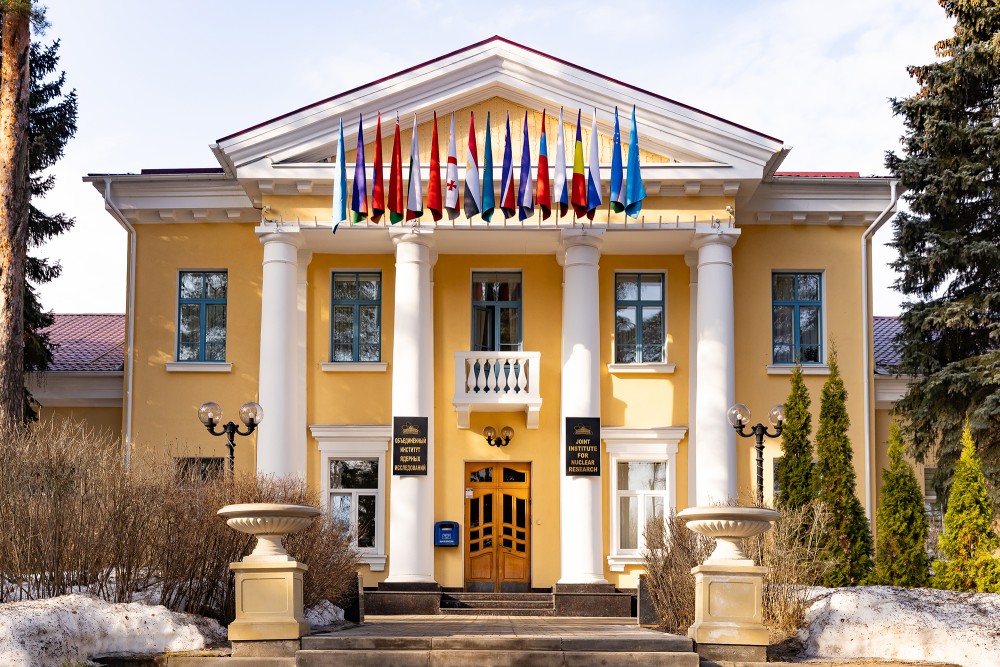
A major research institution in Russia is “deeply embedded” in the Russian military and the country’s military-industrial complex. That is the claim of a report by particle physicist Tetiana Berger-Hrynova, who argues that the activities of scientists belonging to the Joint Institute for Nuclear Research (JINR) in international collaborations should be limited as it poses a security threat to Europe (arXiv:2603.21896).
The JINR is an international research centre for nuclear science with 5500 staff members and prior to 2022 over 1000 scientists from JINR-collaborating organizations visited Dubna each year.
Berger-Hrynova, who is based at the CNRS’s Annecy Particle Physics Laboratory in France, told Physics World that her research was triggered by an article in December 2022 in the New York Times, which found that Kh-101 missiles – a Russian air-launched cruise missile – were produced in Dubna.
“I found that JINR scientists have played a critical role in developing Dubna into a major centre for Russia’s military-industrial complex — through dual-use research, knowledge-transfer programmes and personnel training,” says Berger-Hrynova.
According to Berger-Hrynova, who was born in Ukraine and educated at Liverpool University before doing a PhD at Stanford University, the lack of awareness of the issue has enabled scientists from Dubna to maintain their participation in international collaborations.
“JINR personnel can travel freely to scientific institutions in the EU and the UK, retain access to advanced technologies that can then be transferred to military and security actors through Dubna’s tightly connected research-industrial ecosystem,” claims Berger-Hrynova.
In 2022, following Russia’s invasion of Ukraine, CERN suspended JINR’s observer status at the lab, although Berger-Hrynova points out that the cooperation never stopped as in 2024 CERN’s council decided to maintain its international cooperation agreement with JINR for five more years, which currently allows 321 JINR scientists to be associated with CERN.
Indeed, JINR is also participating in the Russian Regional Center for Processing Experimental Data from the Large Hadron Collider (LHC) — a critical component of the Worldwide LHC Computing Grid.
JINR also still maintains links with nearly 700 research centres and universities in 60 countries and provides scholarships to physicists from developing countries.
The JINR is in addition actively involved in international and national scientific conferences, hosting up to 10 major conferences, over 30 international meetings as well as international schools for young scientists. Scientists from France, Italy, Germany, Latvia and other EU countries are also still on the JINR governing committees. Russia plans to revive abandoned Soviet-era particle accelerator
Ukraine applied sanctions against JINR in August 2025 given its alleged connections to military research and Berger-Hrynova now calls on other countries to do likewise.
“The JINR case illustrates how Russian scientific research institutions are used to circumvent sanctions, underscoring the need for coordinated enforcement among Ukraine, the EU, and the G7, as well as greater awareness within the international scientific community,” writes Berger-Hrynova.
Evgeniy Bragin, an official spokesperson for JINR told Physics World that “nobody from the administration of the Institute can provide comment”.