A new approach to probing the spin states of nitrogen–vacancy (NV) centres in diamond has been unveiled by physicists in Germany. Their technique offers vastly higher contrast than the fluorescence-based approach used in previous studies – according to the team led Florian Schall at the Fraunhofer Institute for Applied Solid State Physics. Their approach involves measuring changes in infrared laser intensity when NV-doped diamond is placed inside a laser cavity. This could make NV centres a far more competitive option for sensing subtle magnetic fields.
NV centres are defects in the atomic lattice of diamond, where adjacent pairs of carbon atoms are replaced with a single nitrogen atom and an empty lattice site. The unpaired electrons associated with these defects create spin states that are ideal for quantum sensing, since their spin states are stabilized by the diamond lattice. This makes NV centres highly sensitive to external factors including changes in temperature, magnetic and electric fields, and mechanical strain – which all alter the energy gaps between the NV spin states.
When NV-doped diamond is illuminated by a green laser, it kicks these unpaired electrons into excited energy levels, causing the diamond to fluoresce (emit light) as the electrons relax back to their ground states. But when microwaves are applied at just the right frequency, they also flip the electrons into higher-energy spin states.
Microwave sweep
When the green laser excites electrons from these spin states, they are far more likely to relax back to their ground states via an intermediate singlet state, without emitting any visible light. By sweeping a range of microwave frequencies across the diamond, researchers can detect shifts in the energy gap between these spin states by measuring the exact microwave frequency where this dip in fluorescence occurs. This energy gap – and therefore microwave frequency – is sensitive to extremely subtle changes in the diamond’s surroundings.
For example, an external magnetic field will affect the energy gap via the Zeeman effect. While this can be used to measure magnetic fields, the performance NV-based magnetic sensors have lagged behind that other cutting-edge techniques.
In current NV sensors, “their magnetic-field-dependent fluorescence signals are usually measured,” Schall explains. “However, this approach is typically limited by weak fluorescence signals and low optical contrasts of just a few percent.”
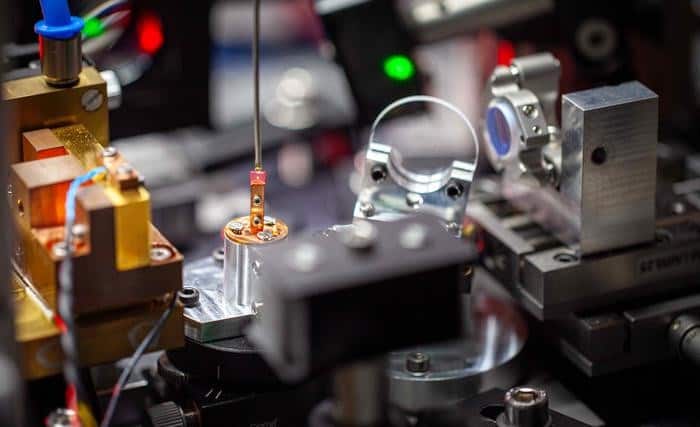
To boost this contrast, Schall’s team introduced an alternative approach that replaced the fluorescence measurements altogether. This involves placing an NV-doped diamond inside the cavity of a near-infrared laser, alongside its semiconductor gain medium. The laser works by bouncing light back and forth between the cavity’s opposite-facing mirrors. The light intensity is amplified each time it passes through the gain medium – producing an intense, coherent beam at a wavelength of 1042 nm.
Direct connection
Light at this wavelength is absorbed by NV centres in the intermediate singlet state. With the applied microwaves fixed at a single frequency, any change in magnetic field would vary the number of NV centres in the singlet state at any given time, and therefore the amount of infrared light the diamond absorbs. This creates a direct connection between the laser intensity and the strength of an external magnetic field.
By operating the laser just above the minimum pump power, even a tiny subtle increase in infrared absorption could dramatically reduce the laser’s intensity. Indeed, the laser is shutdown entirely when the microwaves matched the NV centres’ spin resonance: delivering a 100% optical contrast. At the other end of the scale, the laser produced a strong, coherent beam of over 50 mW when the microwave frequency was mismatched with the gap between the spin states.
Carbon defect in boron nitride creates first omnidirectional magnetometer

Altogether, this broad intensity range corresponded to a roughly 500-fold improvement in the ratio between the system’s fundamental sensitivity limit and its dynamic range, compared with the most advanced fluorescence-based sensors available to date. “It also enabled vector magnetometry – the determination of all three components of the magnetic-field vector, rather than just its magnitude or a single component,” Schall says.
With their successful result, Schall’s team have demonstrated an entirely new approach to probing the spin states of NV centres, which they now hope could be applied more widely. “This could form the basis for a new generation of room-temperature magnetic field sensors with a unique combination of sensitivity and dynamic range, which is particularly interesting for applications in medical diagnostics, magnetic navigation, and resource exploration,” Schall concludes.
The research is described in Nature Communications.