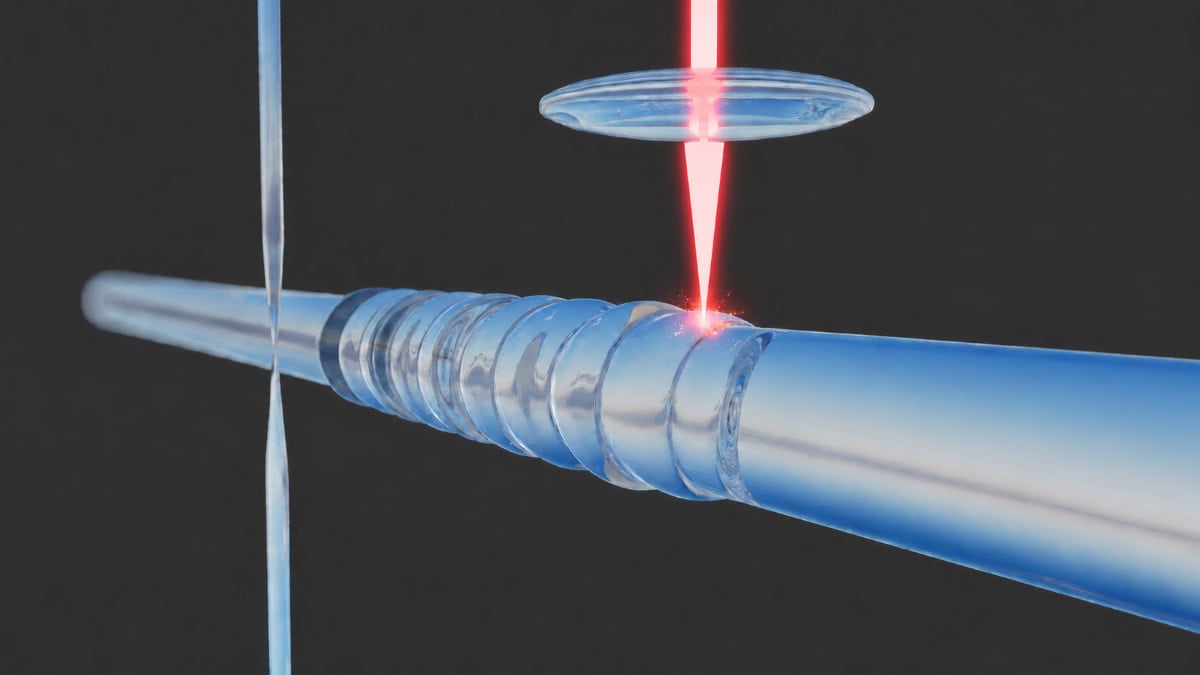
Modern optical communications systems use pure silica glass fibres to transmit data in the form of light. However, these optical fibres need to be as defect-free as possible to prevent the light from scattering, distorting the signal and losing data. To help signals travel more smoothly along high-speed optical cables, researchers from the University of Maryland and the Army Research Laboratory (ARL) have fabricated microscopic structures, or microresonators, on the surface of ultrathin glass fibres. The low-loss platform, dubbed “surface nanoscale axial photonics” (SNAP) precisely controls the light as it travels through the fibre.
“At ARL, I have developed SNAP as a platform for advanced light control. We do this by shaping the surface of low-cost optical fibres at the nanoscale to control whispering gallery modes at the glass–air interface,” explains Dashiell Vitullo. “Because it boasts exceptional fabrication precision and ultralow signal loss, our academic partners recognized it as an ideal platform for topological photonics.”
As such, the team used the platform to investigate topological lattices of SNAP microresonators and explore novel topological heterojunctions.
One interesting property of topological light states is their natural immunity to physical imperfections. “Developing these fundamental building blocks allows us to better understand how to steer light reliably even in the presence of system degradation, a critical step toward future robust communication and sensing networks for the military,” explains Vitullo.
Exceptional fabrication precision
To create the SNAP devices, the researchers used ultraprecise lasers to fabricate nanoscale effective radius variations into the glass–air interface of the optical fibre. A single optical fibre can host many such microresonators, which can be easily post-processed using laser heat to reshape the bumps on the surface with sub-angstrom fabrication precision. In contrast, typical photonic integrated circuits (PICs) fabricated by planar lithography require active tuning to compensate for nanometre-scale fabrication errors – which is highly energy intensive.
The SNAP microresonators showed excellent propagation losses of less than 0.001 dB/cm, compared with an average 0.01 dB/cm loss from PICs. The researchers chained together 21 microresonators to create an optical highway that steers light around obstacles, preventing light scattering and maintaining transmission quality.
This optical highway contained multiple boundaries (interfaces) between the different microresonators, with each side of the interface having different fabrication patterns. Understanding whether the light stopped at the different interfaces or passed through smoothly – depending on the pattern on each side – required the creation of new mathematical models. This understanding, however, gave the researchers complete control of the signal, providing fundamental physics insights that could help create faster and more efficient optical cables.
“Our work shows that SNAP has exceptional promise as a cost-effective, ultraprecise platform for photonic analogue Hamiltonian simulation,” explains Vitullo. “Unlike traditional photonic chips, where imperfect fabrication yield can force you to measure and sort through numerous nonfunctional devices, SNAP allows us to iteratively characterize and locally adjust samples after fabrication to more efficiently realise exact physics models. The SNAP microresonators also support multiple axial modes that provide built-in parameter sweeps. In short, a single inexpensive optical fibre device can do the work of many separate test structures, dramatically accelerating discovery.”
Skyrmion topology makes long-distance optical communications more robust
Having identified the fundamental physics of the SNAP microresonators, the researchers are also looking to explore nonlinear optical behaviours, where the light can be used to create synthetic dimensions that would enable them to simultaneously manipulate multiple aspects of light. This could theoretically increase the amount of data that could be carried in an optical signal without changing the size of the fibre itself. Vitullo also suggests that such optics could also help pave the way for quantum navigation sensors that do not rely on GPS.
This work demonstrated one-dimensional models. Next, the team plans to explore methods for realising two-dimensional or higher models. “One way to do this is to use cavity-enhanced nonlinear-optical effects to couple light between resonant frequency modes,” says Vitullo. “Scaling to higher dimensions is the key to unlocking practical photonic analogue simulators capable of modelling complex quantum systems that overwhelm conventional computers.”
The research is published in Nature Communications.