There are growing signs that humanity’s best bet for detecting extraterrestrial life could be statistics. Abigail Williams speaks to the research teams around the world that are paving the way for new breakthroughs in astrobiology and astrochemistry

Are we alone in the universe? It’s hard to know exactly how long this fundamental question has perplexed humanity. But it’s likely that throughout history, generations of people have looked up at the stars and wondered if life is unique to Earth. In the modern era, our search for life beyond Earth has intensified thanks to an ever-growing array of sophisticated astronomical and scientific instruments and technologies.
Furthermore, our search for signs of alien biology and chemistry already has a multitude of targets. We know of 6366 exoplanets outside our solar system, and there are more than 8100 further potential candidates, both in our galaxy and even beyond it.
In our search for extraterrestrial life, intelligent or otherwise, astrobiologists look for a variety of signs – including radio, optical and infrared signals – that may point the way to advanced civilizations. Crucially though, we look for biosignatures – a substance or structure that may be of biological origin. More recently, we have also started searching for technosignatures, which are markers of past or present technological activity, in the atmospheres of exoplanets (see box “Astrobiology at a glance”).
To help solve the problem of how best to confidently detect signs of life, some scientists are now turning their attention towards cutting-edge machine learning (ML) and statistical techniques to broaden our notions of the most promising types of signals to look for. In doing so, they hope to boost our ability to interpret the vast amounts scientific data captured by telescopes and space probes.
Pattern recognition
When it comes to biosignatures, a recent example of merging statistics and biological-sample data, is a method developed by scientists at NASA and Georgia Institute of Technology. It uses an ML framework to distinguish molecules formed during biological processes from those made by non-biological processes and will analyse samples returned by current and future planetary missions (PNAS Nexus 4(11) pgaf334).
A fundamental challenge in astrobiology is how to determine whether organic compounds found in planetary materials originate from biological or non-biological processes
Dubbed “LifeTracer”, the team directed the system to learn patterns associated with meteorites (known as abiotic materials) and terrestrial geological samples (known as biotic materials) before using it to classify previously unseen samples. According to José Aponte, an astrochemist at NASA’s Goddard Space Flight Center, LifeTracer arose in response to a fundamental challenge in astrobiology: how to determine whether organic compounds found in planetary materials originate from biological or non-biological processes.
Aponte and colleagues analysed eight carbonaceous meteorites and 10 terrestrial geologic samples using 2D gas chromatography coupled with high-resolution time-of-flight mass spectrometry. The idea was to identify subtle patterns in the overall distribution of organic compounds, which helps determine the biotic or abiotic nature of a given sample.
Aponte believes that future sample-return missions from Mars, its moon Phobos, as well as other solar system bodies, such as Saturn’s sixth-largest moon Enceladus, will likely contain complex mixtures of organic molecules. He believes that traditional biomarker-based approaches may not always be sufficient to distinguish between abiotic chemistry and potential evidence of life.
“LifeTracer’s training is based on the identification of molecular features and the detection and clustering of molecular features from complex organic mixtures, which combined lead to effective classification decisions,” he says. “These features could be exploited for the recognition of current or extinct life in future space missions.”
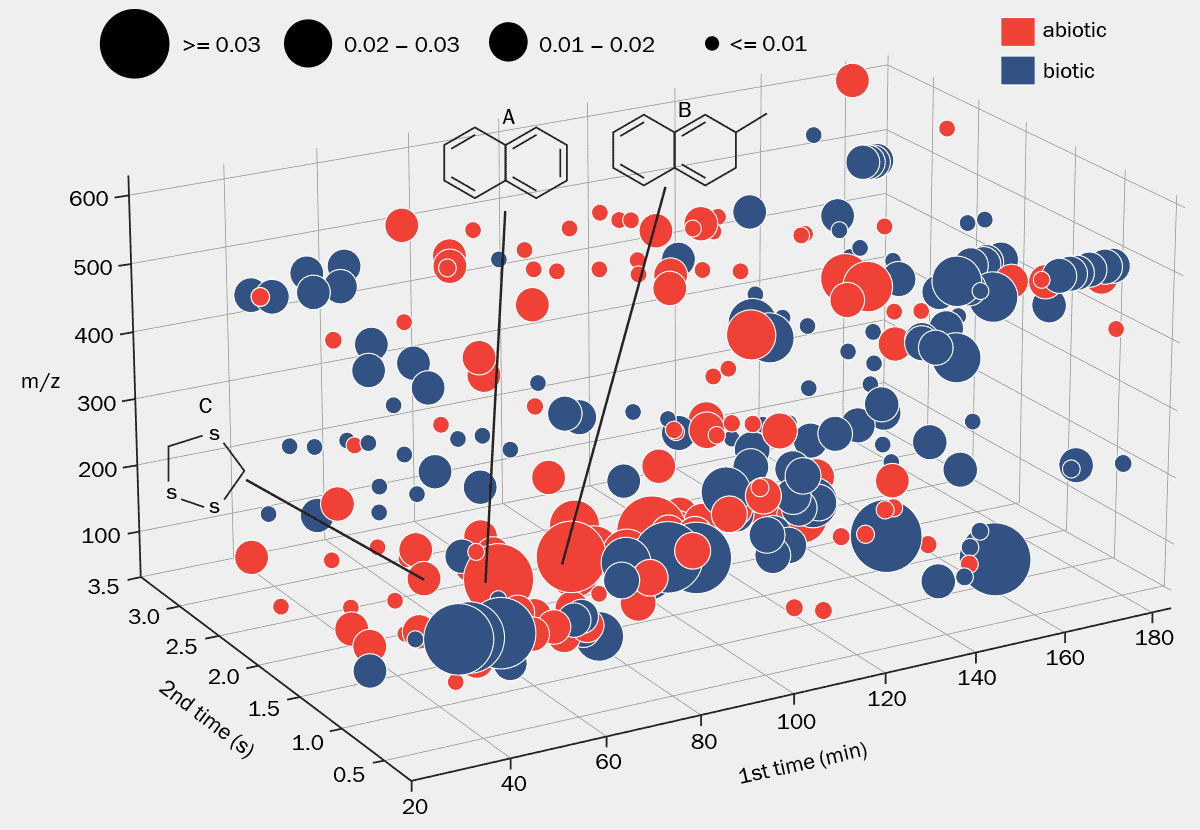
LifeTracer was specifically designed for use in both planetary sample-return missions and landing missions that perform in situ analyses on the surfaces of distant planets or moons. For now, Aponte sees it as relevant for a range of future missions. These could include NASA’s proposed Mars Sample Return (MSR) campaign (currently on hold as a result of US budget cuts); and the Japanese Space Agency (JAXA) Martian Moons eXploration mission (MMX), which launched on 20 October 2026; and any mission returning samples from potentially habitable environments such as Enceladus or Europa.
A key advantage of the ML framework is that it allows the team to simultaneously analyse thousands of molecular features – a feature that Aponte describes as “efficient unbiased analysis and high sensitivity to unknown chemistry”.
Molecular distributions
Traditional biomarker-based approaches to alien life detection generally start with a predefined list of molecules, or molecular characteristics, that could indicate biological activity – based largely on what we know from terrestrial life. Scientists then target specific compounds – such as amino acids, lipids, pigments or other biologically relevant molecules – and assess their presence, abundance, molecular distributions or structural properties. Although such targeted approaches can be highly sensitive and informative when the relevant biosignature is already known, Aponte notes that they “inherently depend on our ability to predict what molecules life produces”.
Instead, he explains that “LifeTracer searches for patterns in molecular abundances, distributions and mass-spectral features across complex organic mixtures, and uses those patterns to distinguish biotic from abiotic samples, which reduces the risk of overlooking unfamiliar biosignatures.”
Astrobiology at a glance
Biosignature A characteristic element, molecule, substance or feature that can demonstrate the presence of biological processes where all possible abiotic causes of the phenomenon have been discounted – potentially providing evidence of past or present life.
Panspermia The hypothesis that the building blocks or “seeds” (sperma) of life, such as amino acids, exist across the universe, and can be propagated though space, by carriers such as cosmic dust, comets, meteorites or even space-faring beings. This suggests that micro-organisms survive being ejected from a planet and travelling through space – and then seed other worlds.
Technosignature A quantifiable property or effect that provides scientific evidence of past or present technology created by intelligent alien life.
Terraforming The hypothetical process of intentionally altering the atmosphere, temperature, surface topography or ecology of a planet, moon or other body to be similar to that of Earth to make it habitable by humans – or, in the case of astrobiology, to modify an exoplanet to make it habitable by some other intelligent alien species.
LifeTracer also looks at low-abundance molecules, which are often filtered out in more targeted analyses. That’s because in a targeted analysis, scientists tend to prioritize compounds that are sufficiently abundant and reproducible to support confident identification and quantification. That does not mean that low-abundance molecules are unimportant – just that they are more difficult to distinguish reliably from instrumental background and noise, and identifying and interpreting thousands of weak signals can be extremely labour-intensive.
All of this makes LifeTracer better suited to detecting evidence of life that differs from terrestrial biology, says Aponte, as it focuses on molecular distributions, rather than specific Earth-derived biomarkers. The immediate next steps for his team are to expand the reference database of abiotic and biotic samples, and to improve the framework’s ability to interpret increasingly complex organic mixtures. “Our current dataset is small, the framework can continue learning as additional extraterrestrial and terrestrial datasets become available,” he says.
Scanning the cosmos for signs of alien technology
Looking ahead, Aponte predicts that ML is likely to become increasingly important in astrobiology, as future missions will generate much larger and more complex datasets. “The integration of AI with advanced mass spectrometry, and the use of multivariate chemical signatures rather than individual biomarkers – as well as autonomous discovery tools capable of identifying unexpected biosignatures – are, for now, only emerging innovations and trends, which will become increasingly important in years to come” he adds.
Diverse molecular distribution
Elsewhere, an international team of scientists is using a statistical framework known as “diversity metrics”, commonly used in a range of disciplines including ecology and astrochemistry, to determine what molecules are key to signs of life (Nature Astronomy 10 664). In ecology, these metrics are used to describe the number and distribution of species in an ecosystem. The astrobiologists found that the statistical method can be used as a sophisticated tool that focuses more heavily on statistical patterns of molecules, than on the presence of any single type of molecule.
“Our method tells us how many molecules are present and how evenly these molecules are distributed,” says team member Fabian Klenner, who is a planetary scientist at University of California, Riverside. “The reasoning is that life does not only produce certain molecules. It organizes molecular mixtures in characteristic ways. In practice, we compare relative abundance patterns within molecular families, such as amino acids and fatty acids,” he adds.
As Klenner explains, life synthesizes amino acids according to functional needs, not simply according to which molecules are easiest to form, which is “very well captured” by the method they use. “We clearly see that biological systems produce broader and more even distributions of amino acids than abiotic systems do,” he says. “But for fatty acids, the trend is different.” Klenner adds that biology selects a more restricted set of fatty acids needed for membrane function, whereas abiotic systems produce broader distributions across chain lengths – all of which is “clearly captured by our method”, he says.
Although this method has not yet been used to detect extraterrestrial life, Klenner confirms that it has been used to analyse amino-acid diversity across a range of known biological, non-biological and mixed samples.
“The key finding is that biological and non-biological samples can clearly be distinguished from each other using this method, meaning that molecular organization can serve as a biosignature,” he says.
Statistics of life
In Klenner’s view, this approach is well suited to missions that measure relative abundances of organic molecules. It also benefits from the fact that it can be applied to data from both current and near future missions, at least partly because it doesn’t require a dedicated new instrument. Another bonus is that the method can even detect biological patterns in degraded samples, which is particularly useful for planetary exploration.
Klenner and colleagues now want to test this framework on broader and more diverse datasets. “This approach is potentially applicable to many current and near future missions,” says Klenner, who is particularly interested in icy ocean worlds, such as Saturn’s moon Enceladus and Jupiter’s moon Europa. “One mission I am especially excited about is Europa Clipper. I think statistical methods will become increasingly important because the search for life often involves ambiguous, noisy and incomplete chemical data,” he adds.
Emerging patterns
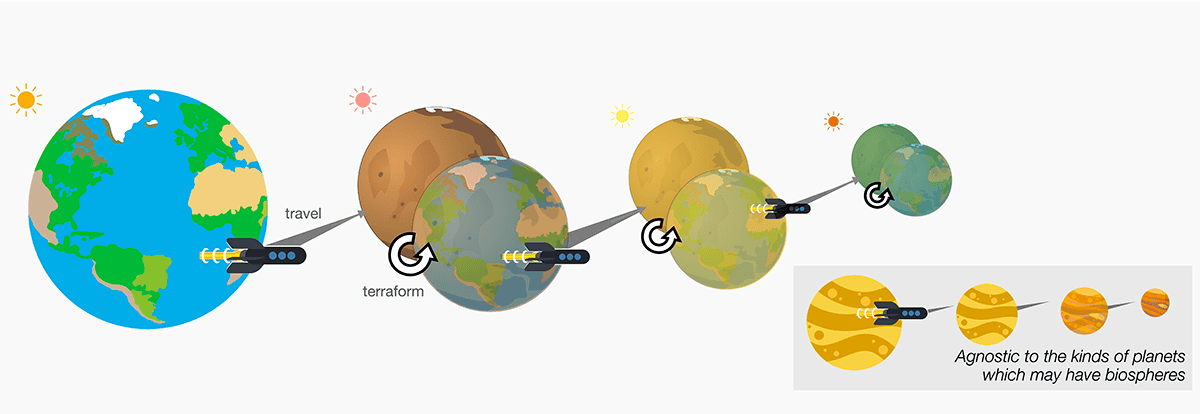
Another team of researchers using a statistical approach in the search for intelligent alien life is based at the Earth-Life Science Institute (ELSI) at the Institute of Science Tokyo. With perhaps the most radical proposal so far, the team suggests that instead of looking for known biomarkers on an exoplanet, the way forward is to find and analyse emerging patterns across groups of planets that may have been terraformed via panspermia (see box “Astrobiology at a glance”).
As Harrison Smith, associate professor at ELSI, explains, even before the concept of “terraforming” took hold, scientists and authors have long speculated about the possibility of intelligent life modifying planets. “I wondered, if you could find planets that looked like they were related? If so, this would be a new kind of biosignature – similarities in planets’ atmospheres that you wouldn’t otherwise expect unless life was out there terraforming them,” he says.
The concept is simple: life can travel to and terraform planets around other stars. In doing so, the planet that life travels to becomes more similar to the planet it came from (see figure 2). “There is nothing inconsistent with the known laws of physics in this assumption – you don’t need faster than light travel, or new particles, or anything strange like that. It’s just technological and financial will,” Smith adds.
Agent-based model
Smith and team modelled how life might spread across star systems and alter planetary characteristics using an agent-based simulation – a type of computer simulation used to study how simple rules, followed independently by individual agents, can give rise to emergent complex behaviour at a larger scale. They discovered that if life extends and impacts planetary environments, it produces detectable statistical correlations between planet locations and their observable traits (ApJ 1001 102).
This model shows that if life can spread between star systems and affect the observable properties of a planet, then a robust signature of life with very few false positives can emerge, defined by correlations between planet characteristics and their locations.
Smith and colleagues cluster planets based not on where they are in “physical” space, but instead where they are in “composition” space, meaning, how similar the planets’ characteristics are, regardless of where they exist in the galaxy. They then filter out clusters which are very spread out in physical space, which lets them demonstrate and evaluate a way to prioritize specific planets for further observation, based on their potential for containing life.
Fewer false positives
The notion of life spread through terraforming was appealing to Smith because it seemed to offer up the potential of identifying life on exoplanets in a way that could be resilient to false positives. “The argument essentially boils down to the fact that technosignatures have the potential to be statistically impossible to explain without life, and biosignatures – at least the ones we’d be able to measure on exoplanets, aren’t,” he says.
Smith is not specifying a specific technosignature, in the traditional sense. “Rather we are saying that the correlational structure that would emerge between planet atmospheres, under our assumptions, would itself be a techno/biosignature,” he adds.
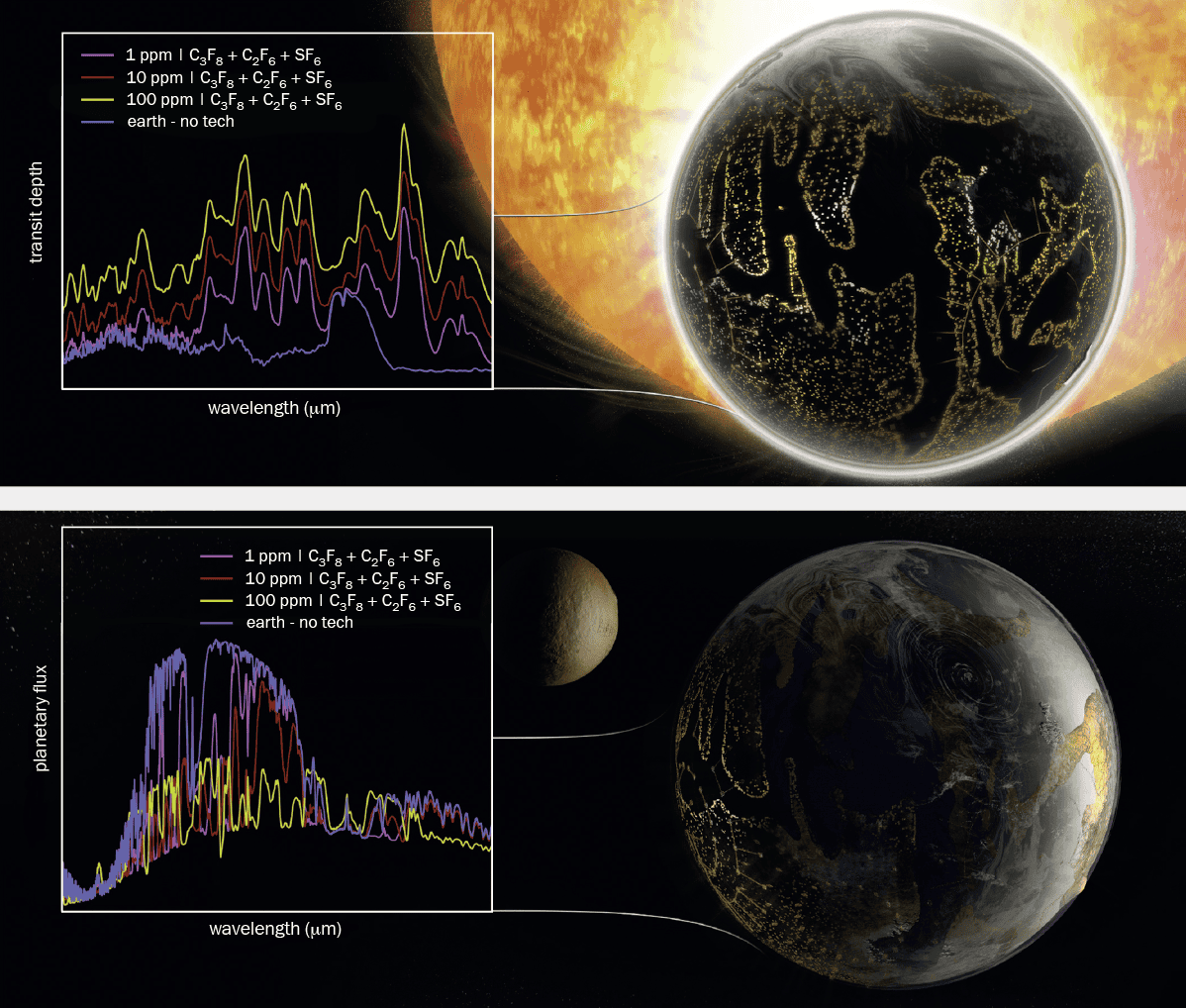
By emphasizing the importance of technosignatures, the ELSI model is similar to a 2024 study on terraforming and technosignatures by Edward Schwieterman of University of California, Riverside, and collaborators. The study put forward the idea that it could be possible to detect artificial greenhouse gases injected into an exoplanet’s atmosphere to modify its climate, perhaps to fend off an encroaching ice age, or to make an icy neighbouring world more habitable (ApJ 969 20).
The researchers suggest that the gases studied – hexafluoroethane (C2F6), octafluoropropane (C3F8), sulphur hexafluoride (SF6), nitrogen trifluoride (NF3), and carbon tetrafluoride (CF4) – are unlikely to be created by non-technologically advanced life and could even persist in planetary atmospheres for millennia, increasing the odds of detection. Schwieterman also points out that such technosignature gases may be easier to detect than those arising from biosignatures; and be equally easy to characterize.
Although the ELSI model hasn’t yet been applied in practice, Smith confirms that he and his team are working on improving its “realism” in order to see if the strategy can maintain the ability to distinguish terraformed versus non-terraformed planets using state-of-the-art exoplanet models – for example, photochemical models – applied to data from future missions.
Statistical departures
Their next step is to incorporate more realistic, state-of-the-art models for planetary atmospheres, before applying the approach on the type of simulated data they might expect from future telescope surveys. Exoplanet astronomy is just starting to be able to better characterize exoplanet atmospheres, and future missions like NASA’s Habitable Worlds Observatory will focus on deeply characterizing a small number of Earth-size planets. “Our life-detection strategy benefits from having characterized, even more coarsely, hundreds or thousands of diverse planets,” says Smith. “So the kind of data expected from ESA’s upcoming ARIEL mission would be more applicable to our approach.”
Thomas Beatty, an astronomer from the University of Wisconsin in the US, finds Smith and colleagues’ “future-facing” approach interesting, but he cautions that the data is not yet available to implement it soon. “The method needs something like a thousand well-characterized Earth-like atmospheres, and we’ll be lucky to get a few dozen from HWO once it launches in the 2040s,” he says. “It also assumes lifeless planets are compositionally uncorrelated with their galactic positions, which may or may not be the case,” he adds. Beatty adds that these studies give us a good reason to measure the baseline compositional diversity of planetary populations.
Ultimately, Beatty observes that all three of these new approaches treat life as “a statistical departure” from what physics and chemistry would achieve on their own.
“That’s a powerful approach, because it doesn’t require alien life to resemble life on Earth. But every statistical biosignature is only as strong as its null hypothesis, and right now our knowledge of the abiotic universe is the limiting step in our ability to apply these methods.”