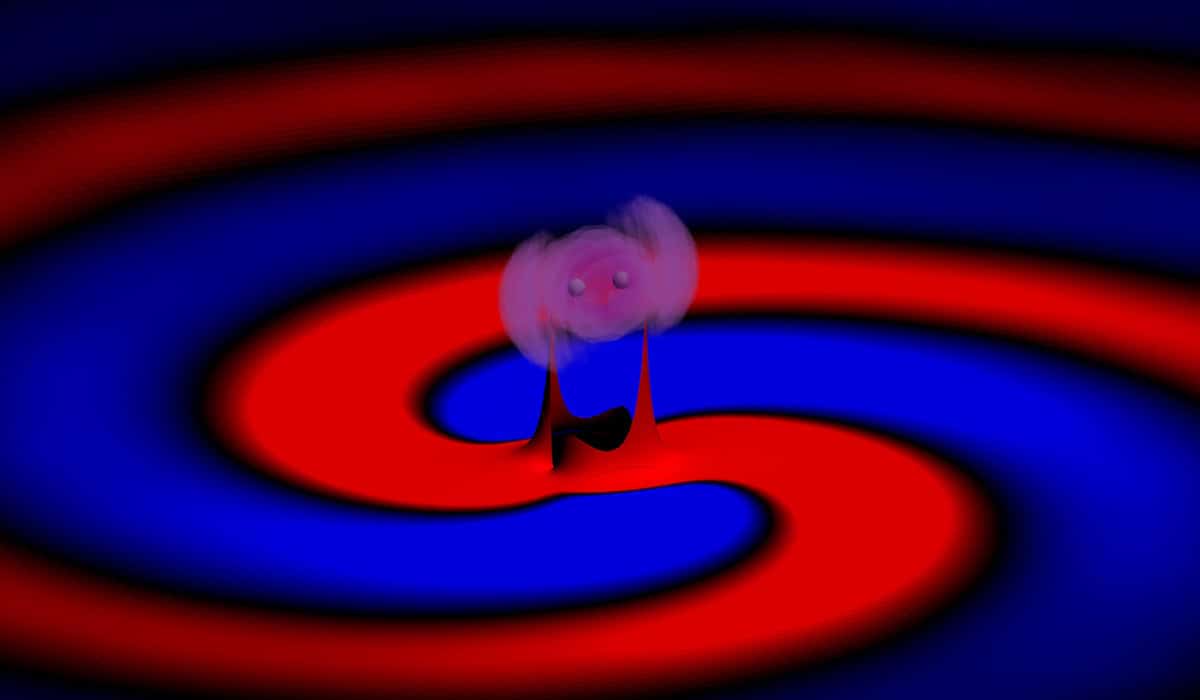
Physicists have developed a model that predicts how gravitational-wave emission changes when a binary black hole system moves through dark matter. Gravitational waves are ripples in spacetime generated by compact objects spiralling together in a cosmic dance that ends in a violent collision. In the presence of dark matter, these waves may carry an imprint of the surrounding environment. Despite making up over 80% of all matter, dark matter does not interact with the electromagnetic force, and its existence has been surmised only by its gravitational interactions, leaving its precise nature a mystery. Gravitational waves may provide a new way to probe the characteristics of dark matter.
One proposed dark-matter candidate is the light scalar boson, an extremely small particle orders of magnitude lighter than an electron, that can exhibit coherent wave-like behaviour. In the presence of spinning black holes, a process called superradiance can transfer rotational energy into the surrounding field of ultralight boson particles, amplifying the dark matter into a dense cloud around the black hole. These clouds can modify the dynamics of black hole binaries, encoding observable signatures into the gravitational-wave signals that they emit.
To understand what these signatures may look like, an international team of researchers developed a model for gravitational-wave emission from a binary black hole system moving through dark matter. Developing their model required meticulous numerical relativity simulations, but ensuring their results were accurate and reliable proved to be a challenge.
“The hardest part was making sure we truly understood what the simulations were telling us. The danger in numerics is fooling yourself,” explains Josu Aurrekoetxea of Massachusetts Institute of Technology. “You run a simulation, you see an effect, and you have to ask – is that dark matter, or is that my code?”
Working with Katy Clough of Queen Mary University of London and Pedro Ferreira of the University of Oxford, Aurrekoetxea spent several years developing these simulations, before joining forces with Soumen Roy of Université Catholique de Louvain and Rodrigo Vicente of the University of Amsterdam, whose expertise in analytical modelling and data analysis helped the team construct and validate the novel waveform model.
Most work in the field of gravitational waves and dark matter focuses on observations with future space-based detectors such as the Laser Interferometer Space Antenna. “Our motivation was to ask what could already be learned about specific dark-matter models using the LVK [LIGO–Virgo–KAGRA] gravitational-wave data available today,” says Vicente. “We were surprised to find that some of the more extreme models can already begin to be tested with signals observed by current experiments.”
Searching for these dark-matter imprints, they applied their model to 28 publicly available signals observed by the LVK collaboration, a global gravitational-wave detector network that has observed signals from hundreds of mergers. For each event, the team compared the signal to their predictive dark matter-modulated waveform and the standard waveform for black holes merging in a vacuum.
After rigorous testing, the researchers found that 27 of the 28 events were consistent with gravitational-wave signals expected from binary black holes evolving in empty space. One event, GW190728, showed a slight preference for the dark-matter model, indicating that its signal contains properties consistent with modulations from the presence of dark matter. However, the statistical evidence is not strong enough to claim a confident detection of a dark-matter imprint.
Although only one event demonstrated a preference for the predictive dark-matter model and no definitive claim of a dark-matter signature could be made, the researchers have demonstrated a novel method to probe and characterize dark matter through signatures encoded in gravitational-wave signals.
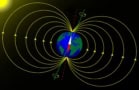
Earth’s magnetic field could be ‘ringing’ with dark matter
“Our findings from GW190728 suggest that, if this interpretation is correct and we are seeing a genuine environmental signature, similar effects may appear in future LVK events,” says Roy. Therefore, the next step for the researchers is to extend their analysis to LVK’s fourth observing run. Roy also says that if they can estimate the number and types of events that should carry dark-matter imprints, they can combine multiple signals to test their hypothesis more robustly.
“It has become clear that gravitational waves have tremendous potential to help us understand how matter behaves in the extreme gravitational fields surrounding black holes. This is particularly relevant for dark matter, which may interact only through gravity,” says Vicente. And as more gravitational-wave signals are observed, they provide a promising channel to uncover the elusive nature of dark matter.
The research is described in Physical Review Letters.