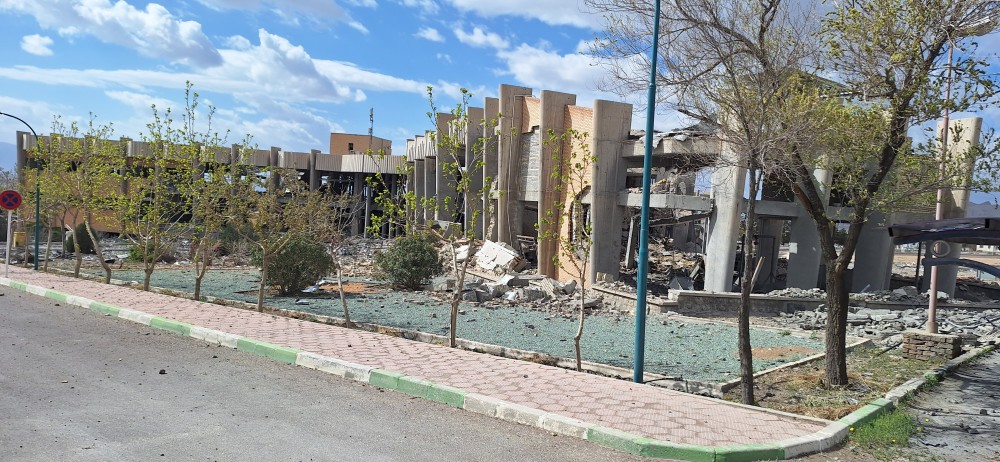
Almost 1400 people, including two Nobel laureates, have signed an open letter condemning the US/Israeli attacks on Iranian academic institutions. The signatories call on the international community to “protect scientific infrastructure, defend academic life, and uphold the principle that knowledge-serving institutions must never be treated as expendable in war”.
The letter, which is addressed to the United Nations secretary-general, the director-general of UNESCO, the UN High Commissioner for Human Rights and “the governments of all parties to the conflict”, was instigated by the theoretical condensed-matter physicist Alireza Qaiumzadeh and colleagues from the Norwegian University of Science and Technology.
The signatories, which include May-Britt Moser and Edvard Moser who shared the 2014 Nobel Prize in Physiology or Medicine, express their “grave concern” over the attacks that they say have “damaged laboratories, universities, hospitals, and other scientific institutions”.
Organizations that have been attacked include Isfahan University of Technology, Iran University of Science and Technology and the Pasteur Institute of Iran and Sharif University of Technology. During the 12-day war between Israel and Iran in June 2025, Israel’s Weizmann Institute of Science and Ben Gurion University were also hit.
“Scientific and educational institutions are civilian spaces essential to public health, knowledge, and human survival,” the letter states. “Their destruction endangers researchers, students, medical personnel, and the broader public, while causing lasting harm to science and society.”
Qaiumzadeh says that many of the Iranian research institutions that have been destroyed were built over decades under sanctions. “My colleagues in Iran are deeply disheartened to see that what they achieved under such difficult conditions has been reduced to rubble,” he says.
Due to the ongoing war, which began on 28 February, many schools, universities and research centres – in which more than 60% of Iranian students in STEM subjects are women – are now closed, with courses forced online under limited internet access.
Particle physicist John Ellis from King’s College London, who is among those who signed the letter, says that he counts many Iranian, Gulf State and Israeli physicists among his colleagues and friends and says he has visited some of the institutions that have been attacked.
“I deplore any and all military attacks on universities, and indeed other educational institutions,” adds Ellis. “I can only hope that this open letter and the publicity it receives may help convince the belligerents to refrain from such attacks.” Academic assassinations are a threat to global science
The letter now calls on all parties in the war to “immediately” end attacks on civilian scientific and educational sites. “Science is not a military target,” the letter states. “Universities and laboratories must not become battlefields.”
It also calls on international bodies to “document [the] damage”, “protect affected scholars and students” and “support independent investigations into violations of international humanitarian law”.
Qaiumzadeh told Physics World that he finds it “particularly troubling” the scientific bodies, such as academies and international scientific organizations, have remained largely silent during the conflict.
“They must understand that undermining academic institutions will only worsen the situation for those who believe in gradual, constructive change within Iran’s complex society,” he says.