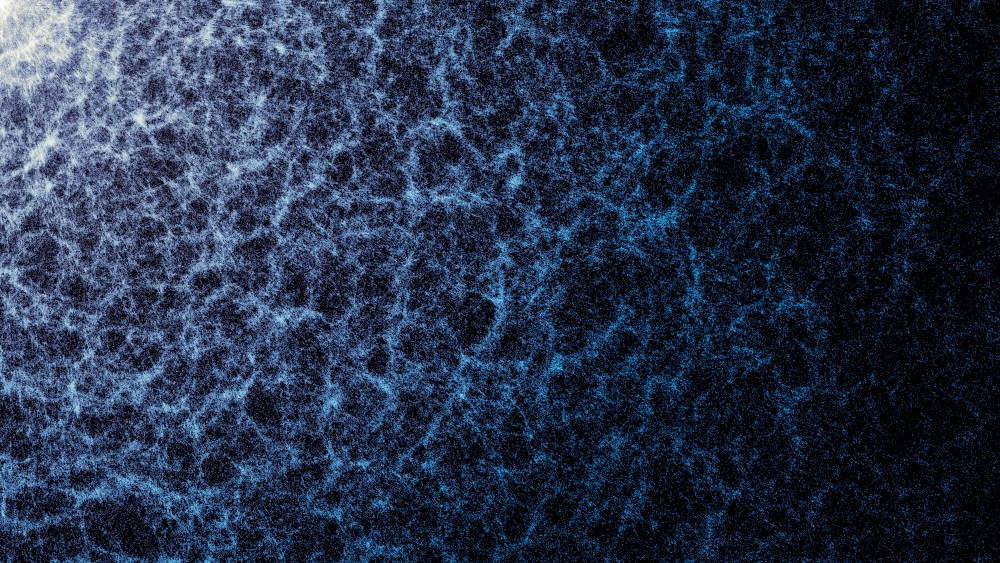
The Dark Energy Spectroscopic Instrument (DESI) has created the largest high-resolution 3D map of the universe. The work involved observing more than 47 million galaxies and quasars as well as 20 million stars over a five-year period. Researchers will now use the vast dataset to probe the nature of dark energy.
DESI, which began collecting data in 2021, is mounted on the Nicholas U Mayall 4-m Telescope at the Kitt Peak National Observatory in Arizona. It comprises 5000 robot-controlled optical fibres that send light to an array of spectrographs.
This allows DESI to make an extensive map of galaxies and quasars with the spectroscopic data providing a measure of how fast a galaxy is moving away from us, which is determined by a galaxy’s redshift.
By comparing how galaxies clustered in the past with their distribution today, researchers can trace dark energy’s influence. Work published in 2024 found hints that the acceleration of the expansion of the universe has not been constant.
DESI will now use the expanded dataset to further test whether the “cosmological constant” could be evolving over time with the results expected to be published next year. Baryon acoustic oscillations hint that dark energy may have changed over time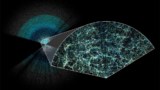
DESI director Michael Levi, who is based at the Lawrence Berkeley National Laboratory, says the survey has been “spectacularly successful and is “incredibly exciting”.
“The instrument performed better than anticipated,” he says, “We’re going to celebrate completion of the original survey and then get started on the work of churning through the data, because we’re all curious about what new surprises are waiting for us.”
DESI will now continue observations into 2028 and further expand the map by about 20% to include parts of the sky that are more challenging to observe.