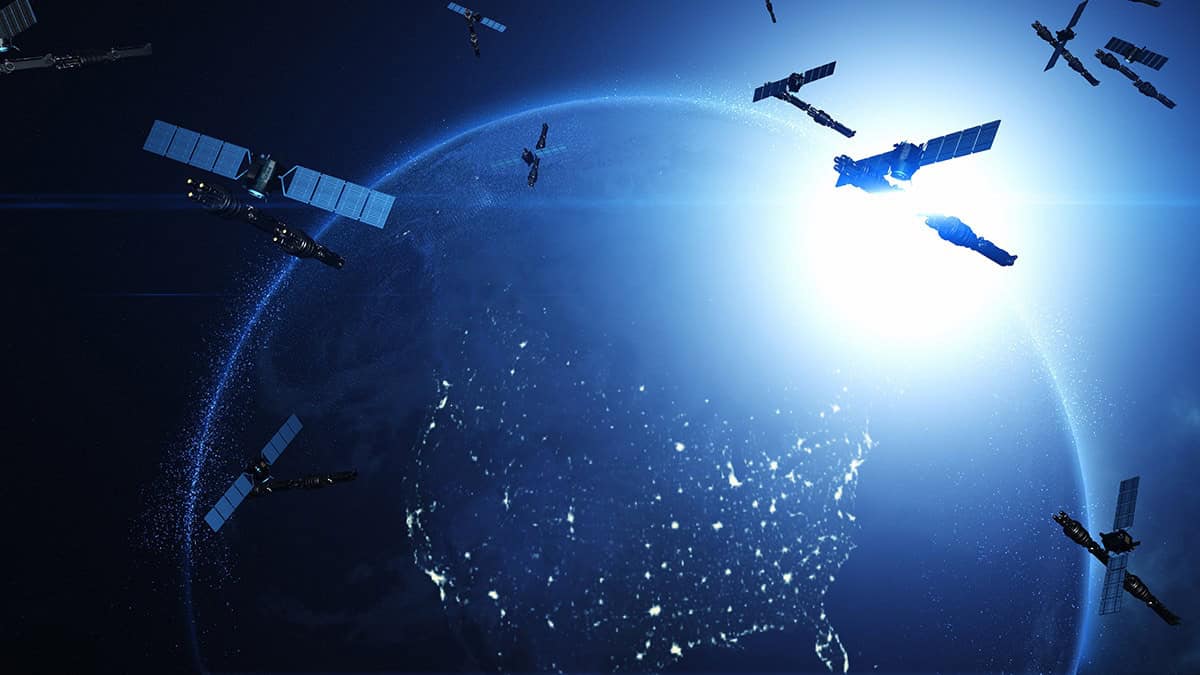
For decades, the Outer Space Treaty (OST) has prevented any nation from placing nuclear weapons in space. To date, however, no mechanisms have been put in place to determine whether a signing member’s satellite may be violating this treaty, or even developing other nuclear capabilities that the original treaty never considered.
Through new analysis of the problem, Areg Danagoulian at MIT suggests a safe and feasible approach to monitoring suspicious satellites, using neutrons emitted as radioactive material is impacted by naturally occurring protons in the Van Allen radiation belt.
At the height of the Cold War in the 1960s, there seemed a growing possibility that space could be used as a platform for developing nuclear weapons. With the prospect of nuclear strikes being launched from orbit with practically no warning, both the US and Soviet governments recognised the possibility of miscalculations by either side leading to a catastrophic nuclear conflict.
In 1967, this led to the signing of the OST: which in part, demands that no signing member should ever deploy nuclear weapons in orbit, on celestial bodies or in outer space. Today, it has been signed by 117 countries, including the US, Russia and China. However, in the decades since the treaty’s origins, both political and technological landscapes have profoundly transformed, creating entirely new concerns that nobody could have conceived in the 1960s.
“In 2022, Russia launched the Kosmos 2553 satellite, which the US has determined is a platform for testing components for a future nuclear anti-satellite weapon,” Danagoulian says. With the ability to target orbiting satellites, such a programme could ultimately destroy vital communication and navigation systems – bringing society to a standstill without any direct strike on the ground.
Despite this threat, no robust mechanism has ever been developed for verifying whether a country is violating the OST, and to date, very little research has even considered the problem.
To Danagoulian’s knowledge, the only related study was an undergraduate thesis by Stanford University student Isobel Portenous – who proposed that suspicious satellites could be probed for nuclear material by measuring radioactivity in the vicinity. However, not only is space already highly radioactive, likely drowning out the signal from a single satellite; it would also require spacecraft to closely approach the satellite, which could be interpreted as a hostile act.
To address this challenge, Danagoulian considered how satellites could instead by probed by naturally occurring, highly energetic protons in the Van Allen radiation belt: which mostly originate from the solar wind, and become trapped by Earth’s magnetosphere.
When interacting with nuclear material in a suspect satellite, “these protons would trigger a process known as spallation in the uranium radiation case of the thermonuclear weapon,” Danagoulian explains. “This would produce a large flux of neutrons that can be detected and used as a fairly specific signature of a nuclear weapon.”
Crucially, the kind of device needed to detect these neutrons wouldn’t need to be too close to the satellite. From a distance of 4 km, Danagoulian calculated that a standard CubeSat detection platform could accurately determine the composition of the nuclear payload of a satellite like Kosmos 2553, within just a week of measurement time.
Antineutrino detectors could spot signs that a fusion reactor is producing weapons-grade plutonium

For now, much more work will be needed before this kind of mechanism can be realistically applied. “Uncertainty remains regarding whether this approach will be practical, so much work is still needed,” Danagoulian says. “Can one build a reliable detector array to perform this measurement? That’s to be determined.”
Yet if these hurdles can be overcome, they could provide a valuable new layer of security in a fast-changing world, and could potentially guide new international policy decisions. “The required physics and basic technology are available to solve this problem,” Danagoulian continues. “If an inspector satellite can be built, it will finally create a mechanism for verifying the OST.”
The study is reported in Nature.