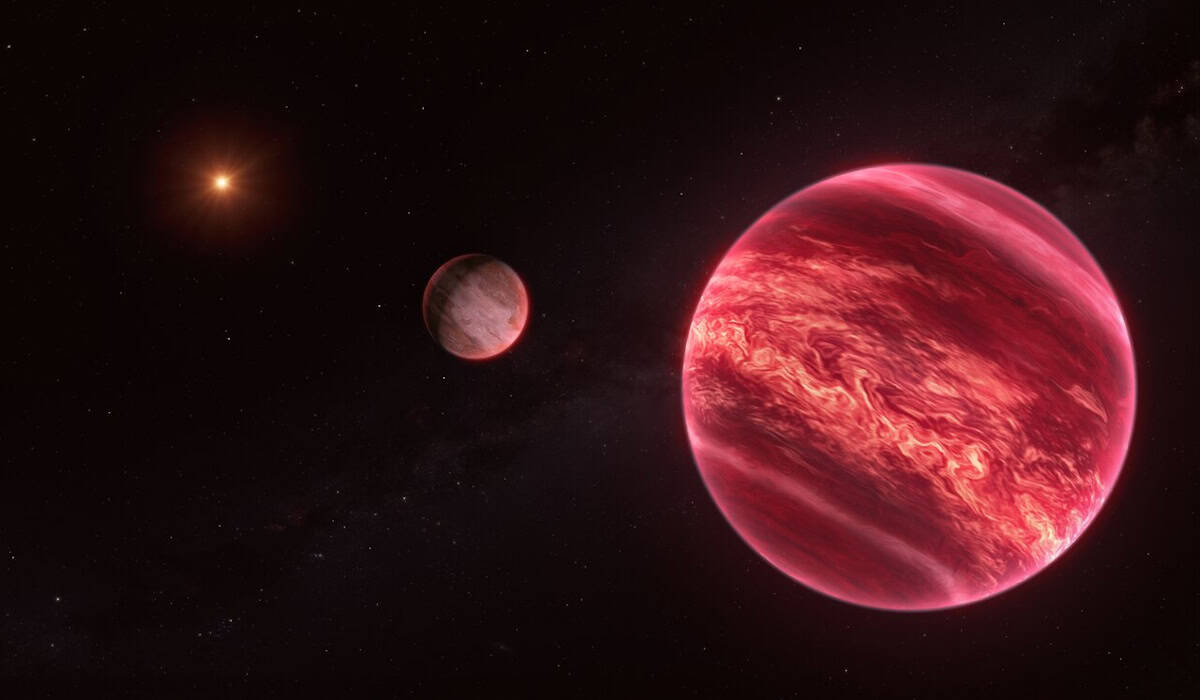
A possible “exosatellite” has been discovered 73 light years away. Bizarrely, it is roughly the size of Jupiter and orbiting a failed star called a brown dwarf, which in turn is orbiting the red dwarf star CD-35 2722.
This huge alien “moon” was found by the Very Large Telescope’s CRIRES+ spectroscopic instrument, which measured the Doppler shift in the brown dwarf’s light as the exosatellite gravitationally tugged on it. This is the same method used to discover the first known exoplanet around a Sun-like star, namely 51 Pegasi b, in 1995.
Only a handful of exosatellite candidates have been discovered thus far, with none being particularly convincing. This newly detected satellite, reported in Nature, is possibly the best of the bunch. The brown dwarf, known as CD-35 2722b, has a mass about 37 times greater than Jupiter and its exosatellite has a minimum mass of 90% that of Jupiter.
Moon, satellite or planet?
Planetary mass objects around brown dwarfs have been discovered before. Take the example of 2M1207b, which is an object up to six times more massive than Jupiter orbiting a brown dwarf, discovered in 2005 by the Very Large Telescope. Such objects have not been referred to previously as moons or satellites, so why now?
“This system is meaningfully different from 2M1207 because of the mass ratios and separations involved in CD-35 2722,” says Kevin Hoy, a PhD candidate at the European Southern Observatory and the Instituto de Estudios Astrofísicos in Chile, who led the discovery.
Whereas 2M1207b is approximately a quarter of the mass of its host brown dwarf and on a very wide orbit, possibly as long as 20,000 years, CD-35 2722b’s satellite has about 2.5% of the mass of its host brown dwarf and is on a much closer 170-day orbit.
There’s also the hierarchy of the system to consider. In the 2M1207 system, the brown dwarf doesn’t orbit anything, but in CD-35 2722 the brown dwarf is on a 5000-year-long orbit around its companion star. The candidate exosatellite therefore orbits something that orbits a star, just as a given moon in our Solar System orbits a planet that orbits a star. Since our Solar System has nothing like this brown dwarf–satellite combination, the language that we use to describe such objects is seemingly inadequate.
Mary Anne Limbach of the University of Michigan, who was not involved in this study, agrees that our nomenclature is increasingly ill-suited to the bizarre objects that we are discovering beyond our Solar System.
“Most people in the astronomical community would probably hesitate to call this an exomoon,” she tells Physics World. “But I think ‘exosatellite’ is appropriate. The field needs language for companions that do not neatly fit into the traditional categories of planets and moons, and ‘satellite’ seems to be the broader term that the field is gravitating towards.”
Forming exosatellites
Definitions are important, adds Limbach, because they allow us to distinguish between how otherwise similar objects formed.
The moons in our Solar System formed from debris discs encircling their parent planets. Material in the discs clumped together, forming cores that were then able to sweep up the remainder of the material. Astronomers refer to this as core accretion formation.
“If I had to put money on it, I would doubt that the CD-35 2722b satellite formed via core accretion for several reasons,” says Hoy. These reasons include the size of the disc required to build such a massive satellite, the speed with which it would have done so (it is only 150 million years old) and its eccentric orbit. Moons born in situ around their parent typically adopt a more circular orbit.
Instead, Hoy suspects that the brown dwarf and its satellite collapsed directly out of a gas cloud in much the same way that stars do. “That would be my best guess,” he says.
The formation mechanism makes all the difference to Limbach, who opines that, “an object can reasonably be called a moon if it formed through a process analogous to the formation of the moons around the Solar System’s planets.”
Limbach cautions that since we only know the satellite’s minimum mass, we cannot yet rule out this being a binary system of two brown dwarfs. Either way, Limbach sees the system as being close to that of a binary giant planet. Our understanding of how giant planetary bodies and low-mass brown dwarfs form tells us that binary giant planets should be rare, “but the first emerging examples hint that they may not be,” says Limbach. These include about 40 pairs of rogue binary giant planets, called Jupiter Mass Binary Objects (JuMBOs), found by the James Webb Space Telescope in the Orion Nebula’s Trapezium star cluster.
Tip of the iceberg
Another unanswered question is how far down does CD-35 2722’s hierarchy go? Could the exosatellite have moons of its own?
“I think it’s definitely possible,” says Hoy, so long as they are on tight orbits so that gravitational tides cannot destabilize them. “Unfortunately such an object is likely impossible to detect with our current methods.”
However, our current methods could soon learn that CD-35 2722 is just the tip of the iceberg.
Moon-forming disc is spotted around a giant exoplanet
“Looking at directly imaged planets and brown dwarfs is the most likely way to yield more exosatellites,” says Hoy, while also citing astrometry (looking for deviations in the motion of a star through space) and microlensing (where the gravity of an otherwise unseen exosatellite creates a temporary gravitational lens) as key techniques that could bring dividends.
Meanwhile, it is hoped that the European Space Agency’s PLATO mission, which will discover exoplanets via transits, will detect significantly large terrestrial moons once the mission launches at the beginning of 2027. All in all, we could be on the cusp of a new era of exomoon and exosatellite discovery.