“Solar towers” that convert sunlight into heat could play a useful role in the renewable energy transition, but high installation costs and complex requirements limit their attractiveness to commercial operators. A team of researchers from Germany’s Karlsruher Institut für Technologie (KIT) and the German Aerospace Center (DLR) is now taking steps to change that. By creating a freely accessible database of information about how these plants work, they aim to accelerate research on solar thermal energy and drive improvements that could allow the technology to be more widely deployed in the future.
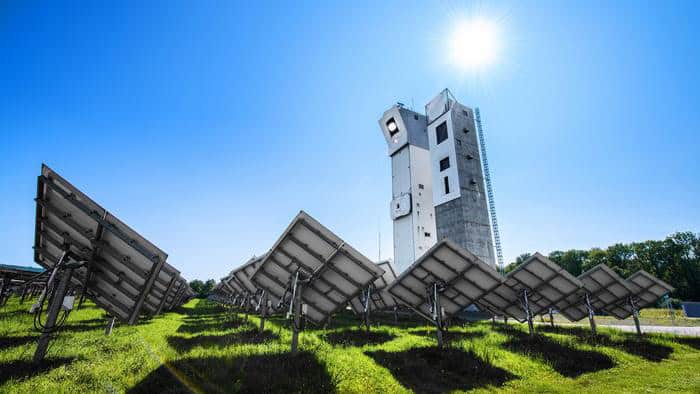
Unlike photovoltaic panels, concentrating solar power (CSP) plants do not convert sunlight directly into electricity. Instead, they generate heat by using an array of movable mirrors called heliostats to funnel sunlight onto a receiver located at the top of a tower. This heat can be used to drive a turbine to produce electricity immediately, but it can also be stored and used to generate electricity at night or on cloudy days. Depending on the plant’s location and setup, the heat could even be used directly for industrial applications and district heating.
The problem, explains study leader Kaleb Phipps, is that operating solar power tower plants safely and efficiently is a complex and expensive task. “CSP technologies have the potential to help the transition to a renewable energy system,” says Phipps, a research fellow at KIT’s Scientific Computing Center. “However, they are still not financially viable and there are operating challenges associated with them.”
Before researchers can develop and reliably test new, improved processes, Phipps explains that they need access to real-world operational CSP data. “We believe that modern data-driven machine learning methods like ours can help solve a lot of these problems,” he says.
849 gigabytes of operational data
To construct their database, which is known as PAINT, researchers collected data from the CSP tower near Jülich, Germany. These data include the exact positions of the tower’s 2014 mirrors, their dimensions, how they are warped and the way they rotate and tilt. The team also obtained fine-grained weather data for the entire 2021-2024 period under study, plus a further 218 000 images to help determine whether the mirrors were efficiently directing sunlight precisely to the top of the tower.
All in all, the PAINT database contains 849 gigabytes of operational data organized using the SpatioTemporal Asset Catalog (STAC) standard. To make these data FAIR (findable, accessible, interoperable and reusable), the researchers developed software to simplify access to the database and then published the data in a way that is freely available to all users.
Their goal, they say, is for other researchers to use this FAIR database to develop “digital twins”, or virtual replicas, of real-world CSP plants. When combined with machine-learning models, such twins can be used to answer questions such as whether the mirrors are aligned for maximal light absorption (one of the most important parameters for efficient operation) in near real time.
Community reaction
“The fact that we are receiving many positive responses regarding the data and that people seem to appreciate it is our biggest success,” Phipps says. Such responses are especially gratifying, he adds, because constructing databases like PAINT can be an arduous task.
“The main difficulties were about collecting the data, cleaning and unifying it into standard formats and parsing and organising all the metadata, which was originally complete chaos,” Phipps recalls. “We therefore put a lot of time and effort into creating standardized and automated workflows so that the process is as transparent as possible and can be reused for future data.”
Combining solar power with thermal storage to avoid wasting energy
The team also faced challenges when trying to convince peers that this work counted as “research”, he adds. “The fact that the data itself didn’t directly result in a new algorithm or method meant that lots of people didn’t believe we would be able to publish the results or achieve anything with them,” says Phipps. “Luckily, we were able to prove the doubters wrong.”
While the PAINT database currently contains data from only one CSP, the KIT researchers, who report their work in Nature Energy, are hoping to expand it. “We really need contributions from other CSP power plants around the world to transform the database into a truly international and diverse source for researchers,” Phipps says. “As data from different facilities is added in the future, it will be possible to develop a common standard for open operational data in solar tower research. This would speed up the development and promote a widespread adoption of this technology.”