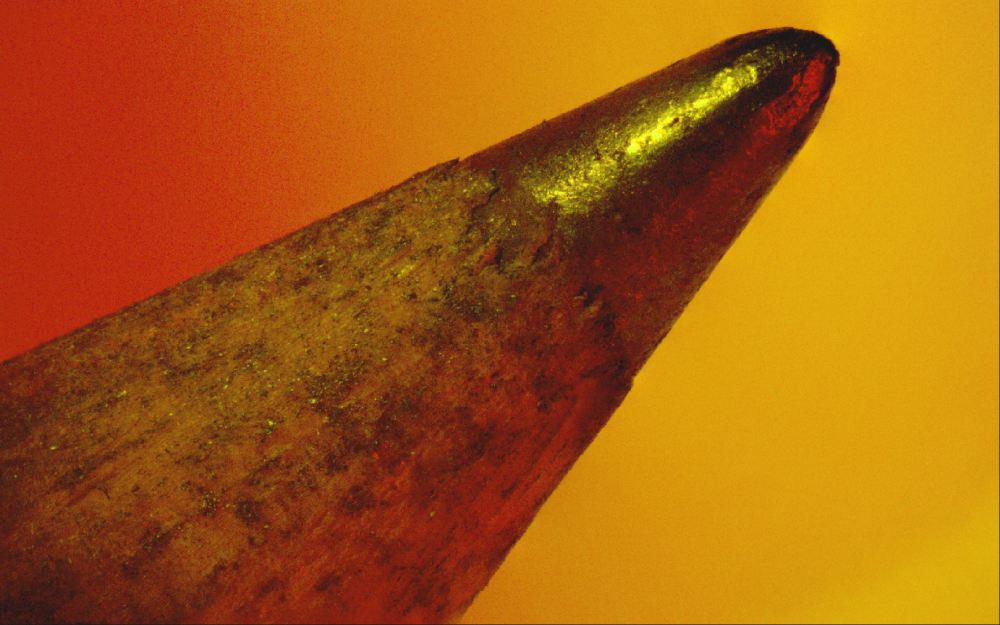
You might think that a bee’s stinger, a rose’s thorn or a razor-like animal tooth has a sharp pointed tip, rather like “cone-shaped” needles used for injections. Yet a closer look finds otherwise, and these objects are usually rounded at the tip, curving gently like a parabola.
Why this is the case is a mystery and it was thought that it was the result of convergent evolution, in other words different species independently arriving at similar solutions.
This is partly because a rounded curve penetrates skin better as it distributes forces more evenly throughout the tissue. The rounded shape is also less prone to breaking than a perfect cone.
Physicist Kaare Hartvig Jensen from the Technical University of Denmark (DTU), however, was not convinced by the evolution argument. “There is a general notion that almost everything in nature exists for a reason,” he says. “But if you look at an unused tooth, it does not necessarily have [a rounded] shape, and if you observe the shape later in the organism’s life, the parabola will emerge.”
Jensen thought that simple mechanical wear might be behind the effect, and so with his DTU colleague John Sebastian, they went about testing this hypothesis.
To do so they were inspired by industrial durability testing where a robot sits on a chair every few seconds to test its robustness, for example.
Their set-up involved a plate atop a vibrating machine containing a number of objects. “Initially, I attempted to build a device using sharpened chalk, but it produced a lot of dust,” he told Physics World. “Ultimately, I settled on pencils.”
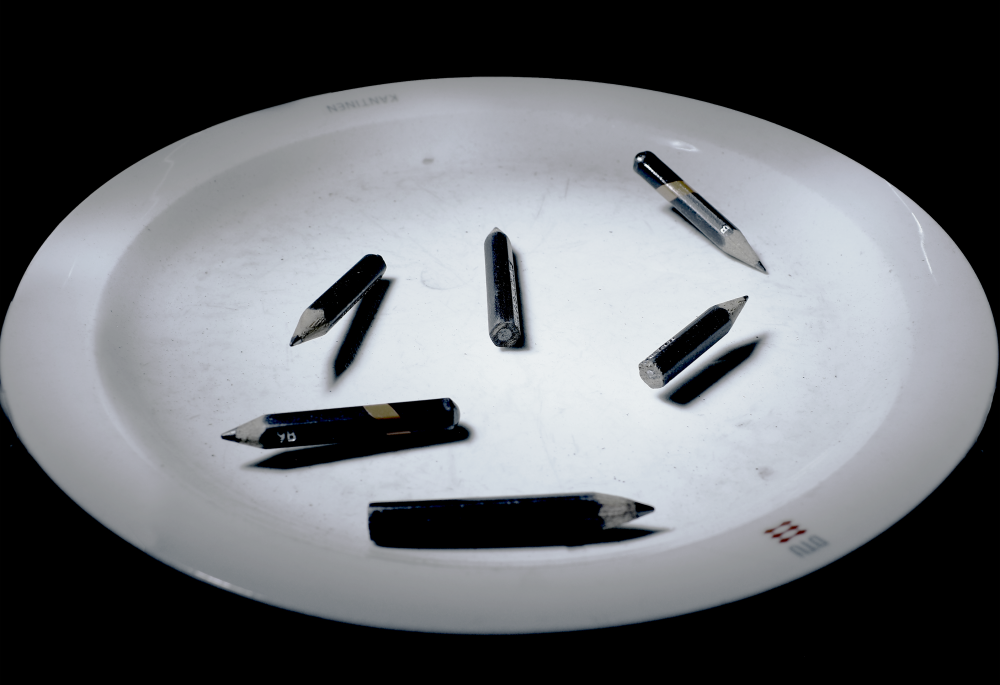
They sharpened the pencils as stand-ins for their biological counterparts and put them on the plate for over four hours as they constantly collided with each other. The team also carried around pencils in a small box in their pockets for several days, again to expose them to random collisions and movements.
They found that no matter how sharp the pencils were to begin with, their tips always developed the same rounded parabolic shape.
“This points to something more fundamental: that random processes in and of themselves can lead to a universal form,” adds Jensen. “The parabola is a stable shape across scales, from a thorn to an elephant’s tusk. The tips are thus not necessarily designed perfectly from the start – they become so through random wear.”
Jensen admits that – rather than in the isotropic case with pencils – most real biological materials have some structure to them, being stronger in one direction than another.
“I would like to explore what shapes result from random wear on these structured materials,” adds Jensen. “Perhaps we can start with something like nails – sharp right after cutting, then gradually blunting. Exactly how this occurs would be of interest.”