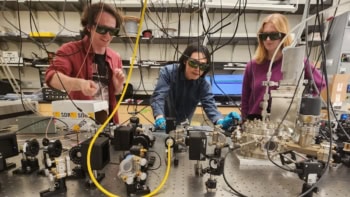
From SI units and quantum sensors to compact particle acceleration and improved radiotherapy – there’s lots to explore in the new free-to-read briefing
The free-to-read Physics World Instrumentation and Vacuum and Briefing 2026 is now available. It includes R&D updates, interviews that explore technology commercialization, and a fun look at the quirky side of SI units.
One topic covered in the briefing is the world of quantum sensors. Over the years, physicists have developed some amazing quantum sensors, but many of the technologies have stayed in the lab because of the challenges of miniaturizing key components. With ultrahigh vacuum (UHV) playing an important role in quantum sensors based on cold atoms, Florence Concepcion of the UK-based firm Aquark talks about her mission to reduce the size and energy consumption of UHV systems.
Elsewhere in the issue, we look at how manipulating individual living cells plays an important role in biology and medicine. Trouble is, cells tend to stick together when grown in vitro and separating them often involves using harsh chemicals that can damage cells or modify their properties. In a special interview, Luke Cox, who co-founded the UK-based firm Impulsonics, discusses its system that uses ultrasound to gently separate living cells.
 Another entrepreneur featured in this briefing is Brian Pogue, co-founder of DoseOptics. The US-based company has developed a system that detects the extremely faint Cherenkov light that is emitted when a radiotherapy beam strikes a patient’s skin. This allows the radiotherapy to be monitored in real time, ensuring that the beam passes through the target tissue and avoids healthy areas of the body.
Also included is a look at the use of intense laser light to accelerate particles. Find out how researchers in the US have created a compact, free electron laser that is driven by a laser plasma accelerator (LPA) – and it has also been used to create a beam of muons.
Finally, you can explore some of the curiosities of the International System of Units (SI), which is the bedrock of metrology. Although SI and its predecessors have been honed and re-defined over the centuries, it still has some surprising quirks. Ben Stein from the US National Institute of Standards and Technology explores some of these oddities including how the candela was derived from the brightness of a candle made from whale fat and beeswax – and the ongoing debate about using the dimensionless radian as the SI derived unit for planar angle.
- Read the Briefing now.
- You can also watch our Physics World Live Quantum metrology panel discussion.