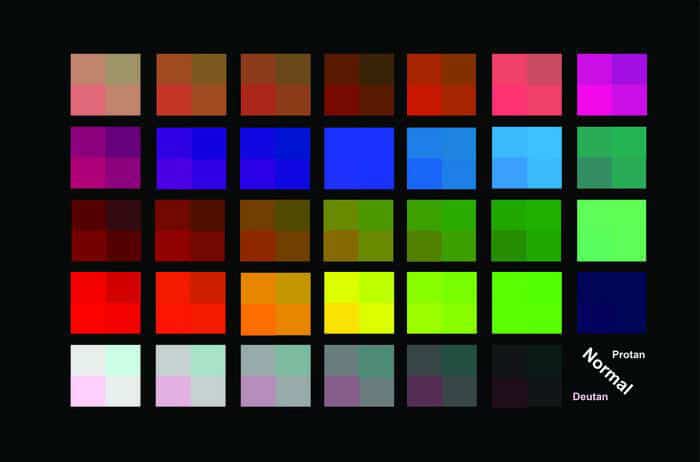
People perceive colours differently, especially on modern displays that produce a wide range of colours. Researchers at University College London (UCL) in the UK have now developed a model to help explain these mismatches. Their work could lead to improved methods for calibrating colour, aiding the development of displays with colours that appear the same to most observers.
Objects absorb and reflect light at a wide range of wavelengths, but when the reflected light reaches our retinas, it gets transduced into a simple trichromatic code thanks to three types of cone photoreceptor cells. These cells are known as L, M and S (for long, medium and short), and each one responds to different wavelengths of visible light.
Almost all display technologies exploit this colour-detecting trichromacy by using red, green and blue colours. The problem with newer displays is that they do not necessarily activate the cones of different observers equally. As study leader Andy Rider of UCL’s Institute of Ophthalmology explains, modern displays owe their vibrant and vivid colours to narrowband, nearly monochromatic primaries that have much larger colour ranges than screens based on older technologies. The downside is that these colours are harder to calibrate accurately, leading to colour mismatches, or metamerism failures, in what different observers perceive. These failures occur even when the displays are calibrated to the same colour standards.
A new model of human colour vision
In their work, which they detail in Optics Express, Rider and colleagues developed a model of human colour vision that describes how the cone cells of different people respond to different spectral wavelengths of light. This model also incorporates disparities in the opacity of the eye’s lens, which becomes yellower as we age and blocks more shortwave (blue/violet) light before it reaches the retina.
The team’s simulations show that some displays, especially those that use narrowband sources such as lasers and quantum dot LEDs, produce marked colour discrepancies for a significant minority of people – sometimes without viewers realizing it. “We began this study when display technology consultant John Frith got in touch with our group,” Rider explains. “One of his friends in the film industry saw the colours of two different side-by-side cinema projectors as being wildly different, even though everyone else in the room agreed they looked the same.”
When Rider and his colleagues tested this person’s colour vision, they found that he had a red-green colour vision deficiency he hadn’t previously known about. And he wasn’t the only one. “Coincidentally, I have the same condition, although I wasn’t properly diagnosed either until my mid-thirties when I joined the Colour and Vision Research Lab at UCL,” Rider says.
The UCL researchers then used their model to predict the colours this person would see. They found that their predictions agreed very well with what he had told them, and indeed with what Rider saw himself. At that point, Rider says, “we decided to look at other common variants of colour vision as well”.
Primary colours
The team collected information about the spectral properties of different displays and analysed them using their model. These analyses showed that the spectrum of blue primary light strongly influences age-related changes in how people see displays. The spectra of red and green primaries, meanwhile, have a similarly strong effect on people with different kinds of red-green colour vision deficiencies. Changing the spectrum of the primary lights displayed could therefore help reduce the mismatches seen by different observers, says Rider.
Upconverting colloidal quantum dots bring ‘colour vision’ to the infrared

The UCL researchers hope their work will highlight the importance of individual differences in colour vision and how these differences affect colour perception. “We have had many fruitful discussions with people in both the creative and the engineering sides of film and television,” Rider says. “This work also feeds into a larger endeavour of developing improved methods for colour calibration and improved colour consistency across displays.” He adds that these kinds of colour discrepancies are also likely to crop up in lighting due to an industry-wide push towards adopting narrowband light sources.
The team now intends to test and validate its modelling results by recruiting volunteers to make colour matches and comparisons between a range of different display technologies. “Colour vision is a complicated phenomenon that depends on many levels of neural processing, and it can be influenced by processes such as memory, emotion and language, so it will be important to test the colours seen under real world conditions,” Rider tells Physics World. “Our results thus far have looked at colour differences seen on existing displays, but we can use the same modelling framework to predict what kinds of displays might work best to reduce those kinds of colour differences, while still producing vivid colours for as many people as possible.”