Can engines made of atoms and light do useful work? New analysis answers that question by showing how rebalancing the books of entropy could help bridge the gap between thermodynamics and quantum mechanics.
Thermodynamics and quantum mechanics have been at the root of two era defining technological revolutions – steam engines and modern electronics. Yet each theoretical framework deals with something completely different. Thermodynamics is the study of how large ensembles of particles behave, while quantum mechanics explains the physics of systems on the atomic and subatomic scale. How to build a smooth bridge between these two disparate fields remains an open question at the cutting edge of contemporary physics.
In a recent paper published in Physical Review Letters, a team of physicists led by Patrick Potts at Switzerland’s University of Basel illustrate such a bridge using light engines as their muse.
Light engine
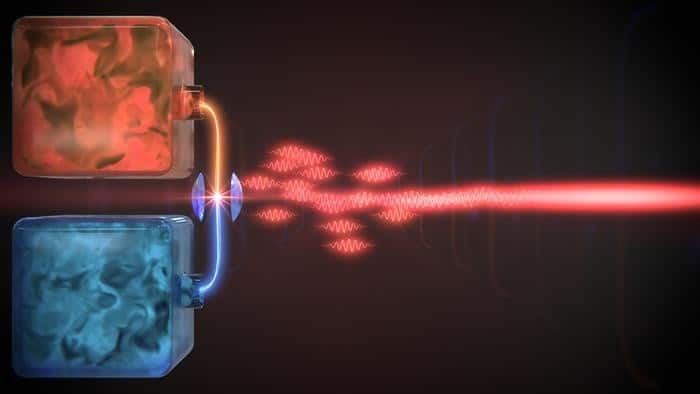
Their tiny light engine consists of an atom placed within a cavity of two mirrors. A laser is shone at the atom causing it to emit photons into the cavity, where the photons bounce back and forth. The mirrors are slightly leaky, meaning that the photons eventually escape the cavity. This forms a driven–dissipative system, where just like an engine, the atom–cavity system can absorb energy in the form of light and dissipate it to its environment. The team’s paper explores the thermodynamic properties of such light engines.
A key question in thermodynamics is how to distinguish between heat and work. Consider two systems, a wind turbine spinning at some speed and a box of hot gas with the same energy. While the turbine’s kinetic energy can be used to do useful work, the energy in the hot gas is less useful and we call it heat. Light works in a similar way. A one-watt laser beam can be used to do work while a one-watt incandescent light bulb produces mostly heat
For quantum systems, defining heat and work is still an open question with no consensus among experts. “In this work, we take two existing treatments of light leaving the cavity and show that only one of them is consistent with the classical thermodynamic treatment of light”, explains Marcelo Janovitch, a postdoctoral researcher at the University of Basel. “Since there is no ambiguity in the classical thermodynamic description, the comparison helps us select the right quantum model.”
Standard bookkeeping fails
Extracting entropy information from quantum dots

In the standard approach, all the light coming out of the cavity is counted as waste heat. This picture can be checked against a fully quantum mechanical model of the same light engine.
“We first build a fully quantum mechanical model of this system. Then, by slowly increasing the power of the incoming laser, the model can be taken to its semi-classical limit where the laser is treated classically and the atom is quantum mechanical”, explains Janovitch. In that limit, the results diverge from the standard thermodynamic model, invalidating this approach.
In an alternate description, they observe that the light leaking out of the cavity has two parts: a coherent, laser-like mean and the fluctuations around it. Treat the coherent part as work and the fluctuations as heat, making the same calculations as before and voilà: thermodynamics and quantum mechanics agree!
Why is correct accounting important?
“The correct accounting of heat and work is at the heart of calculating quantities called ‘thermodynamic uncertainty relations (TURs)’.”, says Janovitch. “These TURs are often used to characterize the quantumness of a system. Incorrect accounting could mean that you fail to recognize quantum mechanical signatures in your system.”
Atom–cavity systems are already used for precision measurement, where it is exactly these quantum signatures that deliver the extra sensitivity. An accounting error, in other words, is not just a bookkeeping problem, it can hide the very quantum effect that the experiment was built to exploit.