

Less is more for conducting graphene composites
Growing gold nanoparticles in situ makes graphene polymer composites effective conductors with very little graphene
 Read article: Less is more for conducting graphene composites

Growing gold nanoparticles in situ makes graphene polymer composites effective conductors with very little graphene
Read article: Less is more for conducting graphene composites
A previously unobserved type of antiferromagnetic switching may be useful for memory applications
 Read article: Data storage prospects broaden for antiferromagnetics
By controlling stray filament formation researchers achieve sub 10 nm feature sizes with standard direct laser writing tools
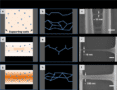 Read article: High-resolution direct laser writing exploits scruffy edges
Experiments in complete darkness reveal extraordinary plasticity in ZnS
 Read article: Inorganic semiconductors can be more flexible in the dark
The UK's National Physical Laboratory opens its doors to shed light on everyday units and the work that goes into defining them
 Read article: World Metrology Day: Celebrating an underappreciated science
Researchers successfully take on the challenge of growing gallenene on silicon using a buffer layer
 Read article: Gallenene grows on silicon
Research collaborators at Southampton, Imperial and Manchester universities in the UK win a grant to develop memristor technology for broader use
 Read article: Memristor technology programme wins £11 million
Researchers produce synthetic membranes with the same capillary reservoir structure that allows extensions of 10,000% without rupture in biological threads
 Read article: Wicked membranes mimic ultrastretchable spider silk
Calculations of carbon fragment fusion highlight the role of edges in making and mending defects
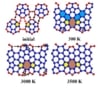 Read article: Graphene nanoribbons mend from the brink
Wenzhuo Wu describes some of the devices for human–machine interfacing and sensing using functional nanomaterials under development in his lab at Purdue University
 Read article: Professor Wu and e-skin