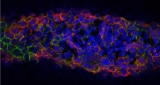
Could graphene quantum dots help treat Parkinson’s disease?
Researchers have found that the nanostructures reduce alpha-synuclein fibrils in mice
Read article: Could graphene quantum dots help treat Parkinson’s disease?
Thank you for registering with Physics World
If you'd like to change your details at any time, please visit My account
Isabelle Dumé is a contributing editor to Physics World. She has more than 10 years of experience in science writing and editing in condensed-matter physics relating to technology/nanotechnology/biotechnology, astronomy and astrophysics, energy and the environment, biology and medicine. She has an MSc in advanced materials and a PhD in magnetism. In her spare time, she helps to organize cafés scientifiques.

Researchers have found that the nanostructures reduce alpha-synuclein fibrils in mice
Read article: Could graphene quantum dots help treat Parkinson’s disease?
Aqueous trapped ions could allow for nanofluidic computing say NIST researchers
Read article: 2D sheets help make liquid logic
Computer modelling offers new insights into the printability cell-laden biomaterials
Read article: 3D bioprinting simulations help optimize bioinks
The semiconductor could be a “revolutionary thermal management material”
Read article: Boron arsenide crystals could cool computer chips
A new neonatal passive lung assist device shows promise
Read article: Double-sided microfluidic blood oxygenator makes artificial placenta
The London brothers may have been right
Read article: Static electric field suppresses superconductivity
Model describes how individual stiches in a knitted fabric behave when stretched
Read article: New knit theory could help make smart self-folding materials
First observations of two independent skyrmion phases in the same magnetic material
Read article: Skyrmion phases: two for the price of two
Could painful injections become a thing of the past for diabetics?
Read article: Ionic liquid formulation makes oral insulin pill
Researchers have succeeded in monitoring the activity of individual retina cells in an awake animal for the first time
Read article: Injectable mesh electronics opens up a new window into vision research