

Liquid carbon reveals its secrets
Researchers characterize the structure of liquid carbon for the first time, thanks to experiments at the European XFEL
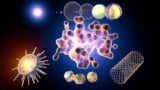 Read article: Liquid carbon reveals its secrets

Researchers characterize the structure of liquid carbon for the first time, thanks to experiments at the European XFEL
Read article: Liquid carbon reveals its secrets
Rare sighting could allow astronomers to test theories of binary star systems
 Read article: Short-lived eclipsing binary pulsar spotted in Milky Way
Portable biomarker detector could also be used in non-contact diagnostics
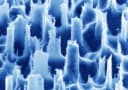 Read article: Handheld device captures airborne signs of disease
Previously unknown protein-based feature in slime allows it to transform from liquid to fibre and back again
 Read article: Worm slime could inspire recyclable polymer design
Device could be transformative in biology, chemistry and lab-on-a-chip applications
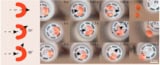 Read article: Sound waves control droplet movement in microfluidic processor
A central mechanism behind information transfer in living cells depends on the transfer of electrons with a specific spin
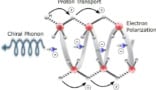 Read article: Quantum physics guides proton motion in biological systems
New device could make the technology accessible outside national and international synchrotron facilities
 Read article: Laboratory-scale three-dimensional X-ray diffraction makes its debut
Mortise-and-tenon structure makes for fast, highly uniform switching
 Read article: Ancient woodworking technique inspires improved memristor
Devices use upconverting nanoparticles to make normally invisible radiation perceptible to humans even with their eyes closed
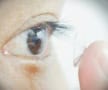 Read article: New contact lenses allow wearers to see in the near-infrared
First high-resolution images of Bolivia's Uturuncu volcano show it is likely to remain active without actually erupting
 Read article: ‘Zombie’ volcano reveals its secrets