

‘Buddy star’ could explain Betelgeuse’s varying brightness
As-yet-undetected stellar companion would displace light-blocking dust
 Read article: ‘Buddy star’ could explain Betelgeuse’s varying brightness

As-yet-undetected stellar companion would displace light-blocking dust
Read article: ‘Buddy star’ could explain Betelgeuse’s varying brightness
Different neutron states could explain why different experiments produce different figures for how long neutrons survive before decaying
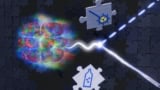 Read article: Physicists propose new solution to the neutron lifetime puzzle
Flatter nanocrystals are unexpectedly good at getting ligands to attach to them, which could have applications in electronics and biomedical science
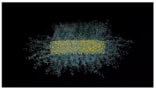 Read article: Nanocrystal shape affects molecular binding
Experiments on tracking firebrands could improve predictions of spot-fire risks
 Read article: Bursts of embers play outsized role in wildfire spread, say physicists
Modified MINFLUX approach could be used to study biological processes inside cells
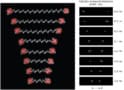 Read article: Optical technique measures intramolecular distances with angstrom precision
New graphene-biopolymer material extracts gold ions 10 times more efficiently than other adsorbents
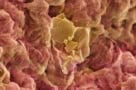 Read article: Eco-friendly graphene composite recovers gold from e-waste
Experimental observations at the Swiss Light Source could advance the development of energy-efficient memory devices based on "orbitronics"
 Read article: Orbital angular momentum monopoles appear in a chiral crystal
New immersive reality method could also inform policymakers and urban planners about risks, say researchers
 Read article: Physics-based model helps pedestrians and cyclists avoid city pollution
New work resolves a longstanding debate and could aid the development of new cutting tools
 Read article: Spiders use physics, not chemistry, to cut silk in their webs
Sensitivity of vanadium-oxide-based device breaks previous record by more than an order of magnitude
 Read article: Quantum material detects tiny mechanical strains