

DNA origami makes 3D superconducting nanostructures
Complex three-dimensional nanostructures could find use in quantum computing and magnetic field sensing
 Read article: DNA origami makes 3D superconducting nanostructures

Complex three-dimensional nanostructures could find use in quantum computing and magnetic field sensing
Read article: DNA origami makes 3D superconducting nanostructures
Appearance of exciton vortices in hybrid halides suggests a possible route to Bose–Einstein condensates of electron–hole pairs at liquid nitrogen temperatures
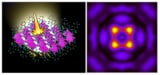 Read article: Perovskites could be platforms for exciton condensates
High-performance instrument is small enough to fit on drones and satellites and could even fly on planetary exploration missions
 Read article: Imaging spectrometer slims down
Kármán vortices shed by leading fish help followers generate thrust
 Read article: Fish save energy by swimming in schools
Large-area low-noise structures detect faint visible light
 Read article: Organic photodiodes rival silicon devices
New design reduces electron “leakage” in quantum cascade lasers and could bring terahertz imaging into wider use
 Read article: Terahertz laser leaves the lab
Novel lightweight materials have magnetic ordering temperatures and coercivities comparable to commercially available inorganic magnets
 Read article: Metal–organic magnets break records
New method does away with the need to stack and twist layers of 2D materials manually
 Read article: Twisted spirals of 2D materials grow on curved surfaces
Stereo-polarimetric compressed ultrafast photography device takes up to 100 billion frames per second in 3D
 Read article: Ultrafast camera breaks 3D speed record
Researchers discover an unexpected new class of superconducting material
 Read article: g-wave superconductor comes into view