

Surfactant monolayers help make polymer crystals
SMAIS technique produces synthetic covalent organic 2D polymer sheets with the largest crystalline domain sizes ever
 Read article: Surfactant monolayers help make polymer crystals

SMAIS technique produces synthetic covalent organic 2D polymer sheets with the largest crystalline domain sizes ever
Read article: Surfactant monolayers help make polymer crystals
Researchers have succeeded in creating the first analogues of Kelvin’s “vortex atoms” in chiral materials
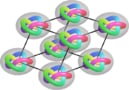 Read article: 3D knots appear in liquid crystals
Results from precise band structure measurements are an important step in the quest for materials in which magnetism and topology could be exploited for future technology
 Read article: Time reversal symmetry breaks in ferromagnetic Weyl semimetals
New process is 100% selective and does not produce undesired solid carbon either – unlike conventional CO2 electrolysis technologies
 Read article: Ceria catalyst could help produce carbon-neutral fuels
New fibrous material could allow robots to feel touch and sense how they interact with their environment
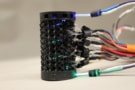 Read article: Optical lace could make a ‘nervous system’ for robots
New technique reliably and precisely inserts single-ion impurities into a crystal and could help in the development of future quantum information technologies
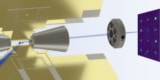 Read article: Laser-cooled ions implant deterministic colour centres
Structures are alternatives to viral vectors for gene therapy using the CRISPR-Cas9 system
 Read article: Nanocapsules deliver gene-editing payload
Technical breakthrough has allowed researchers to make an optical nanopore sensor that does not require any electrical connections
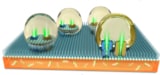 Read article: Nanopore sensing goes electrode free
New result will be important for future real-world applications that make use of these tiny magnetic particle objects
 Read article: Synthetic antiferromagnets host room-temperature skyrmions
The materials might be employed in applications such as fuel cells and other hydrogen-related technologies
 Read article: Thick mica membranes make excellent proton conductors