

Kondo cloud seen at last
New observations could boost understanding of multiple-impurity systems such as Kondo lattices, spin glasses and high transition-temperature superconductors
 Read article: Kondo cloud seen at last

New observations could boost understanding of multiple-impurity systems such as Kondo lattices, spin glasses and high transition-temperature superconductors
Read article: Kondo cloud seen at last
Devices made from these materials could be used to power autonomous submersible vehicles and sensors
 Read article: Wide-band-gap semiconductors could harvest sunlight underwater
New device incorporates nanosized gold ellipses and could help people who struggle to distinguish red from green
 Read article: Metasurface-based contact lens corrects colour blindness
High-quality films formed by quenching hot nickel foil in ethanol are as good as their CVD-grown counterparts at shielding devices from electromagnetic interference
 Read article: Quickly grown graphite film blocks electromagnetic radiation
New work could make devices containing gallium nitride more resistant to radiation-induced faults
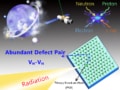 Read article: First-principles calculations shed light on semiconductor defects
New device could find use in digital processors that operate in harsh conditions and require electronics with integrated data storage
 Read article: Non-volatile nano-relay breaks records
Researchers use light-sheet microscopy to study the behaviour of liquid crystals made up of rod-shaped virus particles
 Read article: Thread-like defects in 3D active crystals get a closer look
Aspiration-assisted technique could be used in regenerative medicine, tissue engineering and the creation of “organs-on-a-chip” for drug testing and disease modelling
 Read article: Suction forces enable precise bioprinting
New imaging technique can visualize the dynamics of magnetic structures in three dimensions for the first time
 Read article: 3D nano-vortices come into view
Adding a mirrored substrate to a standard optical microscope’s sample stage could greatly simplify dark-field imaging and make it more widely accessible
 Read article: Dark-field microscopes made easy