

Giant negative thermal expansion seen in nanomagnet
The effect occurs at room temperature and will be important for a host of technology applications
 Read article: Giant negative thermal expansion seen in nanomagnet

The effect occurs at room temperature and will be important for a host of technology applications
Read article: Giant negative thermal expansion seen in nanomagnet
New work could help advance battery research for engineering next-generation high-energy-density technologies
 Read article: Sealed cell improves oxide-peroxide conversion in lithium-ion battery
IBM researchers have solved a long-standing two-carrier transport problem in the Hall effect with light
 Read article: New equation unlocks 140-year-old Hall effect secret
New work will be important for making and controlling high-fidelity gates in quantum computers
 Read article: Hamiltonian learning technique advances quantum spin register
Technique could produce scalable, reversible, shape-shifting structures with hitherto unseen complexity for use in a host of practical applications
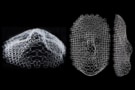 Read article: Material lattice morphs into doubly curved shapes
Researchers observe exotic state at 100 K, a result that bodes well for coherent optoelectronics applications and perhaps even high-temperature superconductivity
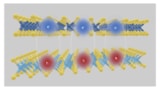 Read article: Exciton condensation breaks new temperature record
The carbon sheet can no longer be considered as a purely 2D material as far as certain mechanical properties are concerned say researchers
 Read article: High-pressure experiments reveal graphene’s 3D nature
SMAIS technique produces synthetic covalent organic 2D polymer sheets with the largest crystalline domain sizes ever
 Read article: Surfactant monolayers help make polymer crystals
Researchers have succeeded in creating the first analogues of Kelvin’s “vortex atoms” in chiral materials
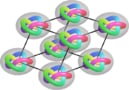 Read article: 3D knots appear in liquid crystals
Results from precise band structure measurements are an important step in the quest for materials in which magnetism and topology could be exploited for future technology
 Read article: Time reversal symmetry breaks in ferromagnetic Weyl semimetals