

Lagging behind the solar cycle
Coronal mass ejections could explain a hiccup in the well-known solar cycle


Coronal mass ejections could explain a hiccup in the well-known solar cycle
New insights into the electronics of nanotubes could bring real devices a step closer
Dark side of the Moon can reveal changes in our atmosphere
 Read article: Moon illuminates climate study
Devices that run on photons instead of electrons could transmit data at the speed of light
Images from the NEAR-Shoemaker spacecraft provide clues to the young solar system
 Read article: Zooming in on the Eros asteroid
The solar wind and the giant planet's magnetic field combine to produce a huge plume
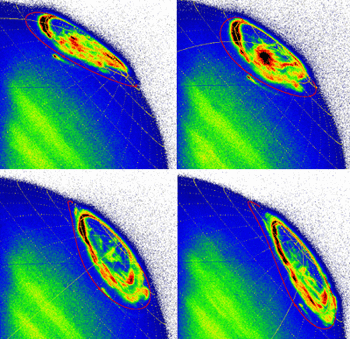 Read article: Jets on Jupiter: first view of an auroral flare
Segregation in a bowl of nuts may be akin to condensation in gases
A hybrid theory solves the long-standing riddle of the element's structure
A radical material with a negative refractive index could revolutionise optoelectronics
The gravitational pull on a spacecraft could be the best test yet of relativity