Author
Array
(
[0] => linkedin
[1] => facebook
[2] => twitter
[3] => google-plus
[4] => youtube
)
Array
(
[0] => linkedin
[1] => facebook
[2] => twitter
[3] => google-plus
[4] => youtube
)
Array
(
[0] => linkedin
[1] => facebook
[2] => twitter
[3] => google-plus
[4] => youtube
)
Array
(
[0] => linkedin
[1] => facebook
[2] => twitter
[3] => google-plus
[4] => youtube
)
Array
(
[0] => linkedin
[1] => facebook
[2] => twitter
[3] => google-plus
[4] => youtube
)
No Author
Author archive
It is a tribute to the dynamism of astrophysics today, and to the achievements of the past century, that Paul Murdin and his distinguished editorial board, together with over 500 contributors, many of them extremely well known astrophysicists, should find it worthwhile to embark on the massive task of creating this encyclopaedia. It is a […]
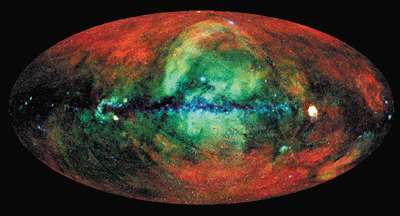 Read article: A reference point to the cosmos
Last month the Royal Society of Chemistry mustered together a collection of like-minded bodies – including the Institute of Physics, the Institute of Biology and the Engineering Council – for the launch of a “charter for science and engineering”. The charter was launched at a meeting at the House of Commons attended by representatives of […]
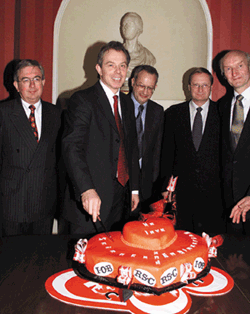 Read article: Getting set for the election
Numerical models are providing detailed insights into the formation and dynamics of avalanches, explain Perry Barteft and Othmar Buser
 Read article: Avalanche physics ploughs ahead
During the past decade, the availability of simple, effective methods for laser cooling and trapping has enabled enormous advances in the experimental study of atoms in their ground state. Until quite recently, however, these techniques have had much less impact on investigations of highly excited atoms – and almost none on plasmas. Several laboratories have […]
 Read article: Ultracold plasmas come of age
In molecular materials like water, the structural units that make up the liquid state can also dictate the properties of the frozen solid. But what about monatomic liquids that are composed of single atoms, rather than molecules? It is tempting to think of such liquids as completely unstructured, like gases in slow motion, but this […]

In the March issue of Physics World, Mike Lockwood of Rutherford Appleton Laboratory and Southampton University, UK, and Duncan H Mackay of the University of St Andrews, UK, underline the significance of the solar magnetic field in our understanding of the solar flux and cosmic rays in particular.
Icy lava could have created the flat regions on Jupiter's largest moon
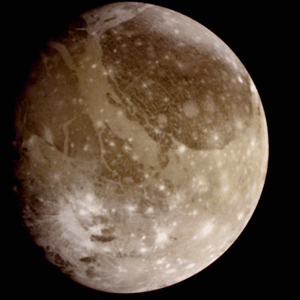 Read article: The flood-plains of Ganymede
Current flow in the new metallic superconductor could be explained by an old theory
More cash on the cards for European R&D
Turbulence is highlighted by imaging methods from high-energy physics
 Read article: Turbulent times for fluids
Copyright © 2026 by IOP Publishing Ltd and individual contributors


