Author
Array
(
[0] => linkedin
[1] => facebook
[2] => twitter
[3] => google-plus
[4] => youtube
)
Array
(
[0] => linkedin
[1] => facebook
[2] => twitter
[3] => google-plus
[4] => youtube
)
Array
(
[0] => linkedin
[1] => facebook
[2] => twitter
[3] => google-plus
[4] => youtube
)
Array
(
[0] => linkedin
[1] => facebook
[2] => twitter
[3] => google-plus
[4] => youtube
)
Array
(
[0] => linkedin
[1] => facebook
[2] => twitter
[3] => google-plus
[4] => youtube
)
No Author
Author archive
Carbon-60 is in a class of organic materials known as fullerenes, which are insulators. Scientists first generated superconductivity – current flow without resistance below a certain ‘transition temperature’ – in carbon-60 ten years ago. They doped the material with alkali metal ions, which donate its electrons and makes the carbon-60 conducting. But electron doping led […]
Louis Néel was born in Lyons in 1904 and dedicated his career to the study of magnetism. In 1932 he discovered antiferromagnetism – a form of magnetism in which the ‘spins’ on neighbouring atoms point in opposite directions. Previously only three forms of magnetism – dia-, para- and ferromagnetism – were known. During the Second […]
Schmid and colleagues used new microscopy techniques to observe in real time interactions between the tin clusters – each containing hundreds of thousands of atoms – and the copper surface. They found that tin and copper atoms swap places at the interface between the two metals to form bronze. The tin atoms in the cluster […]
“This budget is seriously good news for UK physics,” Ian Halliday, PPARC chief executive, told PhysicsWeb. “It has provided PPARC’s first real budget increase for 20 years.” This contrasts with the last round of spending two years ago when PPARC was the only research council not to receive a real-terms rise in funding. The Engineering […]
The US Government makes another presentation next week with the National Medal of Science awards on 1 December. Physicists Willis Lamb and Jeremiah Ostriker receive the medal. Lamb, of the University of Arizona, won the 1995 Nobel Prize for experimental work on hydrogen that revealed a new quantum relativistic effect. His work became one of […]
The internal energy levels of bulk silicon – in particular its ‘indirect bandgap’ – makes it emit light very inefficiently. Existing lasers are therefore based on ‘direct’ bandgap materials like gallium arsenide, which readily emit light. But these materials are expensive and difficult to integrate into the silicon chips used throughout the electronics industry. Pavesi […]
Dago de Leeuw, a physicist at Philips Research Laboratories in the Netherlands, leads a team of physicists recognized for their pioneering research in plastic electronics. De Leeuw and colleagues from The Netherlands, Denmark, Germany and the UK developed a new class of transistors based on polymers. The transistors are strong but flexible and are cheaper […]
Some liquids are very useful because their molecules act as tiny dipoles that can be aligned by electric or magnetic fields. Vehicle clutches, ink-jet printers and lubricants are among the applications that make use of these so-called dipolar fluids, which consist of micron-sized spherical particles suspended in a fluid. But to exploit the liquids further, […]
The standard model – developed by Pierre Weiss in 1907 – treats paramagnets as systems of non-interacting magnetic dipoles. The theory successfully describes the behaviour of paramagnets – materials that become weakly magnetized inside an applied magnetic field – but cannot account for ferromagnets. Ferromagnets are strongly magnetic even when there is no external field, […]
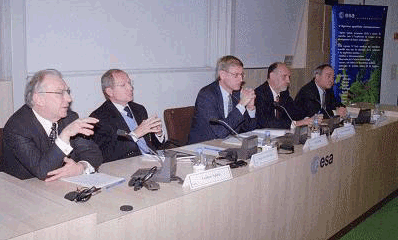
ESA’s director general Antonio Rodotà appointed the committee in March 2000. Carl Bildt, former Swedish Prime Minister and UN Envoy to the Balkans, Jean Peyrelevade, President of Crédit-Lyonnaisse, and Lothar Späth, CEO of German laser and optics company Jenoptik, were chosen to represent political, economic and industrial interests. The committee compares the annual US investment […]
 Read article: Space to play a starring role in Europe’s future
Copyright © 2026 by IOP Publishing Ltd and individual contributors


