Author
Array
(
[0] => linkedin
[1] => facebook
[2] => twitter
[3] => google-plus
[4] => youtube
)
Array
(
[0] => linkedin
[1] => facebook
[2] => twitter
[3] => google-plus
[4] => youtube
)
Array
(
[0] => linkedin
[1] => facebook
[2] => twitter
[3] => google-plus
[4] => youtube
)
Array
(
[0] => linkedin
[1] => facebook
[2] => twitter
[3] => google-plus
[4] => youtube
)
Array
(
[0] => linkedin
[1] => facebook
[2] => twitter
[3] => google-plus
[4] => youtube
)
No Author
Author archive
The idea that the universe is trapped on a membrane in some high-dimensional space-time may explain why gravity is so weak, and could be tested at high-energy particle accelerators
 Read article: The search for extra dimensions
Space station commander Bill Shepherd (US), Soyuz commander Yuri Gidzenko and flight engineer Sergei Krikalev have trained for four years in both Russia and the US in preparation for the expedition, which represents the first permanent human occupation of the space station. The crew is expecting a number of visitors over the next few months. […]
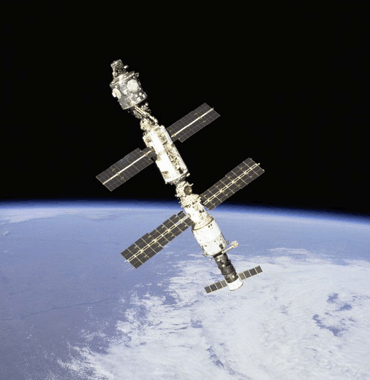 Read article: No space like home
Southwood received his PhD from Imperial College, London, in 1966 and was appointed as lecturer in the physics department in 1971, where he rose to become head of department in 1984. He studied the propagation of waves in the solar and terrestrial environment, joined the Galileo spacecraft team, and was also involved with the solar […]

Galindo-Uribarri and co-workers chose an isotope of neon with an energy structure that prevents it from emitting protons one at a time. This means that the two protons are certainly ejected simultaneously. The team fired a beam of radioactive fluorine ions at a proton-rich target to produce neon-18, which then decays into oxygen and two […]
Conventional magnetic recording works by changing the magnetisation states of different domains. An in-plane applied magnetic field takes a few nanoseconds to ‘switch’ the domain state. But Back and colleagues were surprised recently to find that a magnetic field applied perpendicular to a cobalt film can also flip magnetisation states (C H Back et al […]
Titan’s atmosphere has much in common with our own: it consists mainly of nitrogen, contains organic material, and exerts a pressure one-and-a half times what we feel on Earth. But Titan receives just 1% of the power that the Earth receives from the Sun. Griffith and co-workers believe that at such low temperatures, the methane […]
Although researchers have proposed a wide variety of explanations for sonoluminescence, they are in broad agreement that the oscillating bubbles reach very high temperatures. Until now, however, single-bubble sonoluminescence has been observed only from air bubbles trapped in water, although very weak emissions have been detected in some alcohols. Suslick and colleagues predicted the necessary […]
The Bepi-Colombo mission will begin its trip to Mercury, the solar system’s innermost planet, in 2009. The spacecraft is expected to solve some long-standing puzzles about Mercury and provide insights into our own place in the solar system. The second cornerstone project is a satellite-based telescope called GAIA. Scheduled for launch before 2012, GAIA will […]
 Read article: ESA space missions: the next generation
“We know that cosmic radiation at aircraft altitudes is several orders of magnitude more intense than that experienced at ground level because there is less protection from our atmosphere”, says Bob Bentley, project scientist at MSSL. But scientists are currently unsure how much of the radiation penetrates into the cabins of aircraft and what risk […]
Heeger, MacDiarmid and Shirakawa made their breakthrough in the late 1970s, when they discovered that the electrical conductivity of a certain form of polyacetylene increased by a factor of ten million when it was doped with iodine. Subsequent developments have produced diverse applications for the technology: conductive plastics are used in anti-static materials, filters for […]
Copyright © 2026 by IOP Publishing Ltd and individual contributors


