Author
Array
(
[0] => linkedin
[1] => facebook
[2] => twitter
[3] => google-plus
[4] => youtube
)
Array
(
[0] => linkedin
[1] => facebook
[2] => twitter
[3] => google-plus
[4] => youtube
)
Array
(
[0] => linkedin
[1] => facebook
[2] => twitter
[3] => google-plus
[4] => youtube
)
Array
(
[0] => linkedin
[1] => facebook
[2] => twitter
[3] => google-plus
[4] => youtube
)
Array
(
[0] => linkedin
[1] => facebook
[2] => twitter
[3] => google-plus
[4] => youtube
)
No Author
Author archive
Scanning tunnelling microscopes (STMs) rely on an ultrafine ‘tip’ to push atoms over a surface. The atoms are pushed either by the tip itself, or by an electric field. The new technique relies on the current that tunnels from the tip to the atom. As the tip approaches the bromine atom, the atom moves closer […]

The neutron scattering experiments were carried out by Herb Mook from the Oak Ridge National Laboratory and colleagues, while the ion channelling experiments were performed by Rajeshwar Sharma from the University of Maryland and co-workers. Mook and co-workers showed that certain magnetic fluctuations in YBCO are one-dimensional – as would be expected if the stripe […]
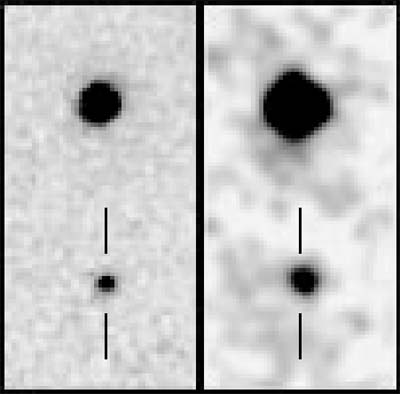
There are four possible explanations for the object: a highly obscured galaxy, an old elliptical galaxy at redshift 3 or 4, a galaxy at redshift 12, or an intergalactic carbon star. However, there are problems with all of these interpretations. “It would be very strange to have found a highly obscured galaxy with colours this […]
 Read article: Hubble sees mystery object
Converting electrical signals into optical pulses is one of the speed ‘bottlenecks’ in current telecommunications systems. To reach high data speeds, a series of electro-optic devices called modulators, all operating at different wavelengths, are used. The most common modulators are based on a lithium niobate compound, but they require high voltages (5 V) to work. […]
The JIF scheme is designed to bring facilities at UK universities to the forefront of international research. Nearly £600m has been awarded to 109 projects in 28 different institutions since the UK Government and the Wellcome Trust – the world’s largest biomedical research charity -first funded the scheme. The size of the third round awards […]
Ulysses was launched to make continuous measurements of the solar wind, a steady stream of ionized particles that flows outwards from the star. In 1998 Pete Riley and colleagues from Los Alamos National Laboratory published a paper describing a dramatic drop in the number of protons registered by Ulysses. They suggested that a comet could […]
The Innsbruck model relies on ions stored in an array of microtraps. Because the microtraps can be fabricated in a solid state device, thousands of traps can be put into an array. The internal quantum state of the ions acts as the qubit. A different ion, called the head ion, moves above the array to […]
Is there a secret that makes a Stradivarius sound so good, and can modern violins match the wonderful tonal quality of this great Italian instrument, asks Colin Gough
 Read article: Science and the Stradivarius
About a year ago I was asked to speak at a local women’s studies conference on mathematics, science and technology. I didn’t flatter myself at having been chosen, because nearly every local woman who was even vaguely involved with science or mathematics at a professional level had been invited to speak. Nevertheless, I had for […]
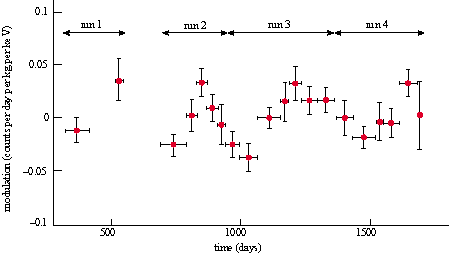
The controversy surrounding evidence for the discovery of “dark matter” particles has heated up following two conflicting talks given at a conference at the end of February. The papers were presented at the 4th International Symposium on Sources and Detection of Dark Matter/Energy in the Universe held in Marina del Ray, California. (Most of the […]
 Read article: Dark-matter dispute intensifies
Copyright © 2026 by IOP Publishing Ltd and individual contributors


