Author
Array
(
[0] => linkedin
[1] => facebook
[2] => twitter
[3] => google-plus
[4] => youtube
)
Array
(
[0] => linkedin
[1] => facebook
[2] => twitter
[3] => google-plus
[4] => youtube
)
Array
(
[0] => linkedin
[1] => facebook
[2] => twitter
[3] => google-plus
[4] => youtube
)
Array
(
[0] => linkedin
[1] => facebook
[2] => twitter
[3] => google-plus
[4] => youtube
)
Array
(
[0] => linkedin
[1] => facebook
[2] => twitter
[3] => google-plus
[4] => youtube
)
No Author
Author archive
While theorists have been battling to understand high-temperature superconductivity, industry is developing devices ready for a global marketplace potentially worth billions of dollars
 Read article: Industry warms to superconductors
The Millennium Dome in London – a £758m high-tech visitor attraction that was built largely with government money – is a national laughing stock in the UK. But at least the Dome opened on time. If only the same could be said for DIAMOND, a third-generation synchrotron radiation source that will be used by scientists […]

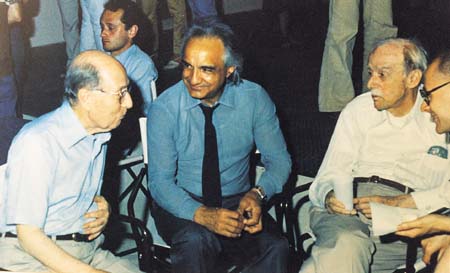
Our greatest endeavour in basic science over the past century has, undoubtedly, been the study of the electromagnetic, strong and weak forces. Although the general theory of relativity was formulated more than 80 years ago, gravitational forces are only now entering the arena of basic scientific research. This is happening because the greatest synthesis of […]
 Read article: Dirac, Einstein and physics
Diodati says he became intrigued by the link between music and physics after thinking about the crescendo in Rossini’s La calunnia è un venticello, an aria from the Barber of Seville. The words in the aria describe an avalanche building up momentum, which eventually reaches the point where it causes an earthquake. “I was initially […]
Using citation data from the Institute for Scientific Information in Philadelphia, Katz has found that there is in fact a power-law or “fractal” relationship between the number of citations and the number of papers. In other words, larger countries publish more papers than smaller countries and receive disproportionately larger numbers of citations. To take this […]
The DAMA collaboration, which is lead by Rita Bernabei of the University of Rome, will present its results at the Fourth International Symposium on Sources and Detection of Dark Matter/Energy in the Universe at Marina del Rel, California, later today. The team’s latest paper, which is available at the Gran Sasso Web site, claims that […]
The MIT team injected small quantities of air into a highly viscous liquid to stimulate the formation of air bubbles. As the bubbles reached the surface, da Silveira and colleagues punctured them with a needle. A high-speed camera recorded the collapse of the bubble. They discovered that the bubble bursts slowly through the hole punctured […]
The number of transistors on a silicon chip has doubled every 18 months, but many observers believe that semiconductor technology will reach its limit in a decade or so. This has prompted the development of new devices, including so-called quantum cellular automata (QCA). So far, however, QCA based on semiconductors have only been operated at […]
One of the biggest challenges in quantum computation is to built “fault tolerant” logic gates. In the mid-1990s it was shown that this requires the time evolution of a quantum sub-system to be controlled by the state of a second sub-system. The evolution of the first system can manifest itself in several ways, including a […]
Mara Prentiss and colleagues at Harvard University in the US mounted two short wires on a sapphire substrate (Phys. Rev. Lett. 84 1124). When electric currents flow in opposite directions through the wires, a magnetic field is generated. An external magnetic field can then be used to cancel this field in the region between the […]
Copyright © 2026 by IOP Publishing Ltd and individual contributors


