Author
Array
(
[0] => linkedin
[1] => facebook
[2] => twitter
[3] => google-plus
[4] => youtube
)
Array
(
[0] => linkedin
[1] => facebook
[2] => twitter
[3] => google-plus
[4] => youtube
)
Array
(
[0] => linkedin
[1] => facebook
[2] => twitter
[3] => google-plus
[4] => youtube
)
Array
(
[0] => linkedin
[1] => facebook
[2] => twitter
[3] => google-plus
[4] => youtube
)
Array
(
[0] => linkedin
[1] => facebook
[2] => twitter
[3] => google-plus
[4] => youtube
)
No Author
Author archive
Antarctica is full of submerged lakes that have been trapped under kilometres of ice for millions of years. The most famous – and largest – of these hidden lakes is Lake Vostok. Price has studied samples taken from 100 metres above the lake’s surface and believes that the nutrients trapped in cracks in the ice […]

The conflict between quantum theory and local realism can be traced back to the work of Schrödinger and Einstein, Podolsky and Rosen in 1935. It remained a philosophical matter until the 1960s when John Bell suggested experiments that could distinguish between quantum theory and local realistic theories. These experiments typically involved creating pairs of photons […]
Overfishing is a worldwide problem and many of the world’s fish stocks are severely depleted. A fundamental question in light of the current state of affairs is whether it is at all possible to manage fishing grounds so that they remain sustainable? If so, how can the sustainability of fish stocks be best achieved and […]
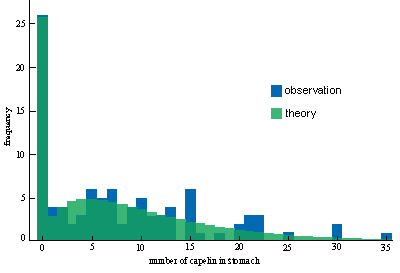 Read article: Can physics save fish stocks?
One of the challenges facing any physics magazine is to adequately cover the activities and interests of physicists working in industry. For a long time Physics World has followed a policy that the best way to do this is to publish articles written by physicists in industry. Just as we prefer articles about the latest […]
The origin of high-temperature superconductivity in cuprate materials is one of the biggest puzzles in physics, explain Bertram Batlogg and Chandra Varma
 Read article: The underdoped phase of cuprate superconductors
White Mars is about a group of men and women who are marooned on Mars at the end of the 21st century. Living in enormous self-perpetuating domes, they produce their own food and oxygen, and extract water from the planet’s core. On this austere Martian world, members of the colony set out to create a […]
The 0.5 nm nanotube was made by boring a hole into a graphite rod. The hole was then filled with cobalt metal powder – which acts as a catalyst – and a mixture of nanotubes and other carbon-based material. A high-voltage electric arc was then applied to the graphite rod generating an carbon plasma from […]
Eskimo Nebula is 5000 light years from Earth and resembles a face inside a furry parka when viewed from ground-based telescopes. Hubble resolved the ‘hood’ into a disk of material containing a ring of comet-shaped objects, with their tails streaming away from the central, dying star. The ‘face’ of the nebula was resolved into an […]
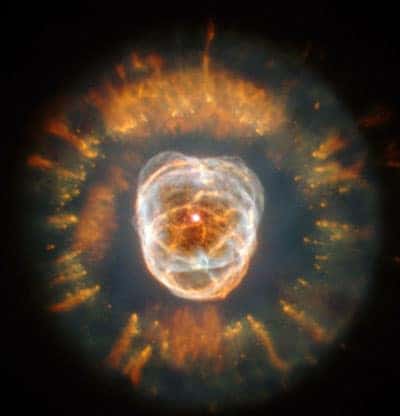 Read article: Hubble back in business
The waveguide structure was created by pouring a mixture of copolymer solution and molecular laser dye into a mould situated on top of a silicon wafer. The solution was allowed to solidify over 12 hours. The mold was imprinted with a set of thin lines by a soft lithography stamp. The sol-gel copolymer used by […]
Copyright © 2026 by IOP Publishing Ltd and individual contributors


