Author
Array
(
[0] => linkedin
[1] => facebook
[2] => twitter
[3] => google-plus
[4] => youtube
)
Array
(
[0] => linkedin
[1] => facebook
[2] => twitter
[3] => google-plus
[4] => youtube
)
Array
(
[0] => linkedin
[1] => facebook
[2] => twitter
[3] => google-plus
[4] => youtube
)
Array
(
[0] => linkedin
[1] => facebook
[2] => twitter
[3] => google-plus
[4] => youtube
)
Array
(
[0] => linkedin
[1] => facebook
[2] => twitter
[3] => google-plus
[4] => youtube
)
No Author
Author archive
There is an old joke about a farmer who has a hen that will not lay eggs. After consulting unsuccessfully with a biologist, and then a chemist, he finally turns to a theoretical physicist. Several days later, the physicist announces that he has solved the problem: “First we assume a spherical chicken…” This story is […]
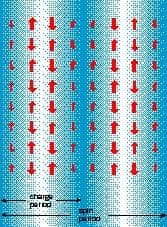 Read article: Superconductor stripes move on
Investment in “knowledge”, which is defined as research and development, software and public spending on education, now accounts for 8% of the OECD’s total gross domestic product (GDP). Expenditure on knowledge is highest in Scandinavia and France (9-10% of GDP), and lowest in Italy and Japan (6-7%). OECD countries also invested an average of 7% […]
Physicists have been attempting to create a vortex in a dilute Bose condensate since these systems were first created in 1995. In principle, atomic condensates are ideal systems in which to study vortices because they can now be created and probed routinely using lasers and microwaves (see Physics World August 1999). However, a direct demonstration […]
Benetton recently signed a two-year partnership with AEA Technology, the UK science and engineering services firm. They believe that AEA’s knowledge of materials will make their cars lighter and faster. Pat Symonds, technical director of Benetton Formula One, says that the deal will “enable us to apply technologies far in advance of anything that we […]
The survey is similar to a study of engineering research being undertaken by the Royal Academy of Engineering and will draw on existing data, assessments from a body of selected international experts, and site visits. The exercise will cover all physics research carried out by or for the research councils in universities, central laboratories and […]
Light is emitted from a quantum cascade laser when an electron falls from an excited energy level in a quantum well to a lower level. The quantum wells are defined by alternating layers of semiconductors with different energy gaps. When an appropriate voltage is applied to the device the electron then tunnels from this lower […]
Like ESA’s recent Hipparcos mission, FAME will use the parallax method to determine the stars’ positions: as the telescope and the Earth orbit the sun, the position of the stars will change slightly. The smaller the change, the further the star is from the Earth. FAME will also look in two directions at once to […]
As the highly energetic particles pass through conventional carbon-rich rocks, they would form carbon-60 molecules in their wake. The fact that these geological detectors have been “collecting data” for millions of years, combined with the stability of carbon-60 molecules, could give this geological approach to particle physics a “winning edge” according to Collar. Another bonus […]
Ultrasound is commonly used to look at the heart, but it is unsuitable for the 10-20% of the population that have breathing difficulties (emphysema) or who are medically obese. In both techniques, patients are given drugs to speed up their hearts and promote vigorous pumping. In a healthy heart both sides of the heart contract […]
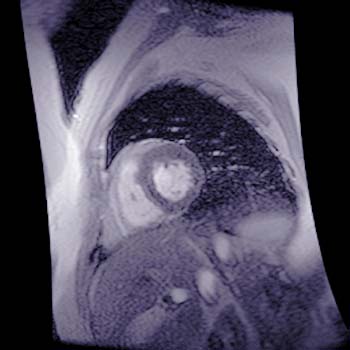 Read article: Magnetic resonance sees the heart beat
The Vienna team sent a collimated beam of carbon-60 molecules through a slit made of silicon nitride and detected the interference pattern by ionizing the molecules with a laser and then counting the ions. The slits in the diffraction grating were 50 nanometres wide and the grating had a period of 100 nanometres. The team […]
Copyright © 2026 by IOP Publishing Ltd and individual contributors


