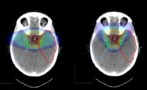
Motion correction enables quantitative PET scans
A data-driven algorithm detects body motion during PET scans and performs motion corrected image reconstruction
Read article: Motion correction enables quantitative PET scans
Thank you for registering with Physics World
If you'd like to change your details at any time, please visit My account
I am an online editor for Physics World. I write and commission news and research articles, in particular for the medical physics and the biophysics and bioengineering sections of the website. I completed a BSc in physics, followed by a PhD in molecular physics, at Leeds University, and then spent a few years working as a postdoc in the university's medical physics department. I joined IOP Publishing in 1999, and in 2008 I became editor of the website medicalphysicsweb - now part of Physics World. Outside of work, I enjoy travelling, as well as singing and dancing in musical theatre productions.

A data-driven algorithm detects body motion during PET scans and performs motion corrected image reconstruction
Read article: Motion correction enables quantitative PET scans
Simulations that run on graphics processing chips enable high-performance cardiac dynamics modelling on personal computers and cell phones
Read article: Desktop computers can now simulate cardiac activity
Compact PET system offers real-time feedback, enabling interactive scanning at the patient's bedside
Read article: Point-of-care PET scanner offers interactive imaging
A round-up of some recent international patent applications in medical imaging
The POP-ART RT study is investigating how adaptive and real-time radiotherapy strategies are being used in clinical practice
Read article: POP-ART RT evaluates prevalence of adaptive and real-time radiotherapy
Polymer dots enable in vivo multiphoton fluorescence imaging of structures deep in the brains of mice
Read article: Polymer dots image deep into the brain
Loss of blood vessels in the retina could provide an early indicator of Alzheimer's disease
Read article: Eye scan can detect signs of Alzheimer’s disease
Electroencephalography can accurately study activity in the deep areas of the brain
Read article: EEG can look deep into the brain
Mechanistic modelling reveals that not all tumour cells are exposed to radiation during radium-223 treatment of bone metastases
Read article: Tumour growth models shed light on radionuclide therapy
A wireless neurostimulator can target a specific brain structure in rats and effectively modulate the animals' behaviour
Read article: Wireless neurostimulator modulates rats’ behaviour