Gas cloud defines extragalactic distance
The team were able to measure the distance because NGC4258 is one of 22 nearby galaxies that have active nuclei consisting of a supermassive black hole (over 100 million solar masses) surrounded by a ...


The team were able to measure the distance because NGC4258 is one of 22 nearby galaxies that have active nuclei consisting of a supermassive black hole (over 100 million solar masses) surrounded by a ...
String theory dates back some 30 years, but it was the “first string revolution” of 1984 that intensified interest in this, the most promising candidate for a “theory of everything&#...
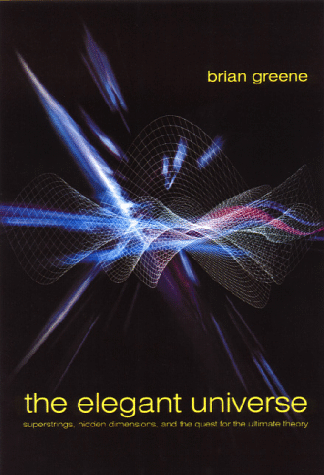 Read article: String theory: simple yet elegant
An eight-year effort to measure the Hubble constant has yielded a result
 Read article: New age of precision cosmology
1. The Elegant Universe: Superstrings, Hidden Dimensions, and the Quest for the Ultimate Theory by Brian Greene A fascinating and thought-provoking journey through the mysteries of space, time, and ma...
The results help to confirm the view that other planetary systems form in ways similar to our solar system. The Kuiper belt is a disk of dust, gas and icy comets stretching from 40 to 10000 times the ...
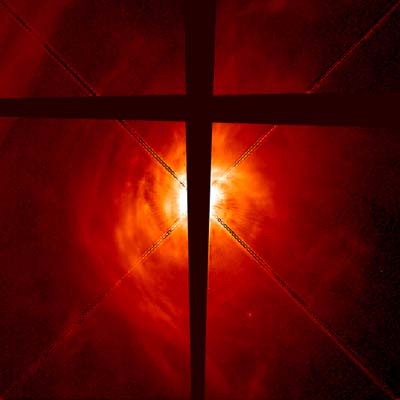 Read article: Hubble finds planetary transition point
The Hubble team, led by Wendy Freedman of the Observatories of the Carnegie Institution of Washington, has spent the last eight years using the telescope to make more accurate measurements of the Hubb...
Wil van Breugel from the Lawrence Livermore Laboratory and colleagues from the University of California, Berkeley and Leiden Observatory in the Netherlands found their galactic nucleus by looking for ...
Galaxies have been forming since the universe was less than 10% of its current age – as supercomputer simulations predict and observations have confirmed
 Read article: How are galaxies made?
ALMA will gather highly red-shifted radiation from the furthest stars and galaxies, and will allow astronomers to observe cool dark objects such as brown dwarfs and interstellar dust clouds. The ALMA ...
Galaxies with extremely large redshifts are hard to detect as the radiation they emit shifts to longer wavelengths that are easily absorbed by giant intergalactic hydrogen clouds. Another problem is t...