‘Lid’ of asteroid dust smothered and burned the dinosaurs, say scientists
Heat and fire may have caused the mass extinction of Cretaceous creatures
 Read article: ‘Lid’ of asteroid dust smothered and burned the dinosaurs, say scientists

Heat and fire may have caused the mass extinction of Cretaceous creatures
Read article: ‘Lid’ of asteroid dust smothered and burned the dinosaurs, say scientists
New models show that high-speed rupture propagation produces stronger and longer-duration ground motion
 Read article: Earthquake fault irregularities control rupture speed and influence ground motion
Discussion and debate at the US National Conference on Earthquake Engineering
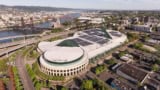 Read article: Physics-based simulations could improve earthquake-damage predictions, why aren’t they being used?
Shift followed the 2011 Tohoku-Oki earthquake and represents a new type of seismic hazard
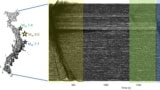 Read article: Seismic waves reflected from Earth’s core moved parts of Japan 5 mm east
Can you reconstruct an image of part of the Mid-Atlantic Ridge in this interactive slide puzzle?
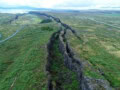 Read article: Identifying maximum viscosity: a slide puzzle
Boundary between materials that flow and those that don’t could shed light on Earth’s early history
Read article: Geophysicist identifies a maximum practical viscosity
Parallel sessions at the American Physical Society’s Global Physics Summit reveal a stark divide
 Read article: The coming hurricane: early-career physicists and the crisis in American science
Field-flipping event 40 million years ago in the Eocene epoch lasted 70,000 years
 Read article: Ancient reversal of Earth’s magnetic field took an extraordinarily long time
Proof-of-principle experiment resolved the shock waves produced by the Shenzhou-15 module when it re-entered the atmosphere
 Read article: Earthquake-sensing network detects space debris as it falls to Earth
Two studies published this week have an unexpected (if tenuous) link to the 20th century’s most famous maritime disaster
 Read article: Saving the Titanic: the science of icebergs and unsinkable ships