Clash of the particle people

Particle physics is a tricky business. Giant accelerators smash subatomic particles together, while fantastically complicated experiments study the debris for clues about the make-up of the universe. Since the middle of the 20th century, accelerators have become bigger and experiments more sensitive. Almost every jump forward produced a new discovery – the most recent being the Higgs boson at CERN’s Large Hadron Collider (LHC). While the story of the science behind these discoveries has been told several times, there is also a lesser-known, but very human, story to tell. These experiments bring together hundreds or even thousands of people from all over the globe, and navigating the inevitable clashes of style, method and personality is a core skill of the modern particle physicist.

Still, in working towards a common scientific goal, all of these little problems must be solved in a calm, rational way, right? Not a chance. Particle physicist Tommaso Dorigo’s book Anomaly!: Collider Physics and the Quest for New Phenomena at Fermilab takes us back to the 1990s, and covers the first 10 years of the US Collider Detector at Fermilab (CDF) experiment, one of two detectors on the Tevatron particle accelerator – the predecessor to the LHC. This was perhaps the beginnings of “modern” particle physics, from new technologies and computing techniques now considered standard, through to the dynamics of new large international collaborations. But unlike many books about particle physics, Dorigo offers a glimpse into the working life of some of the 600-strong team on CDF, and the handful of characters trying to steer the ship – often in different directions.

In the first half of the book, Dorigo shares some classic tales from the construction of CDF, and the early fight for recognition on the international stage. It’s clear that there is more than science at stake here, and Dorigo sets up a moment of real tension as CDF scientists race to publish a result that beats the competition and makes their name. Then, attention turns to the hunt for the top quark, the heaviest particle we know. Discoveries like this may come along only once or twice in a lifetime, so being one of the lead scientists can make a career. The book details how factions formed within CDF, with large groups and larger egos fighting for the glory. Competition with D0, the other experiment at the Tevatron accelerator (and my home for several years), adds to the pressure, and the cracks begin to show. Dorigo is not here to airbrush history – instead, he delights in dishing the dirt on the internal fights that border on industrial espionage: computer scripts that hog resources so other groups cannot work; new ideas being buried under a mountain of questions and requests for cross-checks. This peek behind the curtain at the (mal)functioning of a particle-physics experiment will be surprising to anyone not familiar with the field.

There are some real gems of particle-physics folklore in here. But, like many good ideas in the hunt for the top quark, they are buried under a mountain of unnecessary technical detail, and herein lies the problem I found with this book. The warning signs come early in the “introductory” chapters: the third paragraph in the book is already discussing the vectorial analysis of angular momentum and its quantum analogue. Given that the human stories here provide such great material – and are what make this book unique – I wish Dorigo had focused more on those. Instead, I found myself skipping pages on the interminable meetings, points of procedure, unnecessary technical lingo, and the minutiae of muon triggers and Monte Carlo scale factors. Yes, these details do take up a large part of the daily life of a particle physicist, but if you don’t already know what these things are and how important they can be, I’m not sure this book will give you an appreciation for them.

This is particularly true in the second half, which promises the real controversy (i.e. the really interesting stuff) as it moves from the discovery of the top quark on to the other, more speculative claims that followed. One character, Paolo Giromini, emerges as an agent provocateur in this play, reigniting old fights while refusing to play by the rules. We get a portrait of him dominating the corridors of the CDF offices, ridiculing colleagues, challenging the accepted views while remaining secretive and obstinate in his methods. Is he producing good science or not? It isn’t clear, but with the best theorists in the world putting pressure on the Tevatron experiments to hunt for new particles, Giromini makes claim after claim that he has already found them. The problem is that hardly anyone else at CDF believes him.

At this point, Dorigo himself becomes one of the main actors in the story, and it is clear we are hearing his side of what must have been extremely difficult decisions in how to deal with Giromini’s claims. There is plenty of food for thought here, and given that these events happened 20 years ago, more reflection would have been welcome. Do people like Giromini play a useful role in large collaborations to keep everyone on their toes, or are they just a distraction? When the media catch on to the rumours of a potential discovery, does the prospect of a quick headline interfere with the scientific process?

Given that none of Giromini’s claims have stood the test of time, were his fellow CDF scientists right to be cautious? These are fascinating topics that remain relevant to particle physics and many other areas of science today. But as Dorigo’s narrative remains fixed in the moment, many episodes in the book remain unresolved and the implications unexplored. In the end, this felt like a missed opportunity to tell a fascinating tale of life on the cutting edge of science.

  • 2016 World Scientific Publishing Company 304pp £40pb
Of minds and marches

I didn’t expect so many dogs.

On 22 April I and a few hundred other people spent two hours slowly snaking along the three-mile perimeter road that circles Stony Brook University’s main campus. The event, which took place in intermittent rain, was one of the smallest of more than 600 “science marches” that day. It was nothing like the event on the mall in Washington, DC, which attracted some 50,000 people and eminent speakers, or the tens of thousands who took to the streets in New York City.

I chose the local event because I was ambivalent about the very idea of a “science march” and liked the fact that Stony Brook’s was informal, had no speakers, was not overwhelming and I could bring my dog. Dashiell, it turns out, got along well with the diverse pack of other canines there, many sporting clever signs such as “Dogs fur science” and “Save national labs!”.

Taking sides

My ambivalence reminded me of the reluctance that the German–American philosopher Hannah Arendt had about championing democracy. Arendt (1906–1975) was a Jew who fled Nazi Germany for France in 1933, wound up in a French internment camp, until finally making her way to the US in 1941. In the 1950s she became a writer known for books and essays on the origins of totalitarianism.

In one essay, “The eggs speak up” (1950), Arendt attacked the idea behind the self-justifying Stalinist slogan that the only way to “make an omelette” (get anything done) is to “break some eggs” (commit lesser injustices). But Arendt also wrote critically of ex-communists who championed democracy with the same fervour they’d previously had for communist ideology. “Democratic society as a living reality,” she warned, “is threatened at the very moment that democracy becomes a ‘cause’.”

Causes are things about which one can legitimately “take sides”. As she saw it, there was no alternative to democracy. Democracy, she thought, is what creates the free and open environment needed for genuine political actions – for individuals to act in concert to give birth to new kinds of social forces and institutions. Like the Higgs field that spawns mass, democracy is the environment in which causes can form and be advocated.

Arendt feared that turning democracy itself into a cause might spoil it, fostering an atmosphere of self-righteousness and even zealotry. You begin to evaluate every action not for whether it is good, but for whether it will promote democracy. If a good action might harm that cause, you may entertain the value of “lesser evils”, such as abridging basic freedoms.

Arendt’s remarks captured my own hesitation about the wisdom of marching for science. Science has no alternatives; alternative theories in science are not alternative theories to science. Science is inquiry; an open and imaginative way of exploring the structure and dynamics of the world. The atmosphere in which inquiry thrives is very different from authoritative leaders delivering inspirational speeches to crowds who march from one place to another to show their strength in numbers.

As it happens, on the very day that the science marchers gathered on the mall in Washington, DC, the National Math Festival was being held nearby in the city’s Convention Center. A day-long gala that promoted mathematics and its role in the world, the festival included 80 events with puzzles, music, art, origami, games and geometric sculpture assemblies. A festival that spreads information around in a community-enhancing and entertaining way is, I felt, a better way to promote the open and inquisitive spirit of inquiry than a march.

Yet at one point in “Eggs”, Arendt also observed that making a cause of democracy may be necessary in exceptional times involving “clear and present danger”. That was the other side of my ambivalence. The current US administration’s forthright refusal, I thought, to incorporate scientific findings into critical policy decisions affecting health, environment and energy issues surely counts. The administration is clearly trying to destroy the conditions that underlie inquiry itself, replacing it with certitudes provided by ideology and religion for the benefit of the wealthy and privileged. The rest of us are becoming the broken eggs.

Science, in short, was now cause-like. That’s what made me decide to march.

The critical point

Stony Brook’s event was not the only campus activity that day – there were sports, classes and a concert too. Many signs were bland and generic, some variant of “Support science!” Others were clever – “Remember polio? I don’t. Thanks, science!” – or esoteric, such as the one quoting the French public intellectual Pierre Bourdieu on the value of sociology. Still other signs were about vaccinations, bird-watching and gun violence. I had many unexpected conversations about science and politics, and overheard local gossip, snippets of news and reflections on why we were all doing this.

Nobody was watching our march. That made it feel intensely social, like a theatre performance in which everyone was an actor, spectator and critic all at once. We were consolidating and reinforcing our communal common sense in a way we never could have in a lab, at home or via e-mail. Most demonstrations are designed to get on television, to sway the opinions of nonparticipants. But we were simply celebrating what we did, and it made us feel a part of something larger than ourselves. Here and in hundreds of locations over the globe, the eggs were indeed speaking up.

Creating human organs on chips

Organ on a chip research

 By James Dacey reporting from Boston, Massachusetts

Having left a rain-soaked Bristol on Monday, I was greeted by an even more rain-soaked Boston on Tuesday. Fortunately, I spent my first day in the US under a roof at the Wyss Institute for Biologically Inspired Engineering. I was there to learn about an intriguing technology that reproduces the functionality of human organs on polymer chips about the size of a little finger.

(more…)

Fibre-linked atomic clocks put special relativity to the test

Atomic clocks in France, Germany and the UK have been used to perform the best-ever confirmation of time dilation as set out in Einstein’s special theory of relativity. The clocks have been connected recently by optical-fibre links, which let the devices be compared to each other to an extremely high degree of statistical resolution. The work was done by an international team of physicists that says the test could still be improved further by several orders of magnitude.

The study uses the “Robertson–Mansouri–Sexl” (RMS) framework for violating special relativity. RMS assumes that there is a preferred reference frame in which the average speed of light measured on a return journey (there and back again) between two points is constant in all directions. RMS contradicts special relativity in all other reference frames by assuming that the average speed of light of a return journey varies according to a formula involving the velocities of those frames relative to the preferred frame.

Different directions

As the Earth rotates, different points on its surface have different velocities relative to the centre of the Earth. Points at different longitudes, for example, move in different directions, while points at different latitudes move at different speeds. As a result, sending signals between atomic clocks at two different points on Earth could reveal RMS violation.

The measurement involved optical lattice clocks at LNE-SYRTE in Paris, the PTB standards-lab in Braunschweig and the National Physical Laboratory (NPL) near London. The clocks are connected by two different fibre links – one running from NPL to LNE-SYRTE and the other from PTB to LNE-SYRTE.

The protocol for comparing the frequencies of optical clocks at two different locations can be described as sending a frequency signal from one clock to the other, where it is received and then sent back. In the RMS framework, the shift in frequency of the returned signal will contain a term that involves the difference between the velocities of the atomic clock locations. Because the Earth rotates once a day, the velocities of the two locations – and therefore the RMS frequency shift – will oscillate with a period of 24 h.

Time dilation

In one test, the team compared clocks located at LNE-SYRTE and NPL for 60 h. The researchers also compared clocks at PTB and LNE-SYRTE for 150 h. These comparisons let the team place an upper limit on the RMS violation of special relativity at about one part in 100 million. Specifically, this puts limits on the violation of the special-relativity concept of time dilation, which spells out how the elapsed time between two events can be different when measured by observers in two different situations.

This latest result is a factor of two better than the previous limits on time-dilation violation, which was made using fast moving ions as clocks. Writing in Physical Review Letters the team states: “As clocks improve, and as fibre links are routinely operated, we expect that the tests initiated in this Letter will improve by orders of magnitude in the near future.”

Physics World investigative report bags writing award

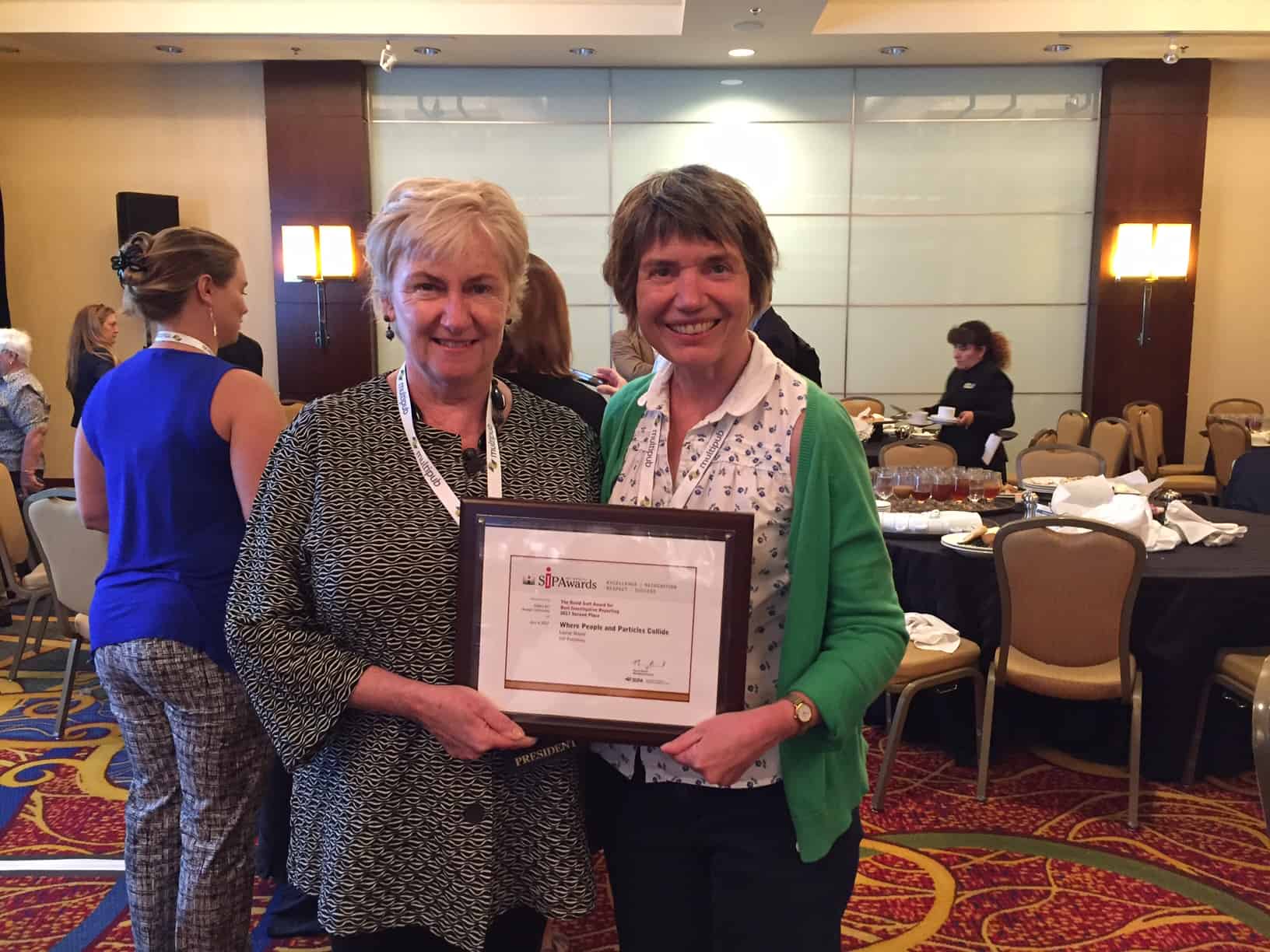
Photo of Susan Curtis from IOP Publishing with Cynthia Carter, president of the Specialised Information Publishers Association (SIPA) picking up a prize on behalf of Louise Mayor for her article "Where people and particles collide"

By Matin Durrani

I am delighted to announce that Physics World features editor Louise Mayor has come second in the David Swit Award for Best Investigative Reporting in the 2017 awards from the Specialized Information Publishers Association (SIPA). Louise was recognized for her feature “Where people and particles collide”, which was published in the March 2016 special issue of Physics World on making physics a more inclusive discipline.

The article examined long-standing attempts by members of the LGBT CERN group at the CERN particle-physics lab near Geneva to become an official “CERN Club” – a request that was denied. It also reported how the group had received some negative reception at CERN, as evidenced by a poster-defacement campaign, photos of which were published in the article.

(more…)

Flash Physics: Quantum cryptography for aircraft, AI boosts X-ray probe, cold nebula born in stellar collision

Cryptic quantum communications for moving aircraft

The potential of using satellites for secure quantum communication has been demonstrated in a proof-of-concept study by researchers in Canada. Thomas Jennewein from the University of Waterloo and colleagues successfully sent quantum key distribution (QKD) transmissions from the ground to a moving aircraft for the first time. QKD uses the laws of quantum mechanics to guarantee complete security when two people exchange a cryptographic key using photons. If the key is read by a third party, this act of measurement will fundamentally change the nature of the key – thereby alerting the two correspondents to the presence of the eavesdropper. On the ground, QKD transmissions can be sent via optical fibres but their range is limited to a few hundred kilometres because of absorption losses. While free space links have been shown to work over ground in both stationary and moving tests, they are also limited to a few hundred kilometres – instead being held back by atmospheric absorption and turbulence, and the need for a clear line of sight. However, these drawbacks could be avoided by using satellites outside the Earth’s atmosphere. Jennewein and team therefore developed a system suitable for a satellite. Restricted to testing the system on Earth, the researchers set up a transmitter on the ground and used a Twin Otter aircraft to fly the receiver over it at angular rates similar to those of low-orbit satellites. They successfully achieved a quantum link for seven of their 14 passes and were able to extract the secret key for six of them. “This is an extremely important step, which took almost eight years of preparation,” explains Jennewein. “We have proved the concept, and our results provide a blueprint for future satellite missions to build upon.” The study can be found in Quantum Science and Technology.

Artificial intelligence boosts X-ray probe

Machine learning has been used to improve how X-ray pulses are used to study molecular dynamics. The new technique was developed by an international team of researchers and tested using data from the Linac Coherent Light Source (LCLS-1) free electron laser (FEL) at SLAC in the US. Trains of X-ray pulses lasting just 10–15 fs are produced at LCLS-1 and can be used to study chemical reactions and changes in molecular structure on very short timescales. However, the processes involved in producing the pulses are inherently unstable, and the intensity and timing of the pulses can vary by as much as 100%. This means that large amounts of measurement data from molecular studies are difficult to interpret and have to be discarded. One way around this problem is to determine the properties of the pulses as they are produced. But this can interfere with the experiment and will become increasingly difficult to do with the shorter pulses that will be produced by next-generation X-ray sources. Now, Alvaro Sanchez-Gonzalez and Jon Marangos of Imperial College London and colleagues have developed a new artificial intelligence-based technique that can accurately predict the properties of the X-ray pulses based on real-time measurements of certain properties of the FEL. Crucially, these measurements can be made fast enough to match the rate at which the X-ray pulses are delivered. “For current instruments, which generate about a hundred pulses per second, sometimes up to a half of the data is unusable,” explains Sanchez-Gonzalez. “This problem will only be compounded in next-generation instruments, such as the European XFEL or LCLS-II, designed to generate hundreds of thousands of pulses per second.” He adds, “Our method effectively resolves the problem, and should work on the new instruments as well as the older ones we tested it on. This will allow useful data to be gathered up to a thousand times faster.” The technique is described in Nature Communications.

Coldest object in the universe born in stellar collision

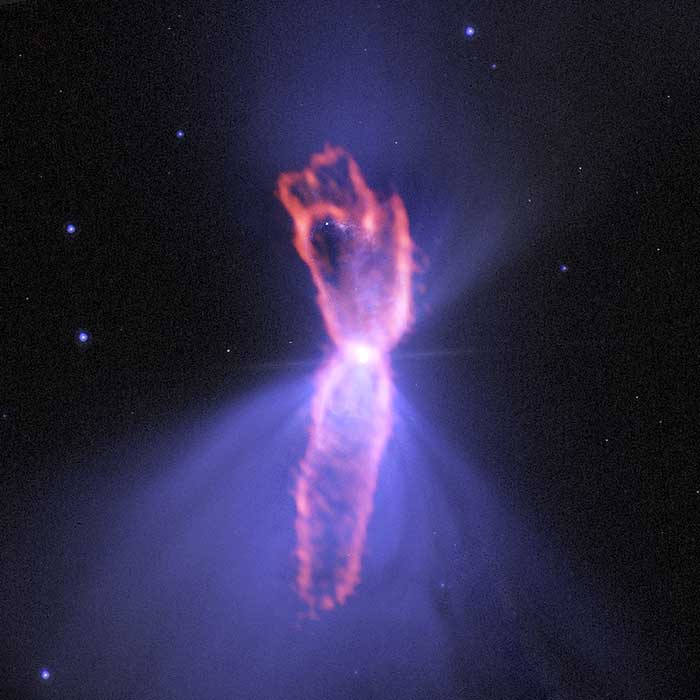
Image of the Boomerang Nebula

Astronomers working on the Atacama Large Millimeter/submillimeter Array (ALMA) in Chile have come up with an explanation of how the Boomerang Nebula – described as the coldest object in the universe – formed. Recent observations with ALMA allowed the team to make precise calculations of the nebula’s extent, age, mass, and kinetic energy. The results suggest that the spectacular outflow of gas and dust was created when a small companion star plunged into the heart of a red giant, ejecting most the matter of the larger star. “These new data show us that most of the stellar envelope from the massive red giant star has been blasted out into space at speeds far beyond the capabilities of a single, red giant star,” said Raghvendra Sahai of NASA’s Jet Propulsion Laboratory. “The only way to eject so much mass and at such extreme speeds is from the gravitational energy of two interacting stars, which would explain the puzzling properties of the ultracold outflow.” Wouter Vlemmings of Chalmers University of Technology in Sweden adds “The extreme properties of the Boomerang challenge the conventional ideas about such interactions and provide us with one of the best opportunities to test the physics of binary systems that contain a giant star.” Discovered in 1995, the nebula is an outflowing of gas and dust that is about 10 times faster than could be produced by a single star. The temperature of the outflow is less than half a degree kelvin. This is much colder than deep space, which is about 2.7 K. The study is reported in the Astrophysical Journal.

Flash Physics: CERN’s high-school interns, more female engineers manage, exoplanet twins are nearly identical

CERN launches high-school internship programme

CERN in Switzerland has hosted 22 high school students from Hungary in a pilot programme designed to show teenagers how science, technology, engineering and mathematics is used at the particle physics lab. The new High-School Students Internship Programme (HSSIP) is being developed by CERN’s Education, Communications & Outreach group and is aimed at students age 16–19. The first group of students was selected by a national committee in Hungary, who chose 22 participants from more than 50 applicants. The students were accompanied by Hungarian mentors and worked on their own projects in particle physics – as well as touring the CERN facilities. “It is wonderful to get out of the classroom where everything is in theory and to see how things are happening in the real world,” says student Balazs Mehes. Another participant, Daniel Nagy, says “I definitely want to come back here one day as an engineer.” Bulgaria and France will be the next countries to participate in HSSIP and will be sending students to CERN in September. France and Norway will also take part in 2017 and the programme will be rolled out to all 22 CERN member states over the next few years.

Is having more female engineers in management always a good thing?

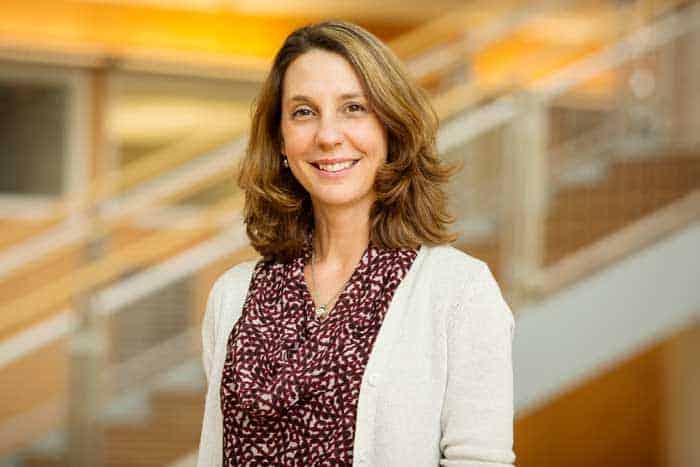
Photograph of Teresa Cardador

While only about 15% of engineers working in the US are women, the number of female engineers in managerial roles is disproportionally larger than their overall representation in the workforce. This might seem like a victory for gender equality, but Teresa Cardador of the University of Illinois at Urbana-Champaign says that this overrepresentation could be creating a segregated workplace in which women tend to perform managerial roles and men technical roles. “There are typically two career paths in engineering organizations – technical or managerial,” explains Cardador. “So you can look at it in two ways: either women are more likely to move into managerial roles in engineering firms, or they’re less likely to stay in technical roles.” Cardador interviewed more than 60 engineers and the results suggest that gender segregation could be caused by engineering firms valuing technical prowess over management skills. “In engineering, technical ability is revered while management is what you do if you have good organizational and communication skills,” she explains. “Women are stereotyped as having less technical competence in engineering, which perhaps explains why men are much more likely to remain on the technical side and women are tracked into the management side,” she said. As well as losing touch with the highly valued technical aspects of their profession, Cardador found that female engineers in management roles also find it more difficult than technical staff to balance work with family responsibilities. “All of these things combined have the potential to increase a woman’s chances of leaving the profession, which may ultimately make the goal of retaining female engineers in engineering firms more tenuous.” The research is described in Organization Science.

Exoplanet “twins” are nearly identical

Schematic demonstrating that WASP-67 b has a cloudier atmosphere than HAT-P-38 b

Two almost identical exoplanets have surprised astronomers by having one unexpected difference – one is cloudier than the other. The gas giants – WASP-67 b and HAT-P-38 b – are nearly the same in size and temperature. They are also both in tight orbits (roughly 4.5 Earth days) around very similar yellow dwarf stars and are both tidally locked – the same side always faces the parent star. Therefore, when studying the two “hot Jupiter” exoplanets with the NASA’s Hubble Space Telescope, Giovanni Bruno from the Space Telescope Science Institute in the US and colleagues expected them to have nearly identical atmospheres. Instead, the chemical spectra of the planets indicated that WASP-67 b had more clouds at the altitudes measured by Hubble’s instruments. “We don’t see what we’re expecting,” says Bruno, “and we need to understand why we find this difference.” Hubble’s Wide Field Camera 3 looked at the spectral signature of water as a measure of the amount of clouds in the atmosphere – as WASP-67 b has more clouds, it had a lower water signal. “This tells us that there had to be something in their past that is changing the way these planets look,” Bruno explains. The team suggests that the planets formed differently and under different circumstances, and future observations with Hubble and the soon-to-be-launched James Webb Space Telescope will help astronomers understand what makes a planet cloudy or clear. The findings were presented at the 230th meeting of the American Astronomical Society in Austin, Texas.

Robust marbles are made of air

“Gas marbles” have been created by encapsulating a bubble of gas within a shell of tiny plastic particles. Developed by Yousra Timounay and colleagues at the Université Paris-Est (UPE) in France, the beads of gas could be used for isolating toxic gases or stabilizing foams.

The work by Timounay and team takes inspiration from “liquid marbles”, which were developed in 2001 by Pascale Aussillous and Davide Quéré from the Collège de France. Aussillous and Quéré had added hydrophobic powder to water droplets, thereby spontaneously creating balls of liquid securely held within water-repellent shells. The surface tension and incompressibility of the liquid allows the marbles to maintain their shape, and they can bounce and roll across surfaces without leaking.

Like soap bubbles

Now, the UPE researchers have created the gas version with a method similar to making bubbles with a soap solution and wire hoop. They carefully spread polystyrene microspheres over the surface of an organic compound solution (sodium dodecyl sulphate), where the spheres then floated in a closely packed formation. The team then submerged a rectangular wire frame (with sides roughly 1 cm long) in the solution.

Gently lifting the frame out creates a film of microspheres, just like on a wand for blowing soap bubbles. When the lift-out reaches a certain point, the film folds in on itself and detaches to form a gas marble that drops back into the liquid, automatically moving to the edge of the liquid’s surface. The marble – typically 5 mm in diameter – can then simply be scooped out. The researchers found that using larger microspheres (diameter 560 µm) and larger wire frames made it easier to create the marbles. “The full mechanism of gas-marble creation is not fully understood for the moment, but their creation is reproducible,” says team member Florence Rouyer.

Robust rollers

The resulting marble, presented in Physical Review Letters, consists of atmospheric gas constrained within a shell of closely packed wet microspheres. The spheres are stuck to their neighbours by the surface tension of a liquid meniscus. This microsphere-liquid “skin” is particularly strong – so much so that the team was able to alter the internal pressure using a syringe that could puncture the shell but not rupture it. The marble could then withstand a 10-fold pressure increase or decrease while maintaining a spherical shape with no volume change, before bursting or collapsing. “The structures are robust enough to hold and roll in your hand,” Rouyer says, “as long as your hands are clean, and you don’t press too hard.” Upon breaking up, the microspheres can be reused to make more marbles.

Timounay, who is now at Syracuse University in the US, and colleagues envisage that the gas marbles could have applications in stabilizing foams and emulsions. While they could also be used to store gases, their usefulness will depend on how easily said gas diffuses through the skin and whether the shells fall apart when the liquid evaporates.

Flash Physics: Supernova kicks black-hole spin, neutron-star probe launches, award-winning planetary scientists

Did supernova kick cause LIGO black-hole spin misalignment?

A huge kick from a supernova could have knocked the spin of one of the black holes that created GW151226 out of alignment – according to calculations done by Richard O’Shaughnessy, Daniel Wysocki of the Rochester Institute of Technology and Davide Gerosa of Caltech. GW151226 is a gravitational wave signal from two merging black holes that was detected in December 2015 by the LIGO observatory. Astronomers believe that two black holes weighing in at 14 and 8 solar masses merged to form a single, spinning 21-solar-mass black hole, some 1.4 billion light-years away from Earth. Careful analysis of the signal from the merger suggest that the spin of the larger black hole may not have been aligned with the orbital angular momentum of the binary – which could provide important information about how the system formed.

One possibility is that the two black holes formed independently and then joined together with their spins misaligned with respect to orbital angular momentum. The other possibility is that the pair started out as a binary star with aligned spins, but then one of the spins became misaligned by “natal kicks” delivered when the stars exploded as supernovae. O’Shaughnessy, Wysocki and Gerosa looked at the second possibility and conclude that misalignment could have occurred when the larger of the two stars in the binary exploded. Writing in a preprint on arXiv (which will be published in Physical Review Letters), the team cautions that the misalignment would require a “natal kick” that is much larger than predicted by current supernova theory. O’Shaughnessy adds: “That’s an exciting challenge for models of how massive stars explode and collapse”. Gerosa says: “Our study corroborates years of tentative but suggestive evidence that black holes might have received these kicks.

NASA launches neutron-star probe

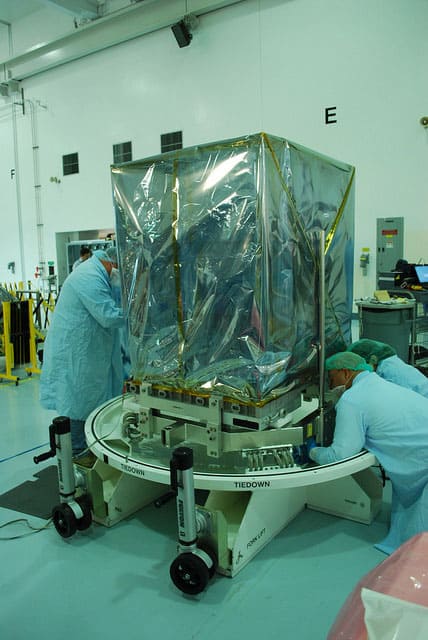
Photograph of the NICER probe

NASA has launched the first-ever mission devoted to studying neutron stars. Launched on a SpaceX Falcon 9 rocket on 3 June from the Kennedy Space Center, the Neutron star Interior Composition Explorer (NICER) will use 56 telescopes to observe X-rays in the range of 0.2–12 keV that have been generated by the stars’ strong magnetic fields.

The probe will be installed on the International Space Station where it will operate for 18 months. NICER will also demonstrate – for the first time – the possibility of using pulsars as a “celestial clock” to test the viability of autonomous X-ray navigation. The launch of the craft comes 50 years after the British astrophysicist Jocelyn Bell Burnell discovered rapidly spinning neutron stars, known as pulsars.

Award-winning planetary scientists announced

Portrait of Margaret Kivelson painted by Pamela Davis Kivelson

Six scientists have been honoured for their contributions to planetary research and communication by the Division for Planetary Sciences (DPS) of the American Astronomical Society (AAS). The awards will be presented at the 49th Annual Meeting of the DPS in October. “Announcing these prizes is the highlight of the spring planetary sciences calendar,” says DPS Chair Lucy McFadden. Margaret Kivelson of the University of California, Los Angeles will be given the Gerard P Kuiper Prize for outstanding contributions to planetary science. Her work on Jupiter and its moons has led scientists to recognize that ocean worlds in the outer solar system may represent our best chances for discovering life beyond Earth.

The Harold C Urey Prize for an early-career scientist will go to Bethany Ehlmann from the California Institute of Technology, for her work studying the mineralogy of Mars. Louise Prockter from the Lunar and Planetary Institute (LPI) in Houston, Texas will receive the Harold Masursky Award, which recognizes outstanding service. Prockter is the first female director of the LPI and has served on National Research Council boards and NASA committees. Megan Schwamb of the Gemini Observatory and Henry Throop from the Planetary Science Institute will each be awarded the Carl Sagan Medal for their public communication efforts. Among their contributions, Schwamb created the Astrotweeps project, whereby different astronomers take control of a Twitter account each week, while Throop presents to students and teachers all over the world. The Jonathan Eberhart Planetary Sciences Journalism Award, which recognizes distinguished popular writing, will go to Joshua Sokol from Boston for his August 2016 article in New Scientist entitled “Hidden depths”.

Monuments to peer review and Canada, Marie Curie as superhero, a 3D book about Einstein

By Michael Banks and Hamish Johnston

You may remember a campaign to create a monument dedicated to those hard-working people who peer-review research papers. Last year, sociologist Igor Chirikov, from the National Research University Higher School of Economics in Moscow, raised $2521 on Kickstarter to turn an “ugly” block of concrete outside the university’s Institute of Education into a monument that reads “accept”, “minor changes”, “major changes”, “revise and resubmit” and “reject” on its five visible sides. Well, after months of toil that monument has now been unveiled by Chirikov in a ceremony at the institution that was attended by over 100 supporters. Most understand the sarcastic nature of the monument and love it,” says Chirikov. “Many also wonder what’s on the bottom side of the monument.” Chirikov is thinking of hanging a small mirror on a nearby tree so that everyone can see “Accept” on the top of the cube.

Still on fundraising, the Marie Curie Alumni Association is launching an illustrated book series for young children called My Super Science Heroes. The first one – Marie Curie and the Power of Persistence – aims to introduce children to Curie and her key accomplishments in a “fun and engaging way”. To get the project off the ground, the association has taken to Indiegogo to raise €15,000. Each scientist in the series will have a certain “superpower”, which in the case of Curie is her persistence. “Unlike being bitten by a radioactive spider, scientific achievement is a realistic goal, and celebrating these real-life heroes will encourage kids to explore the many possibilities a [science, technology, engineering and mathematics] programme offers,” the association writes. There is a month still to go if you want to donate. If the project raises the cash then the book is expected to be released by mid-October.

While that book will most likely be printed in the usual way, how about getting your hands on the world’s first 3D-printed book? Well, soon you can thanks to a project kickstarted last year by the Israeli-born designer Ron Arad. The book Genius: 100 Visions of the Future – will contain articles by 100 leading lights including Microsoft co-founder Paul Allen and the Nobel laureates Steven Chu and the late Harry Kroto. It is part of the Einstein Legacy project that celebrates 100 years since the publication of Albert Einstein’s theory of general relativity. The book is set to be unveiled at an event in Montreal, Canada on 9 September.

Tiny Canadian flag

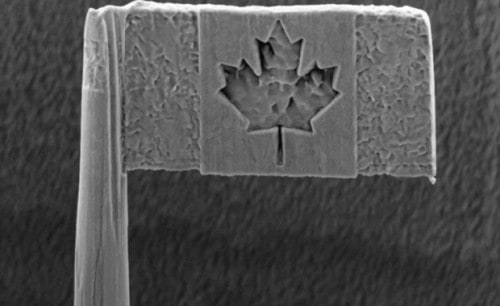
Speaking of Canada, the country is celebrating its 150th anniversary this year. In honour of the sesquicentennial, Travis Casagrande at McMaster University in Hamilton, Ontario has made what just might be the smallest Canadian flag ever – measuring just one-hundredth the width of a human hair. He used a focused ion beam microscope to etch the 3D flag – complete with a flagpole – into a penny. You can read more about the tiny sculpture on the CBC website.

Copyright © 2026 by IOP Publishing Ltd and individual contributors