Errant Science is a blog about being a scientist and working in academia today. Posts cover a range of topics such as “how to plan your science conference schedule”, “a cynic’s guide to academic papers” and even “how to fund your research after #Brexit: a flow diagram”. As the blog’s author Matthew Partridge puts it, the site is about “life as a university researcher [and is] a strange mixture of sarcasm, cynicism and giddy enthusiasm for science”. Partridge is also a skilled cartoonist and illustrator and most posts involve a graphic of some sort. A particularly commendable feature of the site is that it does not suffer from the irregularity that so many other blogs succumb to – it has a new post every week.
Who is behind it?
Partridge, a postdoc at Cranfield University, UK, has been writing Errant Science alone since 2012. Based at Cranfield’s Department of Engineering Photonics, Partridge began blogging when he set up a departmental website (openoptics.info). Looking for a more suitable space to talk about the wider aspects of academia, he created Errant Science. In March a sister blog named Errant Science Clutter was launched as a space for regular guest contributors, run by Michelle Reeve from the Royal Veterinary College, London. “The whole idea is to show that science doesn’t have to be stiff and serious, it can also be self-deprecating.”
What are some of the topics covered?
Pretty much anything that can come up in the life of an academic in the 21st century. There is a definite trend towards “how to” posts that cover everything from writing papers and theses to coding and big data, as well as presenting data and conference talks. Infographics and comics are included in most posts, as are flow diagrams to help you navigate issues such as “what to do when your experiment goes wrong”.
Who is it aimed at?
Absolutely anyone with an interest in academic life – whether you are a student, early-career researcher or established scientist, Errant Science will either help you or make you laugh. For anyone not in science, the blog is a great peephole into the complex and occasionally perplexing world of academia.
Can you give me a sample quote?
From a post published in March titled “How to get any work done while working from home with kids”: “Without colleagues and coffee breaks to distract me I generally found working from home more productive. I’d set myself a list of things to do and be finished by 10:30, leaving me with the moral dilemma: do I work the same number of hours or do the same amount of work?…But that was back when I had a quiet house. Things are different now – I have two noisy children, neither of whom understand the difference between daddy who can play and daddy who’s drafting a paper. Also the surly cat has got a lot more needy in his old age and insists on being anywhere that will either stop me using the keyboard or the mouse, preferably involving sleeping on one or the other.”
New insights into a popular and potentially useful model of how electrons behave in solids have been provided by an experiment involving ultracold atoms. Markus Greiner and colleagues at Harvard University in the US studied the behaviour of lithium-6 atoms that are held in an optical lattice and interact according to rules set out by the Fermi-Hubbard model.
They found that the system becomes magnetic at low temperatures – and that the magnetism disappears when the density of atoms is reduced. The team can now use its atomic simulator to explore regimes of the Fermi-Hubbard model that could harbour very interesting physics including high-temperature superconductivity.
The electronic properties of solid materials arise from quantum-mechanical interactions between large numbers of electrons. It is notoriously difficult to calculate these properties, so physicists rely on simple models to simplify the mathematics – but even models have significant computational challenges. One such scheme is the Fermi-Hubbard model, which represents electrons as Fermi–Dirac particles (fermions) that hop between fixed sites on a lattice and only interact with each other when they occupy the same lattice site.
Dimensional difficulties
Despite its simplicity, the quantum nature of fermions means that meaningful calculations are only possible for 1D chains of lattice sites. Even calculations on 2D lattices – which could by very useful for understanding high-temperature superconductors – have proven extraordinarily difficult to achieve.
One possible way around this problem is to use a physical system of real particles to simulate the Fermi-Hubbard model – effectively doing an experiment to mimic a model that describes another physical system. Greiner and colleagues have used an ensemble of lithium-6 atoms, which are fermions and therefore obey the same quantum-mechanical rules as electrons. The team created their simulation by criss-crossing laser beams to make a square lattice of potential wells, each of which can hold an atom.
While this approach is not new, it had previously been very difficult to reduce the temperature of the atoms such that they behaved like electrons in a solid. Although previous attempts had chilled the atoms to just a tiny fraction of a kelvin, their thermal motions were on par with electrons in a solid heated about 1000 K. This is much hotter than the 100–200 K below which high-temperature superconductivity occurs, and is also too hot for the emergence of magnetism.
Under the microscope
Greiner and colleagues overcame the temperature problem by surrounding the optical lattice with a sea of atoms that act as a coolant. They also used an optical system dubbed a “fermionic microscope” to monitor individual lattice sites.
The team found that when the lattice was full – or nearly full – of atoms, the system behaved as an antiferromagnetic insulator. According to Thierry Giamarchi of the University of Geneva in Switzerland, who was not involved in the experiment, it is the first time that a system has been cooled sufficiently to create a magnetic state with long-range order. As the number of atoms is decreased, the magnetic state is seen to disappear.
It is in this low-density regime that a state resembling a high-temperature d-wave superconductor is expected to exist – albeit at a lower temperature than is currently accessible to Greiner’s team. Writing in Nature, the team points out that it should be possible to further cool the atoms to reach the superconducting state.
Female academics do significantly more internal administrative work than their male counterparts, according to an analysis of surveys performed at US institutions. Carried out by researchers at the University of California, Riverside, and Indiana University, the study found that the gender imbalance is highest in science, technology, engineering and mathematics (STEM) fields. While such internal work is vital for the day-to-day running of institutions, it is less valuable for promotions and salary increases than research and teaching, possibly hindering female career progression.
In one survey, which included 6875 tenure and tenure-track faculty at 140 US institutions, female academics reported spending, on average, 0.6 hours more per week than males on admin. The researchers also looked at 2012 data from a mandatory performance reporting system at two campuses belonging to a large public university. Covering 1378 faculty, it showed that women perform 12.4 admin activities per year, while men do just 10.9. In STEM subjects, women reported performing three more admin activities per year than men, compared with 2.5 for liberal arts and 0.3 for social sciences.
Internal imbalance
The researchers found that the imbalance was driven by internal admin – i.e. work related to the running of departments, schools or universities. Men perform an average of 6.1 internal-admin activities per year, while women do 7.3. There was, however, no significant gender difference in “external” admin work – performed for national or international communities.
Cassandra Guarino, professor of education and public policy from the University of California, Riverside, who led the work, told Physics World that women might be doing more internal-admin work because they are less likely to say no and are being asked more often.
Institutional norms
“Research shows that in negotiations women have more difficulty being assertive and they are more penalized for doing so,” says Guarino, adding that individuals can find it hard to gauge how much of such work is normal. “To me, this is the solution to the problem: making it more transparent so that everyone can see what everybody is doing every year,” she says. “It should be required of department chairs to monitor it, to make sure it doesn’t become unbalanced.”
Patricia Rankin, chair of the American Physical Society’s committee on the status of women in physics, explains that if institutions consider it is up to the individual to deal with this on their own, the problem will persist. “If institutions want to retain their women faculty, they can help by setting norms,” says Rankin. “You only have so much time – if you do more [admin] work there is less time for research. Unless the [work] is valued equally to research, this will slow women down in their career progression.”
Tiny particles of silver could boost the performance of tomorrow’s optical computers. That is the claim of Tim Liedl and colleagues at Ludwig-Maximilians-Universitaet in Munich and Alexander Govorov and team at Ohio University, who have shown that the addition of silver nanoparticles to a chain of gold nanoparticles makes the chain much more efficient at conducting plasmons. Computers could be much faster and more energy efficient in the future if they used light to transmit and process information, rather than the electrical signals used today. However, the light that is most efficient at transmitting data over optical fibres has a wavelength greater than 1 μm, which is huge compared to the current size of computer circuits. One way of creating tiny optical circuits is to “shrink” the wavelength of the light by converting it into a plasmon – an oscillation in the conduction electrons of a metal that occurs when the material interacts with light. Once converted to plasmons, data within an optical signal could be processed in high-density chips. Plasmons can be conducted through a circuit using a chain of tiny gold particles, with diameters measuring just tens of nanometres. One problem, however, is that plasmon transmission in gold results in the generation of a significant amount of heat – making such conductors no more efficient than those found in conventional computer circuits. Liedl, Govorov and colleagues have shown that putting a silver nanoparticle (diameter 30 nm) between two gold nanoparticles (diameters 40 nm) results in plasmons being conducted along the chain with almost no energy lost to heat. The research is described in Nature Physics.
Solar-system-like debris spotted around young star
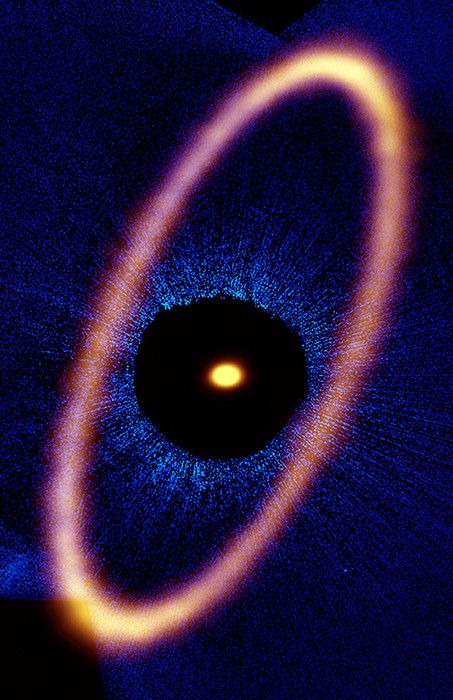
Ring of ice: chaotic destruction surrounds Fomalhaut. Composite image of the Fomalhaut star system – ALMA data (orange) shows the distinct ring, the central dot is the star and the optical data (blue) comes from the Hubble Space Telescope. The dark region is the coronographic mask filtering the star’s light. (Courtesy: ALMA (ESO / NAOJ / NRAO), M MacGregor; NASA / ESA Hubble, P Kalas; B Saxton (NRAO / AUI / NSF))
An icy debris ring surrounding a neighbouring planetary system has a chemical kinship with solar-system comets. An international team reached this conclusion after making the first complete image of the rubble ring using the Atacama Large Millimeter/submilimeter Array (ALMA) in Chile. The planetary system is 25 light-years from Earth and a tenth the age of the solar system. Orbiting Fomalhaut – a young star with twice the mass of the Sun – the system contains one of only 20 planets that scientists have imaged directly. Debris rings are common features for young stars and are thought to be caused by collisions between comets and planetesimals during the system’s chaotic early life. Light from Fomalhaut is absorbed by the rubble and re-emitted as radio waves before being captured by ALMA. The new image shows Fomalhaut’s ring in full, revealing an elongated band of icy dust. “We can finally see the well-defined shape of the disc, which may tell us a great deal about the underlying planetary system responsible for its highly distinctive appearance,” says Meredith MacGregor of the Harvard-Smithsonian Center for Astrophysics in the US. The researchers estimate the band is about two billion km wide and around 20 billion km from Fomalhaut. They also found that the ring’s relative abundance of carbon monoxide and carbon dioxide resembles comets found in the solar system. This suggests the system is going through its own Late Heavy Bombardment – a period four billion years ago when the solar-system planets were frequently struck by asteroids and comets left over from the system’s formation. Two papers presenting the work have been accepted for publication in The Astrophysical Journal.
Former US energy secretary joins fusion power firm
Directing fusion: Former US energy secretary Ernest Moniz has joined Tri Alpha Energy. (Courtesy: MIT Energy Initiative)
The nuclear physicist and former head of the US Department of Energy (DOE) Ernest Moniz has joined the board of directors of Tri Alpha Energy. Based in Foothill Ranch, California, the privately held company is trying to develop an “aneutronic” fusion power system that is based on nuclear-fusion reactions that do not produce large amounts of neutrons. If it can be made to produce energy on a commercial scale, the company’s ion-beam-based system would not have to contend with the damaging neutron radiation that would be generated in other fusion power schemes. Moniz served as US energy secretary under Barack Obama in 2013–2017 and is currently an emeritus professor of physics and engineering at the Massachusetts Institute of Technology.
Having a particle or even a whole class of particles named after you is one of the great legacies in physics. Those who share this rare honour include Enrico Fermi, Satyendra Nath Bose and Peter Higgs. But have you ever heard of the British physicist Tony Skyrme? In the early 1960s Skyrme developed a theoretical model describing forces in atomic nuclei. Within his theory, topological solitons emerge as particle-like solutions of nonlinear field equations, which five years before Skyrme’s death in 1987 became known as skyrmions.
Recently, one variety of skyrmion, the magnetic skyrmion, has emerged as a hot topic in physics. This is partly due to its topological properties, which result in a rich variety of magnetic phenomena, and partly from its potential as a “bit” in future data-storage devices. Rather than being a fundamental particle, such as an electron, magnetic skyrmions are quasiparticles, which can emerge as a collective phenomenon in magnetic materials with broken inversion symmetry. Like real particles, such as atoms, they are localized, can move around, interact with each other, form lattices and have antiparticles. However, skyrmions are confined to the magnetic material as their carrier and have no existence outside it.
1 Magnetic knots
(Courtesy: Kirsten von Bergmann and André Kubetzka)
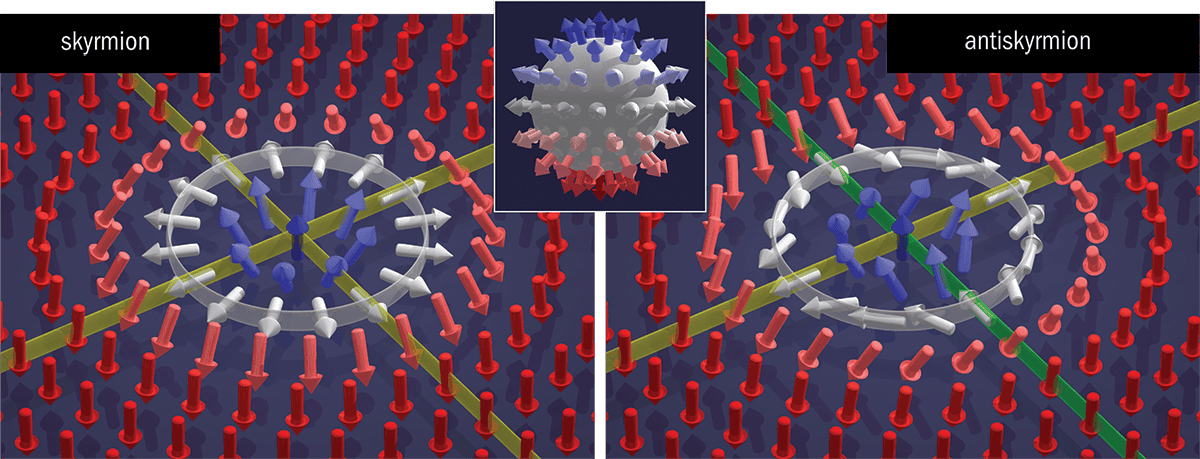
Sketch of a skyrmion and an antiskyrmion. Each arrow represents the local magnetization direction, which varies from upwards (blue) in the centre through horizontal (white) to downwards (red) in the surroundings. While these two quasi-particles are topologically distinct, they both wrap a unit sphere exactly once (see inset). If you follow the arrows indicated by the white circles, they rotate in different directions, which means their topological indices have the opposite sign: +1 for skyrmions and –1 for antiskyrmions.
In a magnetic material, the atomic magnetic moments are coupled with each other and so produce a vector field of magnetization that is almost continuous. In a ferromagnet, for example, all magnetic moments point in the same direction. In a particle-like skyrmion, however, the magnetic moments in its centre point in the opposite direction to those of its ferromagnetic surrounding (figure 1). These magnetic configurations are characterized by a quasi-continuous rotation of the direction of the atoms’ magnetic moments relative to their neighbours. In fact, there are two basic types: the skyrmion and the antiskyrmion. The difference between them is the way they locally twist: skyrmions have rotational symmetry, whereas antiskyrmions have a two-fold rotation axis, i.e. they look the same only when rotated by 180°. The shape of such skyrmions and antiskyrmions is very robust and in some sense they behave like particles, living in a sea of parallel magnetic moments pointing opposite to the one in the centre.
Skyrmions and antiskyrmions, which are like knots in the magnetization, are classified by their topological index. Annihilating a knot turns out to be easy when using a knot with opposite topological properties
Skyrmions and antiskyrmions, which are like knots in the magnetization, are classified by their topological index, which can be viewed as the number of windings around a unit sphere. Unwinding such a single knot would be impossible, if, in an imaginary world, magnetic materials were continuous rather than being composed of atoms. However, annihilating a knot turns out to be easy when using a knot with opposite topological properties. A skyrmion and an antiskyrmion, if brought together, can smoothly unwind to form the topologically trivial ferromagnetic state, similar to the situation in particle physics where electrons and positrons annihilate when brought together.
Keeping stable
In the real world, topology alone cannot stop skyrmions or antiskyrmions from collapsing to the ferromagnetic state. Instead, their stability depends on an energy barrier related to the so-called Dzyaloshinskii–Moriya interaction (DMI), a phenomenon that occurs due to spin–orbit coupling (the interaction of spins with their motions). The DMI stabilizes skyrmions and stops them collapsing, but usually it does not contribute to the energy of an antiskyrmion, which causes the latter to be unstable.
The DMI in general favours adjacent magnetic moments having a twist between them, rather than them being parallel, but importantly it also selects a material-specific rotational sense. Analysing the two magnetic objects in figure 1 demonstrates that the rotation direction is coherent across a skyrmion, but within the antiskyrmion it is changing: following the indicated yellow lines from left to right, the rotation is clockwise, whereas for the perpendicular green line across the antiskyrmion, the rotation is anticlockwise. Let’s consider a case where the DMI favours a clockwise rotation of the magnetization. Speaking in terms of energy, the antiskyrmion gains DMI energy in one direction and pays the same energy penalty perpendicular to it. In contrast, the skyrmion gains DMI energy in every direction, making it the energetically more favourable state.
The DMI is able to impose a unique rotational sense but is itself subject to selection rules: it may only occur in systems that lack inversion symmetry; in all other systems the effective DMI vanishes. Typical skyrmion materials are thus either those with chiral crystal structures, or magnetic films, which lack inversion symmetry due to the presence of a surface or interface.
Harnessing skyrmions
The current interest in skyrmions is fuelled by their promise for future information technology. Their potential to be harnessed in this way is down to their magnetic twist, which interacts strongly with electrical currents. Electrons traversing through such spin “textures” can transfer their spin to atomic magnetic moments and thus induce a torque, resulting in a movement of the spin texture through the material. Pure spin currents generated in an adjacent material can also trigger a motion, which is then sensitive to the magnetization rotation direction, i.e. clockwise rotating skyrmions move in one direction and anticlockwise twisting states in the other.
2 Under the microscope
(Courtesy: Kirsten von Bergmann and André Kubetzka)
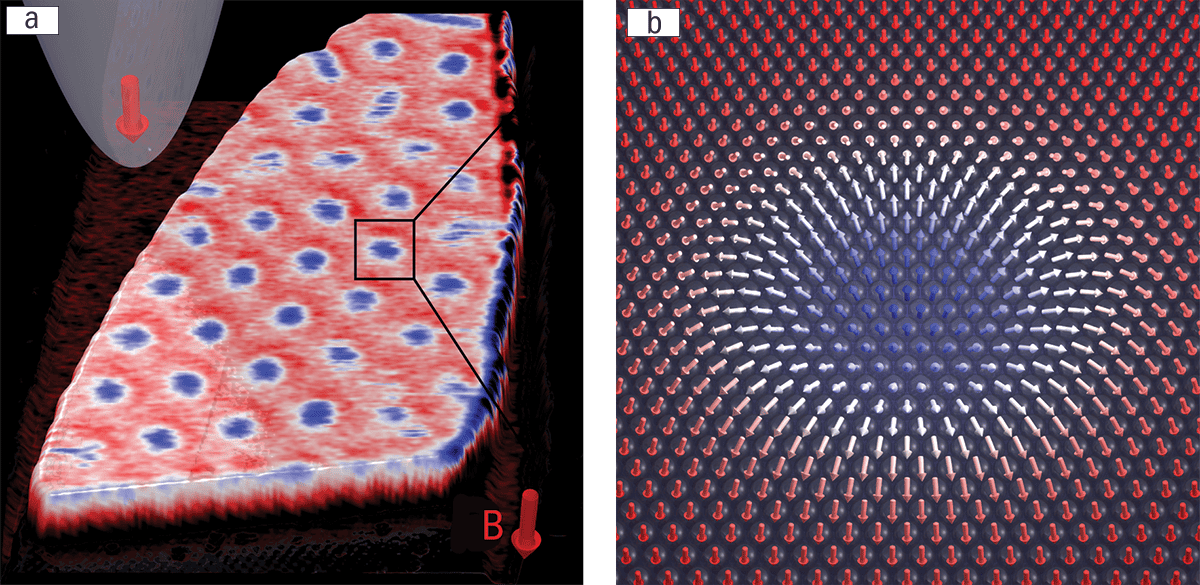
(a) This spin-resolved scanning tunnelling microscopy measurement shows skyrmions in an ultrathin magnetic film made of palladium and iron atoms on a highly ordered iridium surface in a magnetic field, B, of 1.1 T, at a temperature of 8 K. Colours have the same meaning as in figure 1. (b) The precise orientations of the atomic magnetic moments that form the indicated tiny magnetic knot were derived from such a measurement.
The experimentally realized sizes of skyrmions range from the micron- down to the nanometre-scale, eventually comprising barely a few dozen atoms. An example of particularly small skyrmions is those that can form in a bi-atomic layer of palladium and iron on a highly ordered iridium single-crystal surface (figure 2a). Due to the magnetization of the probe tip, the tunnel current is sensitive to the magnetization of the sample, and in this case a magnetization parallel to the tip magnetization is coloured red, whereas the opposite magnetization component is blue. The diameter of a skyrmion (the distance between opposite in-plane spins) depends on the magnetic interaction parameters and the external magnetic field and for those displayed is about 3.5 nm, which corresponds to about 13 atomic distances. Figure 2b shows the atomically precise sketch of the spin structure, which was derived from the experiment.
As for how magnetic particle-like states could be used in information technology, in 2008 IBM fellow Stuart Parkin and colleagues proposed that magnetic domain walls could be used as information carriers (Science320 190). This idea was extended to magnetic skyrmions in 2013 by Albert Fert and colleagues at the Université Paris-Sud (Nature Nanotechnology8 152). The presence of a skyrmion at a specific position could mean a “1” and the absence a “0”.
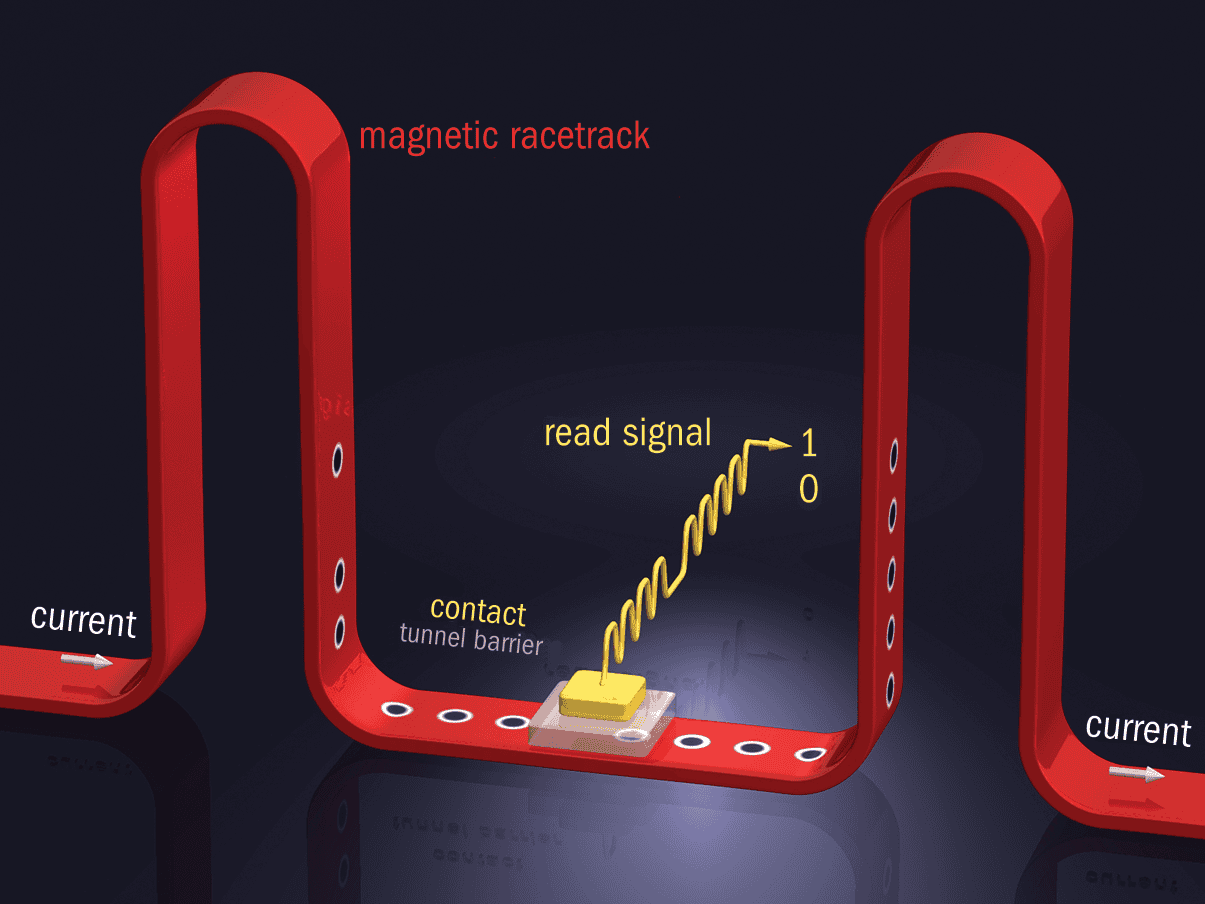
In this so-called “racetrack memory”, magnetic domain walls, or alternatively skyrmions, are moved through a magnetic material by electrical currents (figure 3). In contrast to a conventional computer hard disk where the recording medium is moved mechanically with respect to the read/write heads, in racetrack memory the magnetic bits move along the racetrack, but the racetrack itself (as well as the read/write elements) remains stationary. Lacking any moving mechanical parts, such a device is extremely shock-resistant and therefore also ideal for mobile applications. In addition, the racetrack concept can be a 3D information storage medium, whereas hard drives are 2D. This memory concept, in combination with small skyrmion sizes, has the potential to boost the storage density of data.
Several challenges need to be tackled, however, before skyrmions can be used in racetrack memory for everyday applications. Ordered skyrmion lattices in chiral magnetic bulk crystals can be moved smoothly by electrical currents, but for technology, independent magnetic skyrmions are crucial for the representation of a bit. Such individual magnetic skyrmions are found in magnetic thin-film skyrmion materials, which are compatible with current magnetic multilayer device technology. However, in many of these materials the skyrmions get stuck or “pinned” at defects such as grain boundaries or imperfections, which is a problem. Also, the skyrmions that are stable at room temperature are still one or more orders of magnitude larger than the small isolated nanoscale skyrmions, such as those in figure 2, that have been observed at low temperatures.
3 Memory of the future
(Courtesy: Kirsten von Bergmann and André Kubetzka)
A skyrmion-based racetrack memory would involve equidistant “bits”, where the presence of a skyrmion indicates a “1” and the absence of a skyrmion indicates a “0”. These bits would be moved along a magnetic track (red), using electrical currents, and they would pass a stationary read/write element. The element depicted here consists of a contact (yellow) that is separated from the track by a tunnel barrier (transparent).
Towards skyrmion devices
Size does matter. Bits need to be small, but the tinier they get the harder it is to do reading and controlled writing. However, it has been shown in scanning tunnelling microscope experiments that it is possible to write nanoscale skyrmions reliably using electric-field-driven switching. This proof-of-principle experiment exploits the electric field between the probe tip and the sample. An electric-field-driven mechanism is also compatible with the racetrack memory concept by using a metallic contact, separated from the magnetic track by a tunnelling barrier. This could serve as a combined element that both reads and writes the information, as in figure 3.
In principle, every operation needed for a racetrack memory based on magnetic skyrmions – the all-electrical movement, and the reading and writing of the information – has been demonstrated. However, the individual tasks were realized in different materials, for different length scales of skyrmions, and in different temperature and magnetic-field regimes. The challenge now remains to unify all of these operations into a single prototype device.
“What I wanted to write was something about the universe and our place in it: from the Big Bang, through our insignificance in the vastness of it all, our need for exploration and where space travel will take us, to the nature of light or the make-up of electrons, and finally ideas about multiverses and infinity.”
That is the motivation behind the “secular oratorio” Space Time Matter Energyby Simon McEnery, which premieres at St Mary le Strand Church in London on 10 June. The piece melds the words of famous physicists such as Stephen Hawking, Martin Rees and Albert Einstein with music and song from the Salisbury Chamber Chorus, the percussion ensemble Beaten Track and the pianist Peter Toye. If you can’t be in London on the 10th, there is also a performance in Salisbury on 17 June.
Sticking with the musical theme, theoretical physicist Sabine Hossenfelder’s career as a singer-songwriter looks set to take off with the release of three music videos in one month. Her latest song is about virtual particles and you can watch it above.
He may be just 15 years old, but India’s Rifath Shaarook has designed and built what is claimed to be the lightest satellite ever to be launched by rocket. Shaarook made the external shell of his 64 g satellite from 3D-printed carbon fibre. “It will have a new kind of onboard computer and eight indigenous built-in sensors to measure acceleration, rotation and the magnetosphere of the Earth,” he told the Daily Telegraph. The satellite was a winning entry in the Cubes in Space design competition and will be launched in June by NASA. The rocket will follow a non-orbiting parabolic trajectory before returning to Earth.
Tiny forces: measuring the effect of swimming bacteria. (Courtesy: Rhett S Miller / UC Regents)
A tiny “force probe” that can measure sub-piconewton forces when inserted directly into liquid media has been created by researchers in the US. The team says that it used the probe to detect the tiny forces associated with swimming bacteria and heart-muscle cells. The researchers suggest that the technique could be used to create miniature stethoscopes. A leading biophysicist, however, says more work must be done on characterizing the device before he is convinced of its efficacy.
Sensing and manipulating tiny forces is crucial to numerous areas of science. Scientists have therefore developed several techniques to do this – including the atomic force microscope (AFM). An AFM uses a very sharp tip attached to a flexible cantilever. The tip pushes against or pulls an object, while measuring the forces involved. This involves measuring the cantilever deflection – usually by reflecting light from the cantilever. Although the tip itself can be as small as one atom, the rest of the measurement system is much larger and this can make it difficult to map the forces in a tiny object such as a living cell.
Leaking light
Now, Donald Sirbuly of the University of California, San Diego, and colleagues have taken a different approach by detecting the forces on tiny optical fibres. Their probe comprises tin-dioxide fibres around 100 times thinner than a human hair that are coated with the highly compressible polymer polyethylene glycol. They then deposited gold nanoparticles on the polymer layer. When white light travels down a fibre, some of the electromagnetic energy leaks laterally. This “evanescent” light couples to the gold nanoparticles and then scatters into the surroundings.
The coupling between each nanoparticle and the waveguide – and therefore the strength of the scattering – is extremely sensitive to the positions of the nanoparticles. “Any time a force or sound wave hits these particles, they move,” explains Sirbuly, “and we can track that simply by looking at the optical scattering signals.”
The researchers calibrated their “nanofibre optic force transducer” (NOFT) by pressing on it with an AFM and measuring how the scattering signals varied with applied force. They reckon it is sensitive to forces as small as 160 fN – which they say is at least 10 times smaller than the sensitivity of an AFM.
Tiny stethoscope
To test the NOFT, they tried to measure the forces at work in a solution of living bacteria – finding them significantly greater than in a similar solution of dead bacteria. Then, they placed the device about 100 μm from mouse heart cells in a dish and resolved beating frequencies between 1–3 Hz. The researchers now want to explore the signals from other types of tissue: “The idea of having a really small stethoscope is certainly interesting,” Sirbuly says: “It would be interesting to see if we can detect differences in the acoustic signatures of bio-organisms.” On the more fundamental side, he says NOFTs might be useful to measure the mechanical signals cells produce as they undergo changes to, for example, diseased states.
Biophysicist Vincent Croquette of Ecole Normale Supérieure in Paris agrees that NOFTs could have potential where very small force sensors are required, but believes the paper describing the probe does not properly demonstrate this. He notes a detector’s sensitivity is defined by the smallest signal distinguishable from noise, and, without the noise spectrum of the probe, he says the figure of 160 fN is difficult to interpret.
He also says the NOFT needs proper calibration: “The classic test is to pull on a DNA molecule, which has a force-extension curve that is extremely well known,” he says. “So it’s perfectly suited to test a sensor for forces in the range of 200 fN. Everyone calibrates sensors with a DNA molecule these days, because it’s so reproducible it’s become a standard. Why don’t they choose a classical, canonical example to specify their sensitivity?” He adds: “They have done a good job of making a sensor, but a pretty bad job of showing that their sensor is good.”
Four years ago, theoretical physicists proposed a new quantum-communication scheme with a striking feature: it did not require the transmission of any physical particles. The research raised eyebrows, but now a team of physicists in China claims it has demonstrated that the “counterfactual” scheme works. The group built an optical apparatus that it says can transfer a simple image while sending (almost) no photons in the process.
The theoretical proposal was put forward by scientists at Texas A&M University (TAMU) in the US and the King Abdulaziz City for Science and Technology (KACST) in Saudi Arabia. It is based on the phenomenon of wave–particle duality. Specifically, it uses the fact that the presence of an object blocking an arm of an interferometer can be inferred by virtue of its collapsing the wavefunction of an interrogating photon – even though it has no physical contact with the photon. The work also relies on what is known as the quantum Zeno effect, which stipulates that an ongoing series of weak measurements will stifle the quantum-mechanical evolution of a particle and almost certainly cause it to remain in its initial state.
The communication protocol is defined in terms of two characters Alice and Bob – and it is Bob who sends the message. Alice fires single photons at a chain of interferometers, created by a series of beam splitters and mirrors. At the output of the final interferometer, photons end up in one of two detectors monitored by Alice. Bob, meanwhile, can choose whether or not to switch on a measuring device in the right-hand arm of each interferometer.
Left or right
If Bob switches on his devices, he forces the photon injected by Alice to behave as a particle and therefore follow a definite path – going either left or right – through each interferometer. But since the beam splitters are highly reflective, and photons are always reflected to the left, Bob – employing the quantum Zeno effect – causes the photon to remain in the left-hand channel as it travels through the apparatus and as such triggers Alice’s right-hand detector. But if Bob instead switches his devices off, the photon’s wavefunction is allowed to evolve and the photon instead ends up in the left-hand detector.
Intriguingly, therefore, Alice learns of Bob’s decision – whether or not to turn on the devices – even though no photon passes between them. In neither case does Bob’s equipment interact with a photon. As such, Bob can send Alice a message by using the states “on” and “off” to represent the ones and zeros of a binary code, even though he sends no physical particle to Alice.
The counterfactual protocol put forward by the TAMU-KACST group, which is led by TAMU’s Suhail Zubairy, was actually slightly more complicated. It involved the addition of an extra chain of interferometers in the right-hand arm of each existing interferometer. This was done to make sure that any photons that enter the communication channel between Alice and Bob are lost.
Eve the eavesdropper
That fix clearly didn’t satisfy everyone. After Zubairy and colleagues had published their research in Physical Review Letters, Lev Vaidman of Tel-Aviv University in Israel sent a comment to the journal arguing that photons would not pass between Alice and Bob only when Bob switches his devices on. With the devices off, reckoned Vaidman, a weak measurement would in fact reveal photons to be present in the channel. Saying that Zubairy’s group has a “naive classical approach to the past of the photons”, Vaidman adds that the misconception could allow an eavesdropper (Eve) to uncover part of the message being transmitted.
Notwithstanding the debate that ensued, Jian-Wei Pan of the University of Science and Technology of China in Hefei and team set about building an experiment to put the protocol to the test. As they point out in a paper describing the work in the Proceedings of the National Academy of Sciences, a completely counterfactual scheme would require an infinite number of interferometers, which is clearly not practical. So instead they used a simplified design – employing just two interferometers (one each for the external and internal chains) and sending each photon back and forth multiple times, thanks to the use of nanosecond timing and phase stabilization.
Pan and colleagues transmitted a 100 × 100 monochrome bit map of a Chinese knot. After five hours of painstakingly transmitting each of the 10,000 bits multiple times (to overcome channel loss), the researchers were able to clearly reproduce the image, successfully transmitting the correct bit value – black or white – 87% of the time. Comparing that figure with the rate at which photons erroneously leaked through the communication channel – just 1.4% – they conclude that they had indeed sent the information counterfactually. In other words, the vast majority of the transmitted bits, they say, were not associated with the passage of any physical particle.
Imaging delicate art
Despite their positive results, the Chinese researchers say that further experiments are necessary. Among the possible tests that could be carried out, they say, are weak measurements at the output of each inner interferometer to establish whether photons are in fact leaking through the communication channel. The researchers do not explicitly discuss the possibility of developing a practical ultra-secure communication scheme on the back of their work, but they do raise the possibility of “counterfactual imaging”. Involving an array of optical switches that are used to send data counterfactually to a camera, the technique, they suggest, could prove handy in imaging delicate pieces of ancient art that cannot be exposed to direct light.
As to exactly what is physically transmitting information from Bob to Alice, if not particles, that remains an open question. Hatim Salih, who was lead author on the theory paper and is now at the UK’s University of York, is convinced that the culprit must be the photon’s wavefunction. As such, he argues, the research would help settle a decades-old debate among physicists about the reality of the wavefunction. It must be real, says Salih, who is also co-founder of QuBet, a UK-based quantum technology company.
Prize winning: Sandra Faber is renowned for her work on galaxies. (Courtesy: Gruber Foundation)
Sandra Faber has won the 2017 Gruber Foundation Cosmology Prize for her significant contributions to the modern understanding of galaxies and dark matter. Worth $500,000, the prestigious prize was established in 2000 and honours scientists whose discoveries have led to fundamental advancements in cosmology. Faber holds emeritus positions at the University of California, Santa Cruz and the University of California Observatories, and has made many groundbreaking discoveries over the course of her four-decade career. For example, in 1979 she presented a comprehensive review for the evidence of dark matter that is now considered the turning point of the field. Her later theory of how cold dark matter could explain the structure and behaviour of galaxies now underpins modern understanding of galaxy formation. Faber also discovered that every large galaxy has a supermassive black hole at its centre and played a major role in the development of the 10 m Keck telescope in Hawaii and the Wide-Field Camera for the Hubble Space Telescope. The Gruber Foundation will present Faber with the prize money and a gold laureate medal during a ceremony in the autumn. She joins an elite group of winners including the Laser Interferometer Gravitational Wave (LIGO) scientists who made the first detection of gravitational waves and 2006 Nobel Prize winner John Mather for confirming the universe began with a hot Big Bang. Faber is only the third woman to be a named recipient of the award out of 33 winners in total (not including research groups) and was chosen by a male-only advisory board.
Magnetic-monopole transformation seen in ultracold gas
Poles apart: artist’s impression of the transformation of a quantum-mechanical monopole into a Dirac monopole. (Courtesy: Heikka Valja)
The transformation of a quantum monopole into a Dirac monopole has been observed for the first time by physicists at Amherst College in the US and Aalto University in Finland. Magnetic monopoles – entities that possess only a north or a south magnetic pole – were predicted 80 years ago by Paul Dirac. While isolated monopoles have never been seen, physicists have been able to create several different collective excitations in condensed-matter systems that resemble monopoles. Now, a team led by David Hall and Mikko Möttönen has used a Bose–Einstein condensate (BEC) of ultracold rubidium atoms to first create an excitation called a quantum monopole, which takes the form of a topological point defect. The quantum monopole exists in a non-magnetized state of the BEC, but then the team applies a magnetic field to the BEC, causing it to become magnetized. This causes the destruction of the quantum monopole, which is then reborn as a Dirac monopole – an excitation that more closely resembles Dirac’s original particle. “I was jumping in the air when I saw for the first time that we get a Dirac monopole from the decay,” says Möttönen. “This discovery nicely ties together the monopoles we have been producing over the years.” The research is described in Physical Review X.
Polarized gamma rays could shed light on vacuum scattering
A new way of observing how photons scatter from virtual particles has been proposed by James Koga and Takehito Hayakawa at the National Institutes for Quantum and Radiological Science and Technology in Japan. The pair looked at an effect called Delbrück scattering, whereby photons interact with virtual electron–positron pairs in the presence of the electric field of an atomic nucleus. The effect was first observed in the 1970s, but has proven very difficult to study in isolation because it occurs alongside three other scattering processes that contribute to the elastic scattering of photons from nuclei. Now, Koga and Hayakawa have done calculations that suggest that for certain scattering angles the Delbrück scattering of polarized gamma rays will be 100 times stronger than the three other processes. A potential experiment would involve firing a beam of gamma rays with energy of about 1.1 MeV at a tin target – and Koga and Hayakawa say that this could be done at the Extreme Light Infrastructure – Nuclear Physics (ELI-NP) facility that is being built in Romania. Writing in Physical Review Letters, the pair say that an experiment running at ELI-NP for 76 days could characterize Delbrück scattering to within 1% accuracy. This would provide a new test of quantum electrodynamics and might even reveal new physics beyond the Standard Model. ELI-NP will be fully operational in 2019 and Physics World visited recently to find out how construction is progressing: see “Visiting the most powerful laser in the world“.
From mobile phones to smart watches, the sophistication and popularity of portable electronic devices have increased rapidly over the last decade. Despite revolutionary advances, we still need to plug in and recharge our devices regularly. Researchers in China, the US and Taiwan, reporting in the journal ACS Nano, have developed a portable charger—made partially from paper—which harvests and stores energy from body movement.
Zhong Lin Wang, Chenguo Hu and colleagues came up with the idea for a self-charging power device for small portable electronics such as watches and hearing aids. Electronics on this scale require little power, and typically run on batteries which need to be recharged or replaced. Wang’s team have found a way to reduce our reliance on the wall socket by instead using the energy produced by the user’s body movements such as from physical activities like walking or running.
The chargers make use of triboelectric nanogenerators (TENGs). TENGs have attracted attention in recent years due to their efficiency, high output performance and low cost. They are also lightweight, making them an attractive option for portable power devices. TENGs work by generating a charge caused by friction between different materials. TENG-based self-charger power units (SCPUs) were initially developed as a lightweight and flexible textile for self-powered portable electronics. So far, a drawback to this technology has been the weight—the device substrate has typically been made from acrylic which limits the specific mass/volume charge output of the device.
Here, the researchers have taken the TENG-based SCPU technology and developed an ultra-lightweight, rhombic-shaped cut-paper device measuring just a few inches long. The portable power device can fit into a conventional wallet, and can be charged to 1 volt in just a few minutes. The device comprises different material layers, and charges through the application and release of pressure on the device. It is made by combining a paper-based TENG (PC-TENG) with a paper-based supercapacitor (P-SC).
For the P-SC, precisely cut sandpaper is coated with gold by physical vapour deposition before a layer of graphite is deposited as the active material. A wetted separator is then sandwiched between two of the prepared graphite surfaces. The PC-TENG also uses paper as the substrate, with one side adhering to a nanostructured fluorinated ethylene propylene (FEP) thin film after a layer of Gold is deposited on both sides of the substrate.
The device has been successfully demonstrated as a power source for electric watches, temperature sensors and a remote control. The researchers suggest that there is potential for the device to be used as a self-charging power unit in medical applications. Full details of the research are reported in ACS Nano.