Flash Physics: Stellar family history, extremely sensitive electron camera, full-body PET scanner planned

Stellar family history

The family tree of nearby stars has been mapped by astronomers. Paula Jofré from the University of Cambridge and colleagues have applied biological principles to map how 22 stars are related to each other. In evolutionary biology, the DNA of living organisms allows scientists to map the route of evolution and determine the relationships between different species. While stars are very different to living creatures, they carry the chemical signature of the gas cloud they formed in, and will therefore share “chemical DNA” with other stars formed from the same cloud. Looking at 22 stars in our galactic neighbourhood including the Sun, the astronomers analysed chemical spectra taken by large telescopes in Chile, alongside data from the European Space Agency’s Earth orbiter, Hipparcos. Using computer algorithms, the team identified 3 groups of stars that share a common ancestor and six stars that were not statistically viable for any group. The researchers suggest that the thicker part of the Milky Way’s disc forms new stars more rapidly than other parts of the galaxy. Meanwhile, they also found that some stars may have originated from another galaxy that collided with the Milky Way in the distant past. The work, published in Monthly Notices of the Royal Astronomical Society, is a proof-of-concept study. Further datasets from Hipparcos’ replacement Gaia, more advanced telescopes and sky surveys, should allow astronomers to build a detailed stellar family history.

Electron camera images fragile metal–organic frameworks
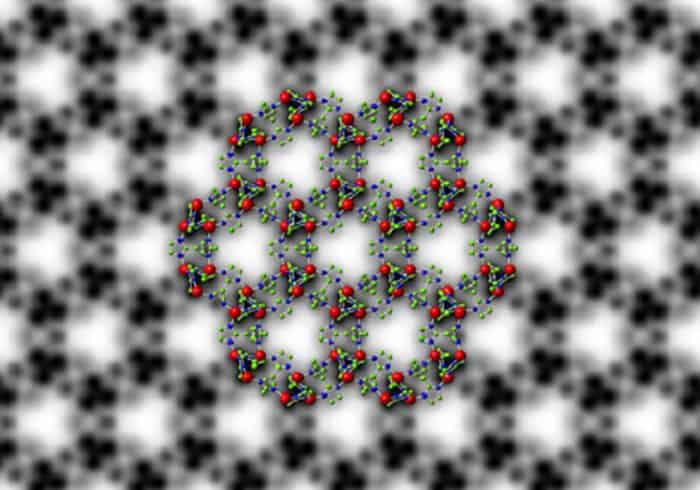
Transmission electron microscope image of ZIF-8

An extremely sensitive electron camera has been used to obtain transmission electron microscope images of fragile crystals called metal–organic frameworks (MOFs). Comprising metal atoms connected by organic molecules, MOFs are highly porous materials that can be engineered to store or transport specific gases. Determining the structure of a MOF is crucial to optimizing its performance, but doing so using electron microscopy is challenging because electron beams intense enough to create a useful image will destroy most MOFs. Now, an international team of researchers led by Yu Han at KAUST in Saudi Arabia have imaged a MOF using an electron-counting camera developed by US-based Gatan, which was also involved in the study. According to Gatan, the camera is able to detect individual electrons – making it possible to take microscope images under extremely low electron illumination. The team acquired images of ZIF-8, which is a MOF made of zinc atoms connected by 2-methylimidazole molecules. The images have a spatial resolution of 0.21 nm, which allowed the team to see individual zinc atoms in columns as well as the organic linking molecules. Han says that the research has already revealed new information about the porosity of the material, “which influences gas molecules transport in ZIF-8 crystals”. The research is described in Nature Materials.

Consortium will build full-body PET scanner

Photograph of positron emission tomography scanner

Researchers at the University of California, Davis, are leading a collaboration to build a prototype total-body positron-emission-tomography (PET) scanner. The EXPLORER consortium hopes to have a small-scale version ready for testing by July and the full-sized prototype by mid-2018. PET scanners use radioactive tracers attached to molecules of interest to show how organs and tissues are functioning. PET scans are mostly used to diagnose and monitor cancer, heart disease and forms of dementia. To gain multiple organ views of diseases such as measuring the spread of cancer, for example, it is necessary to scan the whole body because metastatic cancer can appear at many different sites. The detector in conventional PET scanners only covers a small part of the body, so imaging the whole body involves moving the patient through the scanner. The small detectors also mean that only about 1% of the available signal is actually collected. Another limitation of existing scanners is that they cannot collect dynamic data showing how the radio tracer distributes throughout the body. The new full-body PET scanner should provide a 40 fold gain in effective signal, compared with current scanners. This, say the researchers, will dramatically improve imaging capabilities and quality, revolutionizing the ability to study and diagnose disease as well as also reducing patient radiation exposure, which would allow more frequent use of PET scans. “Total-body PET is going to allow the interactions between different systems to be studied, providing a whole-body system view of disease that is not readily provided by other technologies,” says project leader Simon Cherry.


  • You can find all our daily Flash Physics posts in the website’s news section, as well as on Twitter and Facebook using #FlashPhysics. Tune in to physicsworld.com later today to read today’s extensive news story on how to encourage teenagers to study physics.


Optical clocks hit the road

Two independent groups of physicists in Germany and China have built portable optical clocks that are more accurate than the best caesium devices. They say that their instruments could be used to compare the timekeeping of different optical clocks distributed across the globe, and so take us closer to an overhaul of the SI definition of the second. They also reckon their compact clocks could be used by geodesists to determine the height difference between two widely spaced points on the Earth’s surface.

All atomic clocks rely on counting the oscillations of an electromagnetic wave with a frequency that is locked to that of a known atomic transition. Traditional atomic clocks use a microwave transition in caesium-133 to fix the output of a crystal oscillator, whereas optical clocks use much higher optical frequencies generated when a monochromatic laser beam interacts with various species of trapped ions or with clouds of cold atoms. These clocks now have accuracies and stabilities that are nearly two orders of magnitude higher than those of the best caesium devices – at levels of a few parts in 1018 rather than 1 part in 1016.

These improvements have led to calls for a change in the definition of the second within the SI system of units, from one based on the caesium-133 transition to another based on an optical standard. However, such a move requires a way of comparing the ticking rate of optical clocks located in different laboratories around the world – which is harder to do than a comparison of microwave frequencies.

Clock in a caravan

Now, Christian Lisdat and colleagues at the Physikalisch-Technische Bundesanstalt (PTB) in Braunschweig have shown how this could be done by making a compact optical clock that can be transported in an air-conditioned trailer. Their clock consists of several thousand neutral strontium-87 atoms that are held in place, cooled and excited by lasers. Lisdat says that among the main challenges involved in building the portable system were shrinking the laser systems for cooling and preparation of the atoms. Also difficult was to build a vacuum system for holding the atoms that is compact but at the same time doesn’t cause the lasers to misalign when it is transported.

Another major hurdle the group had to overcome, says Lisdat, was holding in place the optical cavity used to stabilize the frequency of the monochromatic laser that excites the strontium atoms. The kind of soft pads used to support the cavity in a laboratory, he explains, would not survive the clock’s journey by road. The solution, developed by group member Uwe Sterr, was to mount the cavity inside a 3D arrangement of wires that squeeze the cavity to keep its length set to a very precise value. “If you don’t make these corrections, even a tiny vibration will degrade the quality of the laser,” says Sterr.

As Lisdat and colleagues used their clock to carry out two measurement campaigns on the road, and by comparing its performance against that of a stationary optical clock, they showed it was accurate to 7.4 parts in 1017. In particular, they found it was an order of magnitude more accurate and two orders of magnitude more stable than the best portable caesium clock. They are now working to improve the clock’s accuracy by better understanding the behaviour of the lasers used to trap the strontium atoms, and describe their current clock in a paper in Physical Review Letters.

Single ion

Meanwhile in China, a team led by Xueren Huang of the Wuhan Institute of Physics and Mathematics has obtained a similar uncertainty (7.7 parts in 1017) from its own transportable optical clock. The system is based on a transition of a single ion of calcium-40 and is described in a preprint on arXiv.

According to Rachel Godun of the National Physical Laboratory in the UK, the Chinese system has the advantage of simplicity, which, she says, makes it smaller – at just half a cubic metre (minus the electronics) – and cheaper. Writing in an article in Physics that accompanies the Physical Review Letters paper, she says that the PTB set-up benefits from having more atoms and therefore a better signal-to-noise ratio. This, she explains, means it can reach a given statistical uncertainty much more quickly – allowing it to make measurements in minutes rather than days.

Comparisons between atomic clocks in different parts of the world are often carried out using satellites, but noise limits the sensitivity of such comparisons. Optical-fibre networks offer a better method of comparison, but these need special amplifiers at intervals of about 100 km to compensate for lost power. While this can be done on land, creating a similar link between continents would be far costlier. It is here, according to Godun, that the new transportable optical clocks would be very useful. They “could travel between laboratory clocks located anywhere in the world”, she says, so enabling “significant progress towards a redefinition of the SI second”.

Height differences

Godun points out that these portable clocks could also have other applications, including in geodesy. General relativity tells us that time runs more quickly further away from a massive object, which means that clocks on Earth will tick at very slightly different rates, depending on how high up they are. Optical clocks with accuracies of one part in 1017 could resolve height differences of a mere 10 cm, she says, so making them competitive when it comes to comparing the heights of sites that are separated by hundreds of kilometres – a time-consuming task when using the traditional technique of spirit levelling.

Godun adds that optical clocks transported to remote locations could also be used for “long-term environmental monitoring by measuring height changes in ice sheets and ocean levels”.

Flash Physics: Liquid drops explode, developing world scientists honoured, star breaks X-ray emission record

Liquid drops explode

Drops of a water–alcohol mixture exploding into millions of tiny droplets have been observed by Etienne Reyssat and colleagues at the Institute of Industrial Physics and Chemistry in Paris. The explosions occur when the liquid is placed on a layer of oil and the physicists say that the process is driven by a combination of evaporation, surface tension and fluid flow. The relative concentrations of water and alcohol in the mixture determine the surface tension of the fluid – the more water, the greater the surface tension. When a high-alcohol mixture is placed on an oily surface, it will spread out to create a film, whereas a high-water mixture will form drops. However, as alcohol evaporates from the high-alcohol mixture, the increasing surface tension causes the liquid to form puddle-like drops. The rate of alcohol evaporation is greatest at the edge of the drops, causing fluid to flow rapidly towards the edge, where liquid bursts out creating thousands or even millions of droplets. The size of the ejected droplets can be adjusted from a few microns to a fraction of a millimetre by changing the ratio of alcohol to water in the mixture. The study is described in Physical Review Letters.

Award celebrates women for their pioneering research in developing countries

Photograph of the award sculpture

Five early-career researchers from developing countries have been honoured for their work in engineering sciences. The OWSD-Elsevier Foundation Awards for Early-Career Women Scientists in the Developing World celebrates the achievements of female researchers who have made a significant contribution to their field and encouraged young women in science in their respective countries. The 2017 winners are Tanzima Hashem of the University of Engineering and Technology in Bangladesh for her work developing computational methods to the protect privacy of people accessing location-based services; María Fernanda Rivera Velásquez of the Universidad Nacional de Chimborazo in Ecuador for her research on decontaminating industrial areas using native materials; Felycia Edi Soetaredjo of Widya Mandala Catholic University Surabaya in Indonesia for her work on using biomass for renewable energy and environmental decontamination applications; Grace Ofori-Sarpong of the University of Mines and Technology in Ghana for her work on extracting gold-bearing minerals and free particles from mine water; and Rania Mokhtar of Sudan University of Science and Technology in Sudan for her research into advanced security systems for mobile devices. The Elsevier Foundation award is run in partnership with The Academy of Sciences for the Developing World (TWAS) and the Organization for Women in Science for the Developing World (OWSD). The winners were rewarded $5000 each and an all-expenses-paid trip to the 2017 American Association for the Advancement of Science (AAAS) Annual Meeting in Boston, where they were honoured during a ceremony on 18 February.

Neutron star breaks X-ray emission record

The XMM-Newton space telescope

A neutron star that emits X-rays at 1000 times greater intensity than predicted by theory has been discovered by astronomers working on the EXTraS X-ray observation programme. Located in NGC 5907 – a spiral galaxy 50m light-years from Earth, the ultraluminous X-ray source (ULX) is far too bright to be explained by the balance between the force of radiation acting outward on a neutron star and the gravitational force acting inward. This balance is called the “Eddington limit” and had led astronomers to assume that ULXs were driven by small black holes. Instead, observations using the XMM-Newton space telescope suggest that the X-rays are emitted by a spinning neutron star that is accelerating rapidly as it sucks in surrounding matter. While the intense X-ray emission cannot be explained if the star has a simple dipole magnetic field, the team writes in Science that the emissions could be driven by a magnetic field with strong multipolar components.


  • You can find all our daily Flash Physics posts in the website’s news section, as well as on Twitter and Facebook using #FlashPhysics. Tune in to physicsworld.com later today to read today’s extensive news story on an atomic clock in a van.

Science supporters protest in Boston

Stand up for Science rally in Boston, 19 February 2017

By Matin Durrani in Boston, US

Hundreds of scientists and science supporters gathered in Copley Square in Boston earlier today in a rally to underline the importance of science. The “Stand up for Science” event was organized to coincide with the annual meeting of the American Association for the Advancement of Science, which is taking place a few blocks away.

To find out more about the aims and purpose of the rally, I hooked up with Geoffrey Supran (picutred below), who helped to organize the event. Having originally studied physics at the University of Cambridgein the UK, Supran obtained a PhD in materials science at the Massachussetts Institute of Technology and is now doing a postdoc in the history of science with Naomi Oreskes at nearby Harvard University.

(more…)

Budget crunch hits Brazilian physics

Scientists in Brazil have protested devastating cuts to science that are threatening to close institutes and funding agencies across the country. Earlier this month about 900 people took to the streets in Rio de Janeiro to protest over budget reductions that have hit science this year. Meanwhile, around 80,000 people in Brazil have signed an online petition, set up in late August, calling on Brazil’s president, Michel Temer, to reverse the cuts.

Brazil spent around R$10bn (£2.4bn) on science in 2014, but that figure has been steadily dropping. This year the budget was initially planned to be around R$6bn, but the new government that took over in August 2016 following the impeachment of Dilma Rousseff slashed it even further to R$3.4m.

Major scientific agencies are now starting to run out of money. The National Council for Scientific and Technological Development, for example, may not be able to pay employees and researchers in October, while other major science and research centres such as the National Observatory and the National Institute for Space Research are also facing restrictions on cash flows.

Crisis point

One institute that is particularly badly hit is the Brazilian Centre for Research in Physics (CBPF) in Rio de Janeiro, which is facing its worst financial crisis on record. It is expected to run out of money in October and will no longer be able to maintain its lab infrastructure or even afford basic expenditure such as electricity.

The CBPF, which carries out research into a range of topics from nanotechnology to high-energy physics, is one of the top physics institutes in the country. It also serves as the main hub for the academic Internet infrastructure on which a variety of other scientific institutions rely, such as the Brazilian National Cancer Institute. During the 2016 Olympics in the city, for example, the CBPF’s facilities were used as the headquarters for the event’s digital security.

I don’t believe this is part of a wicked governmental plan to dismantle the country’s scientific endeavour; it’s more like the government has no plan at all

Ronald Shellard, CBPF

To maintain its labs in 2017, the CBPF requires R$24m – roughly what the institution has been receiving in recent years. However, this year’s budget has been just R$7.6m. “The bad news is that this money will be gone by mid-September,” says physicist Ronald Shellard, who is the CBPF’s president. According to Shellard, the CBPF could perhaps survive until the end of the year with a R$15m annual budget “without having to fire researchers or staff from other departments”. But the financial problems, he feels, are undermining attempts to develop a solid scientific programme of research at the CBPF.

Brain drain

Brazil’s Ministry of Science, Technology, Innovation and Communications (MCTIC) states that the financial constraints that hit the CBPF will be dealt with on a month-by-month basis. While ministry representatives declined Physics World‘s request for an interview, they stated that they have been working jointly with other governmental institutions to ease the effects that recent cuts have had on research institutions. “We acknowledge the importance of investments in science and technology as vital to the development of the country and we work towards the recovery of the full budget that was initially expected for this year,” they say.

According to Shellard, however, the MCTIC is not to blame for the lack of financial resources, but rather government figures who he says think that science is a secondary topic. “I don’t believe this is part of a wicked governmental plan to dismantle the country’s scientific endeavour; it’s more like the government has no plan at all.” Indeed, he is optimistic, despite the problems, that a solution to the crisis can be found.

Yet many Brazilian researchers, particularly those starting out, are already leaving the country. “The current status quo has been one of discouragement to new generations of scientists,” says physicist Ildeu de Castro Moreira, who is president of the Brazilian Society for the Progress of Science. “If no action is taken soon, the future of Brazilian science and technology will be dramatic.”

Doomsday scenario

As well as the protests and petitions, members of the scientific community are also regularly heading to Brasília, the country’s capital, to persuade politicians and policy makers that science is crucial for the country’s economy and is not a trivial expense. “Strangely, many politicians in Brazil seem to have a hard time in understanding such a message,” says Shellard.

So serious is the situation that the CBPF’s communication department has been running a public-awareness campaign that is inspired by the metaphorical Doomsday Clock, which is used by the Bulletin of Atomic Scientists as a warning of the risk of global catastrophe. According to the CBPF’s campaign, “2017 might be the year when the clock of Brazilian science approaches its midnight.”

AAAS chief predicts ‘tough and uncertain times’ for US science funding

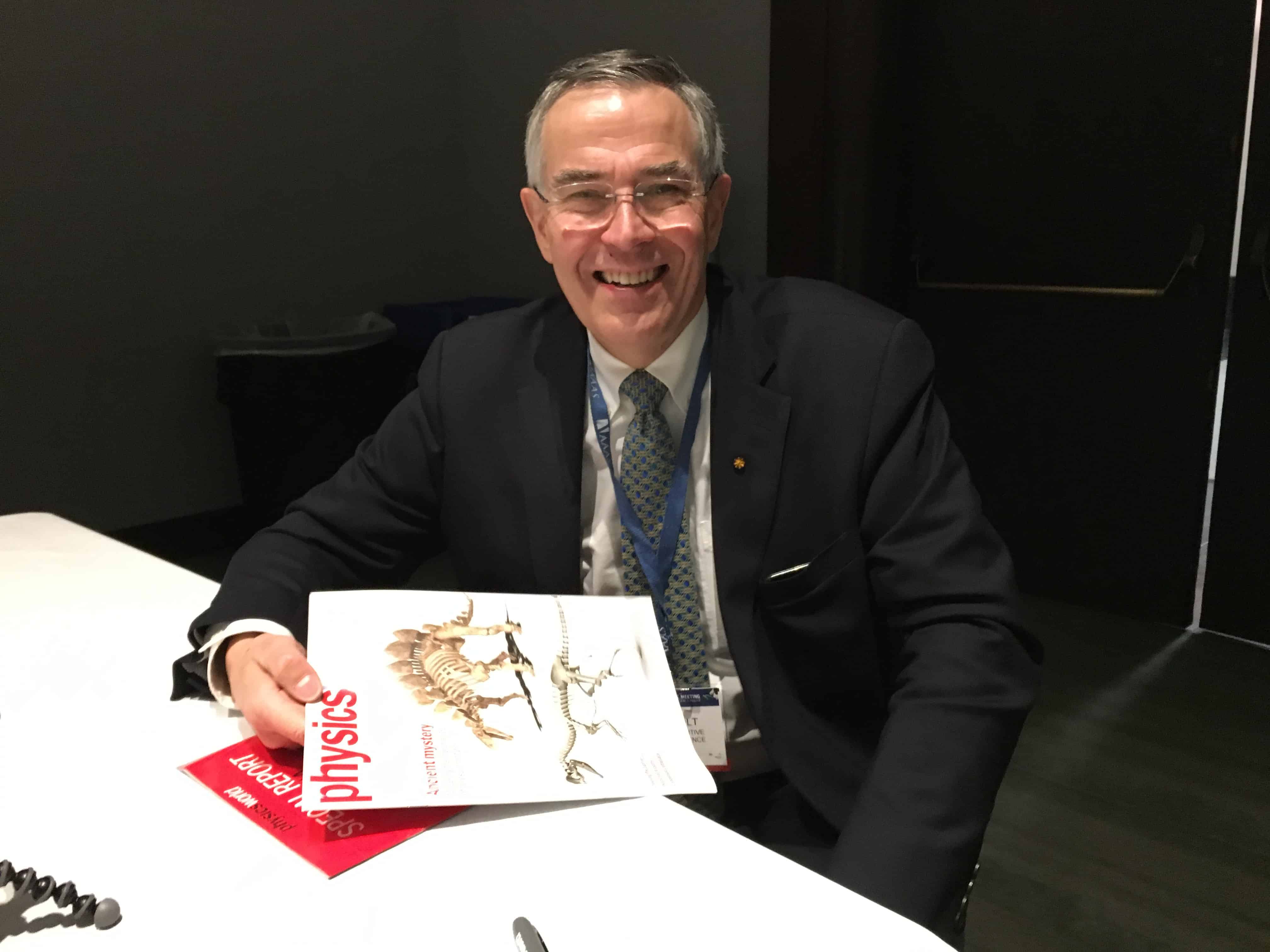
physicist and former Congressman Rush Holt is the current president of the American Association for the Advvancement of Science at the AAAS annual meeting in Boston 17 February 2017

By Matin Durrani in Boston, US

Rush Holt is that rarity: a physicist who’s also been a politician, having spent 16 years as Democratic Congressman for New Jersey’s 12th congressional district from 1999 to 2015. Those two attributes make him well placed in his current role as president of the American Association for the Advancement of Science (AAAS), which is holding its annual meeting here in Boston.

So when I sat down with Holt yesterday, our conversation naturally focused on the impact on science of Donald Trump’s election as US president. The bouffant-haired, former businessman and reality-TV star may have so far said little about the subject, but Holt believes that “tough and uncertain times” lie ahead for scientific funding. “I think we will be on a very austere budget for all non-defence discretionary activity,” he warns.

(more…)

Discover the secrets of science on TV

the panel of top TV producers seeking documentary ideas

By Matin Durrani in Boston, US

Physics World has been involved in making online videos and what we call “mini documentaries” for more than seven years. But these are mostly low-budget affairs aimed at people who are, by and large, already interested in physics.

So what if you’re a physicist who wants to work with a big-shot producer to make a full-blown, hour-long  TV documentary watched by millions? Shows such as Horizon on the BBC or Through the Wormhole with Morgan Freeman on Discovery’s Science Channel get massive audiences, putting you in touch with far more people than most scientists could ever dream of.

A special session at this year’s annual meeting of the American Association for the Advancement of Science had some of the answers. It brought together a bevvy of top TV producers (see slide above) who shared their tips on how scientists should pitch ideas for documentaries to them. A further session will be held tomorrow to let scientists propose real ideas in a kind of TV-science speed-dating.

(more…)

US policy chiefs explain how to handle Trump

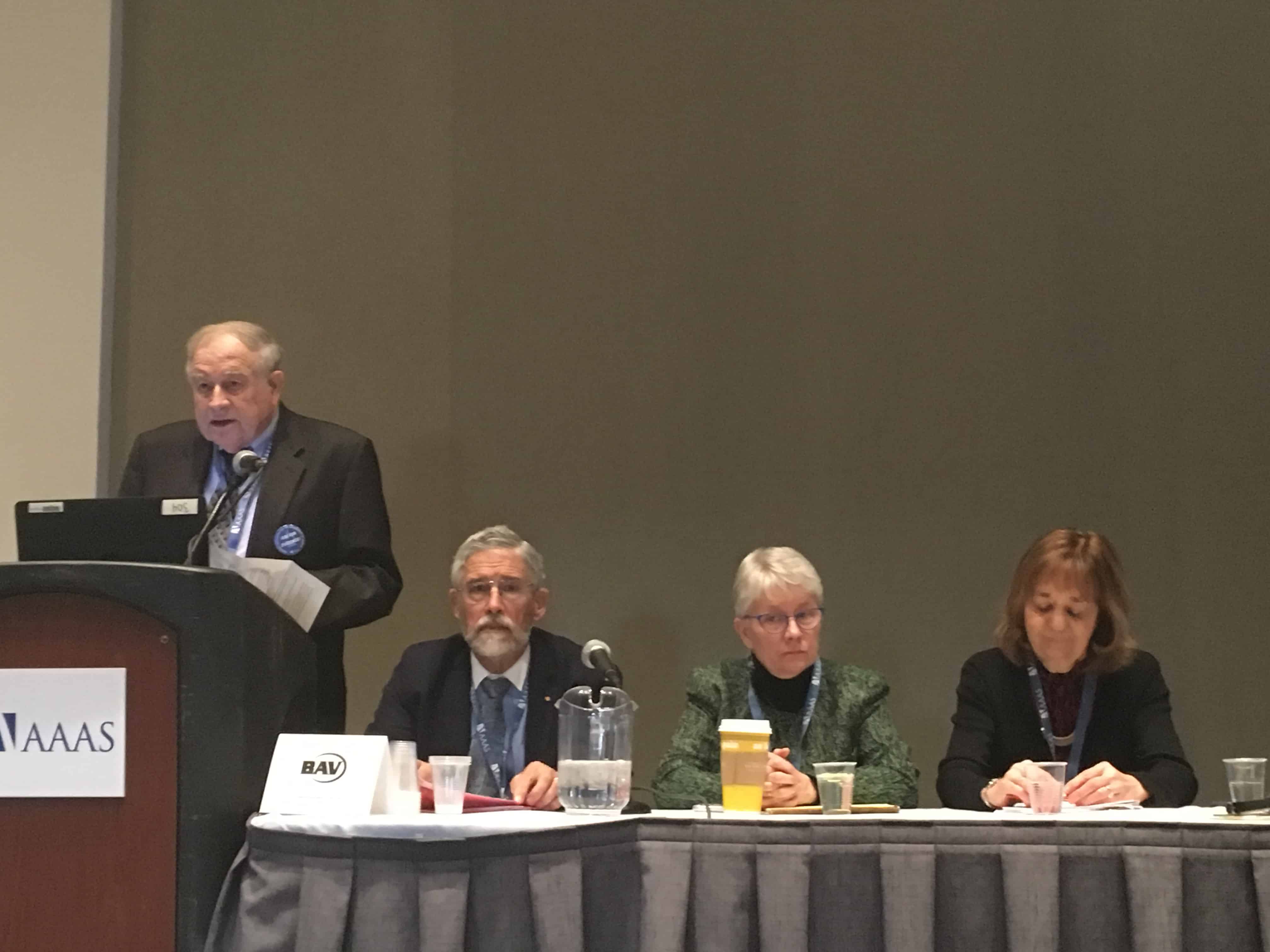
At the AAAS meeting in Boston, February 2017, Neal Lane introduces John Holdren (left), Kerri-Ann Jones (centre) and Rosina Bierbaum

By Matin Durrani in Boston, US

I’m here at the 2017 meeting of the American Assocation for the Advancement of Science in Boston, where the theme is “Serving society through science policy”. The focus was picked last year, but it turned out to be an auspicious choice with the election of Donald Trump throwing the science community into uncharted policy waters.

Trying to make sense of what life will be like for US scientists under the Trump administration were five people with extensive experience of working closely with recent US presidents.

Chairing the session was Neal Lane, who served as Bill Clinton’s presidential science adviser for two years in the 1990s. Also present was physicist John Holdren, who spent eight years until last month as Barack Obama’s science chief, for which the audience gave him a generous round of applause.

(more…)

Churchill discusses aliens, quantum films make the cut, graphene in a dress

By Sarah Tesh

Last September, the Centre for Quantum Technologies at the National University of Singapore invited people to submit short films about quantum physics for their Quantum Shorts 2016 competition. Both scientists and filmmakers alike have made the short list, which has just been released. The films could be about the science, history, theories, technologies or philosophies of quantum mechanics – anything that sparked the imagination. The online competition has been going since 2012 and alternates between short films and flash fiction, and this year the films will be screened at a film festival as well. The shortlist comprises of 10 films, all available to watch and vote for online. There are supernovae, love triangles, muesli with bananas and cats – everything you could want to help explain quantum physics.

(more…)

Building blocks of life found on Ceres

Organic compounds have been discovered on the surface of the dwarf-planet Ceres. The Visual and Infrared Spectrometer (VIR) on NASA’s Dawn spacecraft detected the compounds while in orbit around the minor planet. The team investigating the data suggests that the organics were formed on Ceres, indicating the planet has a more complex chemical history than previously assumed.

The organics detected are aliphatic compounds – chain molecules primarily comprised of carbon and hydrogen atoms. They were found moving across the south-western floor of a 50 km-wide crater called Ernutet, as well as in patches to the crater’s north-west. Organic compounds are volatile and would be easily destroyed by the intense heat of an asteroid impact. Also, their distribution across the surface does not seem to match with the ejecta from any specific crater.

The discovery was made by a team led by Maria Cristina De Sanctis of the National Institute of Astrophysics in Rome, during a survey of Ceres’ surface between 60° north and 60° south. At higher latitudes the data was too noisy to be useful. “I’ve never seen anything like this anywhere in the solar system,” De Sanctis told Physics World. “It’s difficult to see how the organics could have come from an impactor.”

If they were not delivered by an impactor, the organics must have somehow formed on Ceres itself. De Sanctis admits it is not certain whether they were made on the surface, or instead formed inside the dwarf planet before welling up from a water-rich layer below. Although all the raw materials for the organic compounds – carbon, hydrogen, nitrogen, phyllosilicates, water – are present on Ceres, “it is not very clear to me how the organics could have formed in situ,” says Thomas Prettyman of the Planetary Science Institute in Arizona.

Sampling Ceres

Knowing exactly which aliphatic compounds are present would help to solve this puzzle, but they all have similar infrared emission lines centred around 3.4 μm, making it difficult for VIR to distinguish between different compounds. “We know for sure that they are organics, but we can’t say what kind of organics,” says De Sanctis. “There could be several different types together, or just one.”

An image of the terrain around crater Ernutet, as seen by Dawn. Warmer colours indicate the densest concentrations of organics.

At the comet 67P Churyumov–Gerasimenko, the European Space Agency’s Rosetta mission was able to distinguish between organics because “the identification of specific molecules is best done by mass spectroscopy”, says ESA’s Michael Küppers. Rosetta was able to fly through the gaseous hood of the comet, called the coma, and sample organics directly with its mass spectrometer. Dawn does not have this option around Ceres.

Instead, team-member and Dawn’s principal investigator, Christopher Russell from the University of California, Los Angeles, says that “the community is talking about a lander, which should be much easier to accomplish than landing on a larger body like Mars, and we know where the interesting sites on Ceres are.”

Planetary designation

It’s not the first time that organics have been found in the asteroid belt. Remote observations of several asteroids have hinted at the presence of organics, but it is unclear if they were deposited by impact or interplanetary dust. Meanwhile at the 92 km-wide Occator Crater on Ceres – home to bright patches of material known as “faculae” that are thought to be salt (possibly sodium carbonate) brought to the surface by water – there is an unidentified emission signature that could also be organics.

“What this discovery does is go beyond the wet-planet paradigm to Ceres being a possible incubator of more complex chemistry,” says Russell. Although classified as a dwarf planet, Ceres is considered to be a protoplanet – the leftover hulk of a planet that never fully formed. Russell believes that the International Astronomical Union (IAU) misunderstood Ceres’ nature when they promoted it to dwarf planet in 2006.

“The IAU chose to classify planetary status by size, which is flawed reasoning,” he says. “Planetary designation should be judged on the interior properties instead. Ceres is a protoplanet or a small planet because of its internal chemistry. It did something besides just melting material, it made new [organic] material.”

Although there is no suggestion of life on Ceres, aliphatic compounds ranging from methane and ethane to more complex compounds including kerite and asphaltite are thought to be essential building blocks of life’s simplest biochemical mechanisms, making their discovery relevant to astrobiologists. “The presence of organics is a very important discovery,” says Prettyman, before concluding that “it may be very challenging to determine their origins.”

The findings are presented in Science.

Copyright © 2026 by IOP Publishing Ltd and individual contributors