Flash Physics: MRI pioneer dies, star polluted by ingredients for life, flat lens avoids chromatic aberration

MRI pioneer and Nobel laureate Peter Mansfield dies at 83

The UK physicist and Nobel laureate Peter Mansfield has died at the age of 83. Mansfield pioneered the development of Magnetic Resonance Imaging (MRI) for which he was awarded the 2003 Nobel Prize in Physiology or Medicine together with the US chemist Paul Lauterbur. Mansfield was born in London in 1933 and studied physics at Queen Mary College, London, graduating with a BSc in 1959 and a PhD in 1962. After a stint at the University of Illinois at Urbana–Champaign in the US, where he continued his work in Nuclear Magnetic Resonance (NMR), he moved to the UK’s University of Nottingham in 1964 where he remained for the rest of his career. It was there that he developed the use of NMR to image parts of the body and in 1976 produced the first human NMR image that showed a complete finger with bone, bone marrow, nerves and arteries. Two years later he became the first person to step inside the first whole-body scanner, despite warnings that it could be dangerous. MRI – an application of NMR – has since transformed neuroscience and physiology research by providing detailed images of anatomical structure. Mansfield was knighted in 1993 for his services to medical science and retired in 1994.

White dwarf polluted by ingredients for life
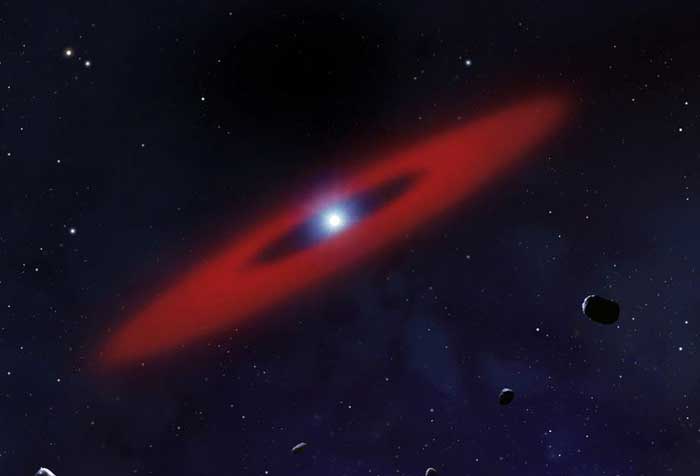
Artist's rendering of a white dwarf surrounded by a ring of debris from a minor planet destroyed by the star's strong gravitational fields

The building blocks of life have been found on a “polluted” white dwarf star 200 light-years away. A collaboration between the European Southern Observatory, the University of California, Los Angeles and the University of Montreal were studying the star WD–1425+540 when they observed nitrogen, carbon and oxygen. This is the first time nitrogen has been detected outside of the solar system. Typically, any heavy elements within white dwarfs are not observable because their strong gravitational pull draws the elements into their interiors. Siyi Xu and colleagues therefore attribute WD 1425+540’s pollution to a relatively recent destruction of a Kuiper Belt-like object. The Kuiper Belt is a ring of debris past Neptune’s orbit that surrounds the solar system. Scientists believe that short period comets from the belt may have delivered water and other molecules to Earth, allowing for life to evolve. In the case of WD 1425+540, Xu and team report in Astrophysical Journal Letters that a minor planet, similar to Kuiper-Belt objects, came very close to the white dwarf after a shift in its orbit. The planet was ripped apart by the star’s strong gravitational fields and the remnants went into orbit. Eventually these spiralled into the star, introducing the heavy elements. The researchers believe the event happened in the past 100,000 years or so which is why they could observe the aftermath. The finding confirms that other planetary systems contain Kuiper Belt-like objects. Impacts between these and rocky planets may mean that they contain the building blocks to life.

Flat lens focuses blue and green light
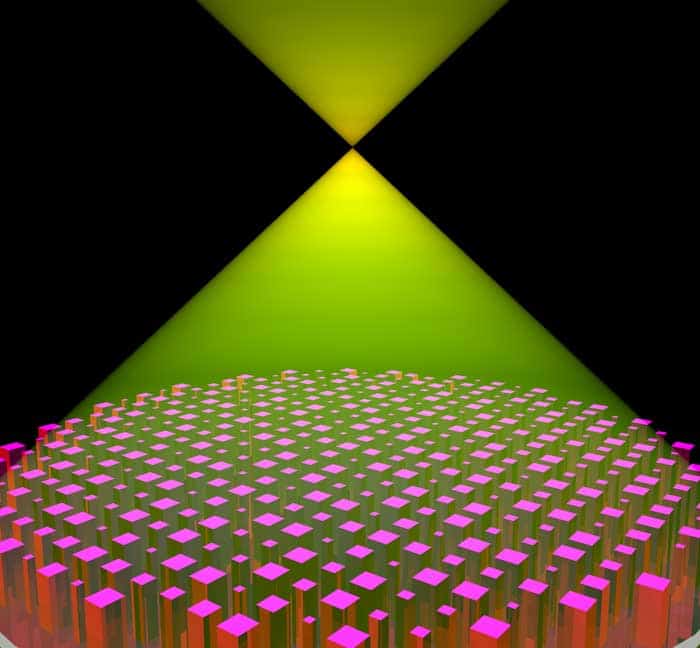
Illustration showing the flat lens in action

A “flat lens” less than one micron thick that can focus blue and green light has been unveiled by Federico Capasso and colleagues at Harvard University. The lens is an improvement on a similar monochromatic device unveiled by the same group in 2016. The quality of an optical system based on conventional lenses tends to improve with length. This is because multiple curved lenses are needed to correct for chromatic aberration that occurs because light of different colours will take different paths through a simple lens. This causes problems for makers of smartphones and other devices, who want lenses that are as thin, lightweight and simple as possible. In 2016 Capasso’s team unveiled a new type of lens that uses tiny pillars to focus light. The lens could only focus light at one specific wavelength – violet light at 405 nm – which limited its use. All of the nanopillars were of the same shape and size in the 2016 lens – but now the team has shown that a lens made from nanopillars of different sizes can focus blue and green light with wavelengths of 490–550 nm without suffering from chromatic aberration. The lens is made from an array titanium oxide nanopillars that are about 400 nm tall and vary in thickness from 50 to 300 nm. The arrangement, shape, width and height of the nanopillars were all carefully chosen to minimize chromatic aberration for blue and green light. The researchers say that the lens can be made using standard chip manufacturing methods and that early application of the lens could be in imaging, spectroscopy and sensing. The lens is described in Nano Letters.


  • You can find all our daily Flash Physics posts in the website’s news section, as well as on Twitter and Facebook using #FlashPhysics. Tune in to physicsworld.com later today to read today’s extensive news story on the Sun’s rotation.
Decaying atoms feel a tiny frictional force, say physicists

An excited atom decaying in a vacuum experiences a force very similar to friction, according to calculations done by physicists in the UK. At first sight, the result appears to violate Einstein’s equivalence principle. However, the researchers calculate that, in fact, relativity rides to its own rescue, and the mass lost from the atom as it decays to the ground state allows it to lose momentum without slowing down.

Einstein’s special theory of relativity famously says there is no such thing as absolute motion: the laws of physics are the same in all inertial frames of reference. Theoretical physicists Matthias Sonnleitner, Nils Trautmann and Stephen Barnett at the University of Glasgow noticed an apparent contradiction, however, when considering a textbook quantum-mechanics problem.

An excited atom in a vacuum decays to a lower energy state, emitting a photon in a random direction. For simplicity, the problem is normally solved in the rest frame of the atom. In this frame, the magnitude of the photon’s momentum is independent of its direction so, as a photon is equally likely to be emitted in any direction, the expectation values of the photon’s momentum and the atom’s consequent recoil momentum remain constant at zero.

Net force

However, the trio also considered the problem in a frame in which the atom is moving: because of the Doppler effect, a photon emitted in the same direction of travel as the atom would be blue-shifted, having its frequency, and therefore its momentum, increased; whereas a photon emitted in the opposite direction would be red-shifted and have its momentum decreased. The atom would therefore experience a net force proportional to its momentum but in the opposite direction – effectively, it would experience friction from the vacuum.

This appears to violate the principle of relativity because, if the atom’s velocity changed, an observer could measure this change in velocity and use it to determine the absolute motion of the observer’s own frame of reference. Sonnleitner says the trio spent “weeks questioning their sanity”. They later discovered an earlier paper, published on the arXiv pre-print server in 2012, in which Wei Guo of Queens University of Charlotte in North Carolina identified the problem but could not solve it.

The Glasgow researchers eventually realized that, although they had not explicitly included relativity in their calculations, it had nevertheless sneaked in the back door: when an atom emits a photon and decays to a lower energy state, the classic equation E = mc2 shows that its mass must also decrease. Although the decrease is tiny, it is precisely sufficient to compensate for the decrease in momentum, allowing its velocity to stay constant. This only works when a small, often-neglected correction proposed in 1888 by the physicist Wilhelm Röntgen (who won the 1901 Nobel Prize for the discovery of X-rays) is included to accommodate the interaction between the moving atom’s electric dipole and a magnetic field. In this latest research, the magnetic field is associated with quantum vacuum fluctuations. “[Guo’s 2012 paper] dropped the Röntgen term at some point,” explains Sonnleitner. “The Röntgen term is necessary to get the correct change in momentum. Only then do you see that it’s just due to a change in mass and not due to a change in velocity.”

Immeasurably small

Although the researchers considered the simplest possible situation, in which one atom in a vacuum decays by photon emission, the phenomenon is, in principle, applicable whenever an atom absorbs or emits a photon. “If this effect were larger,” says Sonnleitner, “You would see its contribution whenever you tried to cool an atom, for instance.” In practice, however, other influences are much larger in these cases, so the effect is not significant. He adds, “Experiments are getting so, so much better right now that it’s really hard to say that something cannot be measured at all, but at least as far as I’ve seen this one is not feasible yet.”

“This is an interesting conceptual point,” says theoretical physicist Peter Milonni of the University of Rochester in the US. “Maybe this work will lead the way to experiments to probe this conceptual difference between the change in momentum associated with translational motion and the change in momentum associated with the internal energy dynamics – these kinds of things are well known in nuclear physics. Whether it will lead to practical consequences in the theory of laser cooling and trapping, and new ways to trap atoms and so on: I don’t think so, but I could be wrong.”

The research is described in Physical Review Letters.

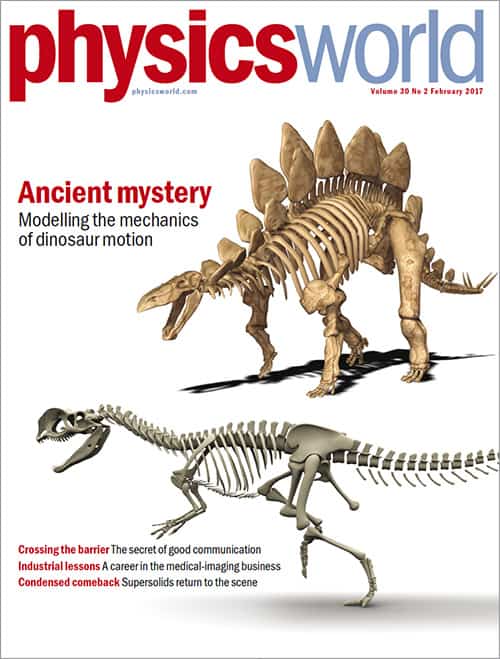
The February 2017 issue of Physics World is now out

PWFeb17cover-500-ruleBy Matin Durrani

It’s time to check out the February issue of Physics World magazine, where our cover story looks at the physicists studying how dinosaurs moved. The issue is now live in the Physics World app for mobile and desktop, and you can also read the article on physicsworld.com here.

There’s also a great feature about whether supersolids could be making a comeback, while science writer Brian Clegg explains why anticipating people’s questions is the secret to good science communication.

Elsewhere in the new issue, check out why Jules Verne was spot-on with the physics of drones and meet the man who’s been the driving force behind statistical physics meetings.

Remember that if you are a member of the Institute of Physics, you can read Physics World magazine every month via our digital apps for iOS, Android and desktop.

(more…)

2D materials are not so two-dimensional

Stacking order and interlayer interactions in suspended graphene/mono-layer hBN heterostructures can now be detected using a novel scanning transmission electron microscopy (STEM) technique. Such suspended van der Waals heterostructures and the 2D materials required to make them have potential applications as nanomechanical actuators and force sensors to name a few.

STEM obtains structural information about thin samples from the deflection or scattering angle of electrons that pass through. Using a custom-made aperture and a pixelated detector, the University of Vienna team – led by Jannik Meyer – measured not only the intensity of scattered electrons in the medium angle annular dark field (MAADF) (60–200 mrad), but more importantly the lateral deflection of the electron beam at every point of the sample. The resulting imaging technique is highly sensitive to the inclination of the sample and the electron scattering profile is heavily dependent on the stacking regime.

Using a combination of empirical results and density functional theory (DFT) calculations, the researchers then created a pair of simulations of the system. One assumed the flake structure was rigid and flat, and the other – called the relaxed model – accounted for out-of-plane distortions in the crystal structure. The latter of these two models was a markedly better fit to the experimental data.

It is well documented that crystallographically aligned graphene and hexagonal boron nitride (hBN) produces a superlattice Moiré pattern of interference fringes. Meyer and his team also show that these out-of-plane distortions have the same periodicity as the Moiré superlattice.

Graphene on hBN is one of the simplest examples of suspended van der Waals heterostructures. The results provide insights into the interlayer interactions and the effects of suspension, which are important for designing more complicated, multilayer devices.

It can no longer be taken for granted that 2D materials remain two-dimensional when incorporated into a van der Waals heterostructure.

The research is detailed in Nano Letters 10.1021/acs.nanolett.6b04360.

Nuclear diamonds: the ultimate long-life battery?

The proposal comes from a group of researchers at the University of Bristol in the UK, who say they have a practical way of dealing with some of the nearly 95,000 tonnes of radioactive graphite that was used as a moderator in the UK’s nuclear reactors. Applications of such devices could include long-lasting power supplies for pacemakers and even a lightweight power supply for space missions.

Unsurprisingly, this eye-catching research captured the attention of specialist and mainstream media publications alike when it was announced towards the end of 2016. In this podcast, we probe deeper into the science behind the headlines.

The episode is presented and produced by Andrew Glester, a science communicator based in Bristol, who says he takes a “sceptical optimism” to such bold scientific claims. Glester visits the research team at the University of Bristol to find out more about the proposal – its applications, nuclear safety concerns, and the challenges that stand in the way of this idea becoming a practical reality.

Flash Physics: Circuits survive on Venus, electronics powered by stomach acid, Israel tops global R&D spend

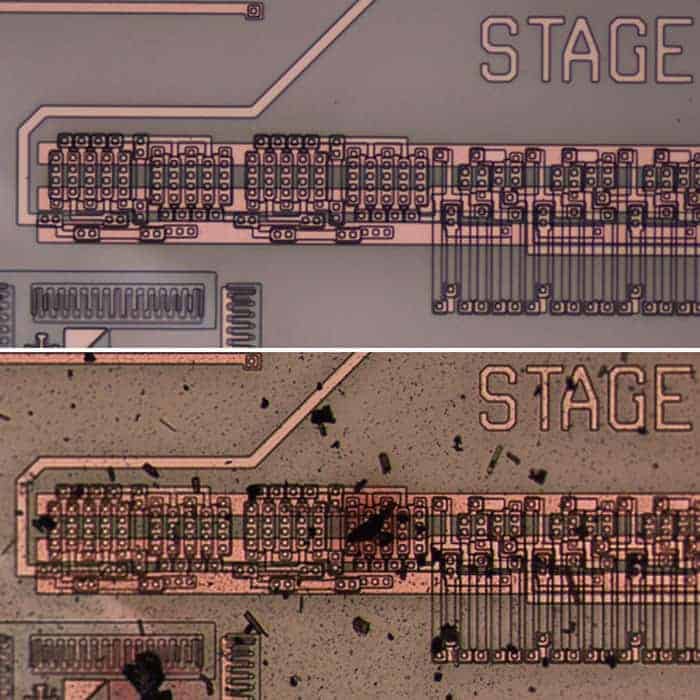
Photographs of an integrated circuit before and after testing

Integrated circuits smash survival record in Venusian atmosphere

Integrated circuits that could withstand the harsh conditions on Venus for a record-breaking length of time have been built and tested by researchers at the NASA Glenn Research Center in Cleveland, Ohio. Operating a lander on the surface of Venus is a very difficult task because the temperatures there can reach 460˚ C and the pressure of the caustic atmosphere is about 100 times that of Earth’s. This vicious environment quickly destroys electronic circuits – even if they are cocooned in heat- and pressure-resistant vessels – and the best systems have only survived for a few hours on Venus. Creating circuits that can resist the Venusian atmosphere for longer and without the need for heavy and cumbersome shields is the goal of NASA’s Phil Neudeck and colleagues. They have created a new integrated circuit from silicon carbide (SiC), which is an extremely tough, chemically inert and heat-resistant semiconductor. They made two ring-oscillator integrated circuits from SiC junction field-effect transistors and tested them in the Glenn Extreme Environments Rig, which can simulate conditions on Venus. The chips survived for more than 500 h while exposed directly to the harsh environment, with no cooling and no protective chip packaging. “Both integrated circuits still worked after the end of the test,” Neudeck says. The work is described in AIP Advances.

Electronic capsule powers itself with stomach acid

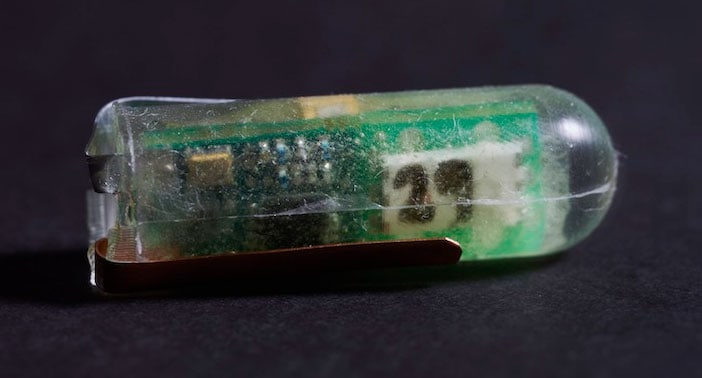
Photograph of the ingestible electronic device

A new ingestible electronic device can harvest energy inside the gastrointestinal (GI) tract, allowing it to monitor temperature over several days. In recent years, the technology behind ingestible electronics has significantly improved. These small devices can take live images of the GI tract, deliver drugs and measure conditions such as pH and temperature. However, powering the devices for more than a few hours remains challenging. Now, a team led by Giovanni Traverso of the Massachusetts Institute of Technology (MIT) and Harvard Medical School has developed a capsule that uses biocompatible galvanic cells. The cells harvest energy from the GI tract by transferring electrons between metallic electrodes and the gastric or intestinal fluid. The process can power the device for several days, allowing it to monitor temperature and send data wirelessly to the researchers. The electronic capsule could be used for diagnosis and treatment, and the team hopes to combine the technology with other sensors. A more detailed report on the work presented in Nature Biomedical Engineering can be found on nanotechweb.org.

Israel tops global R&D spend

Israel put 4.3% of its gross domestic product (GDP) into R&D in 2015, making it the biggest spender – in terms of the percentage of its economic output – of the 35 countries belonging to the Organisation for Economic Co-operation and Development (OECD). Israel just surpassed South Korea, who ploughed 4.2% of the country’s GDP into science, while Japan was third (3.5%). The US, meanwhile, spent 2.8% of its GDP on R&D, with China spending 2.1%. In Europe, Sweden was the highest at 3.3% followed by Austria at 3.1%. The UK, meanwhile, spent 1.7% of its GDP on R&D, below the EU average of 2.1% and the OECD average of 2.4%. The OECD says that there was a slight decline in government R&D budgets in 2015 but businesses increased their contribution by 2.5%, making the private sector responsible for nearly 70% of all R&D spending that year.


  • You can find all our daily Flash Physics posts in the website’s news section, as well as on Twitter and Facebook using #FlashPhysics. Tune in to physicsworld.com later today to read today’s extensive news story on atomic friction.

Joel’s conference

Just as it had on the previous 115 occasions, the event opened with a bell carried by Joel Lebowitz. The 86-year-old physicist, often fondly called “the soul of statistical mechanics”, strode through the lobby of the Hill Center at Rutgers University’s Busch campus in New Jersey, clanging the bell to summon the animated coffee drinkers to the lecture hall. The 116th Statistical Mechanics Conference, held on 16–18 December last year, was about to begin.

Lebowitz’s biannual conferences are remarkable not only for their longevity – they have run since 1959 – but also for their egalitarianism and diversity. What’s more, the meetings, along with the Journal of Statistical Physics that Lebowitz has edited for the past 40 years, have helped the field of statistical mechanics to survive the forces threatening to fragment it into subfields.

Lebowitz: a life

Born in 1930 in a small town in what was then Czechoslovakia, Lebowitz’s native tongue was Yiddish. Life was tough in a Jewish community in this part of the world, but grew grimmer after the German occupation during the Second World War. Lebowitz’s family was sent to Auschwitz; only Joel – then aged 15 – survived. Thanks to a project to help orphaned children headed by Eleanor Roosevelt, Lebowitz obtained a visa to the US. He graduated from Brooklyn College in 1952, and was introduced to statistical mechanics, getting his PhD in physics from Syracuse University in 1956.

Outgoing and unflappable, Lebowitz readily collected friends. One was an artist and teacher named Kate Millett, who later became a famous feminist author. In her 1974 memoir Flying, Millett refers to Lebowitz under the pseudonym Jacob, describing him as “a charming Slavic soul with an insatiable taste for women and a tattoo on his arm from Auschwitz”.

In 1959, while at Stevens University of Technology in New Jersey, Lebowitz hosted his first informal conference on statistical mechanics. It was well received; the only alternatives, he told me at the most recent event, were formal conferences. Lebowitz continued the meetings, twice-yearly in May and December, after moving to Yeshiva University in Manhattan in the autumn of 1959. Talks were limited to five minutes and anyone who wanted could give one.

“Joel’s conferences were no-frills, geared for locals and on a single day,” recalls Pierre Hohenberg, a physicist then at Bell Labs. “You took the subway, no accommodation, no invited speakers, no Vugraphs [plastic sheets on which one could print or write and display with the aid of an overhead projector] and no food. They brought together a broad cross-section of the community and were how you kept up on the field.” Between 50 and 100 people would attend in the early years.

In 1977 Lebowitz moved to Rutgers. Many regular attendees were horrified: Rutgers was in the New Jersey countryside, you needed a car to get there and you had to stay overnight in a dilapidated hotel. Afraid the conferences would lose either their informal character or their audience, Hohenberg and others lobbied to continue the conferences at Yeshiva. Instead, Lebowitz rethought it.

He added invited speakers and celebrations of senior leaders in the field. If people stayed over, it might as well be a two-day (eventually three-day) conference. Amenities included meals and musical events. Finally, he flirted with formality by allowing Rutgers attendees to use Vugraphs. “That was a big ideological transition,” Hohenberg told me.

But Lebowitz continued to ensure that the conferences reflected the field’s diversity. At the start of his career, statistical mechanics was mainly concerned with effects on equilibrium processes in microscopic systems and scientists had only a data-driven grasp of phase transitions. The 1970s development of the renormalization group supplied a physical/mathematical understanding of phase transitions and scaling, which strengthened the difference between the mathematical side of statistical mechanics – involving exactly solvable models – and its physical side, allied with experimentation. The renormalization group also provided calculational techniques for scaling non-equilibrium systems that helped give statistical mechanics a broader range of applications. Lebowitz’s inclusive conferences embraced a spectrum of them.

At the December 2016 meeting, for instance, invited talks were given on statistical mechanics-related aspects of earthquakes, superconductors, liquid crystals, swimming particles, number theory, HIV, quantum mechanics and nacre – the beautiful iridescent material on the inside of certain molluscs. The spirit of the original Yeshiva format was retained in a morning session of five-minute talks on the behaviour of everything from electrons to microbes. As always, anyone who wanted to could give one of these talks, as long as you didn’t use Vugraphs or PowerPoint and erased the blackboard afterwards.

Lebowitz introduced each speaker, asked pointed questions and when speakers exceeded the allotted time, stood up and smiled until his genially expressed moral authority brought them to a halt. “It’s a one-man show, yet democratic and egalitarian,” Nihat Berker, an emeritus professor at the Massachusetts Institute of Technology, told me. “You don’t often see that.”

One talk is always devoted to human rights; this time Lebowitz gave it himself. “These are not good days for human rights,” he warned, mentioning recent cases involving individuals in Iran, the US, Egypt, China, Pakistan, Saudi Arabia and Turkey.

The critical point

Lebowitz’s meetings are ideal for our modern world, where researchers want to communicate their results and learn new ones – fast. Indeed, the standard scientific-conference format of concurrent sessions of PowerPoint-driven papers seems to me obsolete. Joel’s conference offers one successful alternative; the Gordon conferences, which have many imitators, are another. These reveal not only the continuing value of conferences in an electronic age but also the importance of leadership for creating a truly effective meeting.

Entanglement boosts data transmission

The efficiency of data transmission through ordinary optical fibres has been enhanced using a quantum-mechanical technique known as superdense coding. Physicists in the US have shown that they could nearly double the capacity of a fibre link compared with conventional transmission – and the researchers say their work could increase how much data the internet can handle.

Superdense coding exploits the phenomenon of entanglement to double, at least in principle, the capacity of an information channel. A single binary bit sent down a channel can normally encode two possible values – 0 or 1. But a single quantum bit, or qubit, that is entangled with a second qubit some distance away can instead encode four possible values. This is because the two particles, even though spatially separated, are strongly correlated with one another and so effectively act as a single entity. The total information transmitted is therefore equivalent to that of two classical bits.

First demonstrated experimentally in 1996, superdense coding involves two people – usually known as Alice and Bob – sharing a pair of photons that have their polarizations entangled. Alice then operates on her photon, her part of the quantum state, to prepare one of four quantum states jointly held with Bob. When Bob receives Alice’s photon, he holds the complete state, he can determine which of the four states is present using a complete Bell state measurement.

Notoriously difficult

However, these “Bell-state measurements” are notoriously difficult to do. Usually Bob can at best only make out two of the four possible states that he is trying to distinguish. With the remaining two considered unidentifiable he effectively has three of the four possible values to play with. This means the channel has a maximum capacity of about 1.59 bits, rather than the two bits that are theoretically possible.

One way to get around this is to use “hyperentanglement”, which involves entangling the particle pair together using two degrees of freedom, rather than just one. This allows Bob to differentiate between all four possible outputs. This was demonstrated in 2008 by researchers at the University of Illinois at Urbana-Champaign in the US, who used pairs of photons entangled simultaneously in spin and orbital angular momentum. They achieved what was then a record of 1.63 bits per channel.

The Illinois team carried out its experiments by firing laser beams through free space. Pointing out that atmospheric turbulence quickly destroys photons’ orbital angular momentum states, they concluded that their set-up was probably only suited for data transmission between satellites.

Special interferometer

The latest work, in contrast, shows the potential of superdense coding for use across fibre-based communication networks. Travis Humble, Brian Williams and Ronald Sadlier of the Oak Ridge National Laboratory in Tennessee used a specially designed interferometer to entangle the arrival times, as well as the polarization, of pairs of photons. In this way they showed they could increase the channel capacity of a 2 m long piece of standard optical fibre cable, using standard photon detectors to carry out the measurements. They report a new record of 1.67 bits per channel, demonstrating the feasibility of their approach by sending a 3.4 kilobyte image of an oak leaf – their lab’s logo – with a fidelity of 87% (see figure).

“What is nice about our demonstration is that we were able to use off-the-shelf equipment,” says Williams. As to the relatively small gain over the previous record, he explains that the higher the capacity, the harder it becomes to improve that capacity. “People can run a four-minute mile but no-one will ever run a three-minute mile,” he says by analogy.

A remarkable breakthrough for a useful realization of superdense coding over fibre
Julio Barreiro, University of California, San Diego

Julio Barreiro of the University of California, San Diego, who was part of the 2008 Illinois team, characterizes the earlier research as a “proof-of-principle demonstration”. In contrast, he says, the latest results constitute “a remarkable breakthrough for a useful realization of superdense coding over fibre”.

Humble says that the research could in principle increase the bandwidth of large swathes of the internet. But he notes that there are significant technical challenges to overcome, including the fact that superdense coding requires much lower power levels than are used in today’s fibre networks in order to limit channel noise. Low power levels increase the cost of deployment significantly, making it unlikely that the quantum technique would be used for mainstream data transfer.

Standalone quantum networks

Instead, Humble believes that standalone quantum networks could prove cost effective when it comes to specialist applications such as synchronizing atomic clocks around the world or setting up networks for high-performance computing. He adds that a partner organization of his group, the United States Army Research Laboratory, plans to build a standalone quantum network within the next three years.

The research is described in Physical Review Letters.

Flash Physics: Starlight closes Bell loophole, elusive white dwarf pulsar, St Andrews champions gender equality

Starlight closes Bell loophole

A Bell test of quantum entanglement that claims to use starlight to close the “freedom of choice” loophole has been done by an international team of physicists. Entanglement is a curious consequence of quantum mechanics that allows two particles to be connected in a way that cannot be described by classical physics. Entanglement is observed as correlations between measurements made on two particles (such as their polarizations) and in 1964 John Bell described his famous test of whether such correlations are stronger than those allowed by classical physics. Since then, physicists have done many Bell test experiments that confirm entanglement. However, no experiment is perfect and researchers have come up with a number of experimental “loopholes” that could allow purely classical phenomena such as faulty detectors to affect the outcome. In 2015, physicists were able to simultaneously close two important loopholes called “fair sampling” and “locality”. Freedom of choice is another important loophole that involves how the measurements are done. In a Bell test on entangled photons, a large number of measurements are made on different entangled pairs in which the direction of the polarization measurement is selected at random. If, for some reason, the polarization selection is not random but correlated to other aspects of the experiment, then the outcome of the Bell test could be affected. Now, Johannes Handsteiner and Anton Zeilinger of the University of Vienna and colleagues worldwide have used the random nature of starlight to close this loophole. Two telescopes at two locations separated by nearly 2 km were pointed at two different stars. The colour of the starlight changes in a random manner and this was used to decide how to set Bell test polarization detectors. The stars were chosen so that their light arrives at their respective telescopes first, before reaching other parts of the experiment. This, and the fact that the starlight light was created hundreds of years ago and very far away from Earth, allowed the physicists to conclude that there is no correlation between the choices of polarization measurement and the rest of the Bell test experiment. However, writing in Physical Review Letters, they point out that their experiment does not close the fair sampling loophole.

Elusive white dwarf pulsar strikes out at red dwarf neighbour

Artist impression of the AR Scorpii binary system, containing a white dwarf pulsar and red dwarf

The first white dwarf pulsar has been discovered after half a century of searching. Astronomers at the South African Astronomical Observatory in Cape Town and the University of Warwick in the UK have identified an elusive white dwarf version of a pulsar within the AR Scorpii binary system. Traditionally, a pulsar is a neutron star that emits beams of radiation due to its strong magnetic field and rapid spin. From Earth, the highly directional beams are seen as pulses of radiation. While a neutron star is the collapsed core of a massive star, a white dwarf results from smaller stars and astronomers have been searching for a white dwarf pulsar for more than 50 years. The AR Scorpii binary system studied by David Buckley and colleagues contains a white dwarf that is a similar size to Earth but 200,000 times more massive, alongside a cool, low-mass red dwarf star. The two are around 1.4 million km apart (three times the distance between the Moon and Earth) and orbit each other in 3.55 h. The white dwarf spins every 1.97 min and emits powerful beams of electrical particles and polarized radiation that are created in a similar manner to neutron star pulsars. The researchers have also established that the high-energy beams strike the companion star, exciting and accelerating electrons in the atmosphere to nearly the speed of light. This causes further pulses of radiation, from ultraviolet to radio wavelengths, in time with the white dwarf rotation. This means the entire system seems to pulse when observed from Earth. The current work is presented in Nature Astronomy and the team hopes further studies will help determine the exact mechanisms of the red dwarf’s atmospheric interactions as well as further disentangle the signals from the white dwarf pulsar and its companion.

St Andrews named a champion of gender equality

The Institute of Physics (IOP) has named the School of Physics and Astronomy at the University of St Andrews as a Juno Champion. Project Juno is an IOP initiative to address the underrepresentation of women in university physics and encourage gender equality. The project rewards departments across the UK and Ireland for promoting an inclusive atmosphere, ensuring that both women and men have equal opportunities at all levels of academia and providing supportive and flexible working practices. St Andrews has become the 17th university to achieve Champion status, the highest of the three Juno awards after Supporter and Practitioner. “The school has worked hard to deliver on our goals for equality of opportunity and reward for all staff and students,” explains Graham Turnbull, head of the School of Physics and Astronomy at St Andrews. Other Juno Champions include physics departments at the University of Cambridge, the University of Birmingham and Imperial College London.

  • You can find all our daily Flash Physics posts in the website’s news section, as well as on Twitter and Facebook using #FlashPhysics. Tune in to physicsworld.com later today to read today’s extensive news story on quantum information.

Juan Morante: an energetic man

[brightcove videoID=5315350733001 playerID=106573614001 height=330 width=500]


By Matin Durrani

Juan Morante, who’s boss of the Catalonian Institute for Energy Research (IREC), visited the headquarters of IOP Publishing, which publishes Physics World, late last year. Morante has also just taken up the reins as the new editor-in-chief of the Journal of Physics D and was here to discuss everything about the journal, from commissioning and peer review to design and marketing.

(more…)

Copyright © 2026 by IOP Publishing Ltd and individual contributors