Your future with physics

PWCareers17-cover-500By Margaret Harris

In a typical month, the careers section of Physics World features the stories of two different physicists: one who is working in a physics-related field (such as engineering or teaching), and another who decided to do something totally different (such as designing sailboats or running a winery).

I find these stories endlessly fascinating, and when I was Physics World’s careers editor, I loved sharing them with the wider physics community. But the section isn’t there just to add human interest. It’s also giving current students (and later-career physicists seeking a change) a better idea of what they could do with their physics knowledge in the workplace.

After talking to students and careers professionals, I realized that publishing two stories in the magazine once a month wasn’t really the ideal way of doing this – at least, not for readers who are actively looking for careers ideas, and who might therefore prefer to learn about lots of different options at once.

So with these readers in mind, we’ve come up with a brand-new publication for 2017. The first edition of Physics World Careers contains a selection of the best articles published in the magazine’s careers section last year, plus an extensive employer directory.

(more…)

‘Atomtronic’ battery made from Bose–Einstein condensate

A battery-like device that supplies a current of ultracold atoms has been created by physicists at the University of Colorado in Boulder. Their “atomtronic” battery is based on a Bose–Einstein condensate (BEC) and could be used to supply circuits made from transistors and other components that operate using atomic rather than electronic currents. Potential applications of the battery include inertial sensing and quantum-information processing.

Atomtronics is a new field of applied physics that aims to create analogue and logical circuits using currents of atoms. According to Boulder’s Dana Anderson, “practical devices do not yet exist”, and his team is focused on developing an atom transistor and simple transistor circuits. In 2016 Anderson and colleagues reported the development of an atomtronic transistor based on a magneto-optical trap that contains three potential energy wells.

Now, Anderson, Seth Caliga and Cameron Straatsma have created an atomtronic battery that, in principle, could drive their transistor and other components. It consists of a gas of rubidium-87 trapped by magnetic fields in a long, thin cigar-shaped region. The BEC is created by cooling the atoms to an extremely low temperature so the atoms fall into the same low-energy quantum state. A repulsive energy barrier made from laser light is then swept across the trap from the right side to the centre, which pushes all of the atoms into the left half of the trap, leaving the right half empty (see figure). The energy barrier is then lowered in height to let atoms flow from the left half of the trap to the right half.

Chemical potential

Unlike conventional batteries, which are driven by an electrical potential, the atomtronic battery is driven by a chemical potential – which is related to the abundances of atoms in the left and right portions of the trap. “The atoms in the BEC repel each other,” explains Anderson. “They like to move away from each other, and given a circuit they can do so by causing a current of atoms.”

Anderson says that one possible use of the atomtronic battery is a temporally coherent source of matter waves – atoms that behave both as matter and waves. Such a source, he believes, could be combined with a matter-wave resonator to create an inertial sensor that could measure tiny accelerations. “Such circuitry would enable sensors that are competitive with current atom interferometers but be considerably smaller,” he says. The battery could also be used to apply quantum techniques to a problem known as “blind signal separation”, which aims to separate mixed signals from a number of different sources.

Anderson is also keen to demonstrate the quantum behaviour of his team’s atomtronic transistor. “This requires atomic temperatures that are in the range of 50 nK or so”. While colder temperatures have been achieved in laboratories, Anderson says such a demonstration involves significant technical challenges.

The atomtronic battery is described in New Journal of Physics.

Flash Physics: How single atoms conduct heat, prosthetic senses arm motion, 3D printer mimics plant porosity

Single gold atoms conduct heat like a metal

Single atoms of gold conduct heat according to the same physical law as larger pieces of the metal. That is the conclusion of researchers at IBM Research in Zurich, Switzerland, who have confirmed that the Wiedemann–Franz law applies to thermal contacts comprising just one gold atom. Dissipating heat in electronic circuits is becoming more difficult as devices become smaller and operate at higher frequencies, and therefore it is crucial to understand how heat is conducted along atomic-scale connections. The majority of heat transfer in a metal is done by the conduction electrons, which means that the thermal conductance of a metal is proportional to its electrical conductance – the Wiedemann–Franz law. While this law holds for bulk metals, it has proven difficult to confirm that it applies to nanometre- and atomic-scale structures. Making such measurements is particularly tricky for single-atom contacts because the electrical conductance is quantized. Now, Nico Mosso, Bernd Gotsmann and colleagues have addressed these challenges using a scanning tunnelling microscope (STM) with an atomically sharp gold tip that is brought into contact with a heated gold surface. Writing in Nature Nanotechnology, the researchers describe how they measured the thermal and electrical conductance of the tip as it was placed in thousands of different locations on the surface. While the conductances were different in different locations, the relationship between the two values obeyed the Wiedemann–Franz law. The measurement is also the first to make a direct link between quantized electrical conductance and quantized thermal conductance. The team now plans to use the set-up to measure the effect of lattice vibrations on heat conduction in tiny connections.

Robotic prosthetic senses phantom arm movements

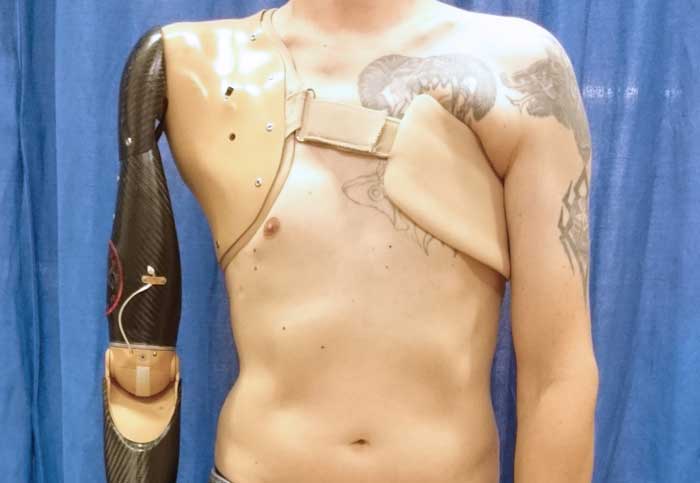
A new prosthetic arm could give amputees a full range of hand and arm function by detecting nerve signals. An international team has developed a sensor that can detect electrical signals from the nervous system and then interpret the signals to move a prosthetic arm. Currently available robotic prosthetics are controlled by movements in the remaining muscles. These remnant muscles are often damaged, which limits the prosthetics to simple grasp commands. The study in Nature Biomedical Engineering gets around this problem by focusing on the nervous system rather than muscles. The researchers, led by Dario Farina of Imperial College London in the UK, worked with six volunteers who had amputations from either the shoulder or just above the elbow. The volunteers had surgery to re-route nerves from the peripheral nervous system (nerves outside of the spine and brain) that would normally connect with the arm and hand. The nerves were instead directed to healthy muscles either in the bicep or chest depending on the amputation. A sensor patch made of high-density, flexible electrode grids then detects electrical signals from the re-routed nerve cells. The team decoded and mapped the signals using computer models and then compared them with those in healthy patients. As a result, they were able to program the prosthetic to respond to specific signals that were triggered by the patient thinking about phantom arm and hand commands. Although the work needs further refinements and clinical trials, the study is a proof-of-concept and the scientists hope that the robotic prosthetic will be on the market within three years, and they will be able to offer full movement to amputees.

3D printed structure mimics plant porosity

Close-up image showing the microporous structure within the node of the 3D printed triangular honeycomb

A new 3D printed material takes inspiration from plant structures. By using ceramic foam ink, scientists at Harvard University and Massachusetts Institute of Technology (MIT) in the US have developed a method of printing 3D structures with both macro- and microscale structures. In nature, there are many extraordinary materials that have similar structures. Grass, for example, has a hollow tubular macrostructure with a porous microstructure. This means the plant can recover after compression and support its own weight. Jennifer Lewis and team looked to mimic this architecture to create strong, lightweight materials. Using a ceramic foam ink containing alumina particles, water and air, they printed a triangular honeycomb structure that had microporous walls. The ink and printed structure were both tested and tuned to optimize density and stiffness. Other foam inks can be made from polymers and metals, and the resulting lightweight material could be used for thermal insulation or tissue scaffolds. The work is presented in Proceedings of the Natural Academy of Science.

  • You can find all our daily Flash Physics posts in the website’s news section, as well as on Twitter and Facebook using #FlashPhysics. Tune in to physicsworld.com later today to read today’s extensive news story on and atomtronic battery.

Water evaporation generates electrical energy

An electric power supply driven by water evaporating from a carbon nanomaterial has been unveiled by researchers in China. Their device is about 2.5 cm long and can create a voltage of about 1.5 V – on par with a standard AA battery. While the power supply only delivers a few hundred nanoamps, the team connected several devices together to run a liquid-crystal display. With further improvements, the researchers say, the device could be used to run sterilization equipment and to purify or desalinate water in warm regions of the world.

The power supply has been built by a team led by Wanlin Guo at Nanjing University and Jun Zhou at Huazhong University. It involved depositing multi-walled carbon nanotubes (MWCNTs) onto a quartz substrate to create two electrodes. The substrate is about 25 mm long and the 2 mm electrodes are positioned at each end. Carbon black – tiny particles of carbon about 20 nm in diameter – was then deposited, covering the substrate to a thickness of about 70 µm. Copper wires were then attached to each electrode and a circuit was completed via a voltmeter.

Dunked in water

One end of the device is placed in a beaker of deionized water so that the bottom few millimetres of the device are immersed. Capillary action draws water up the previously dry portion of the device, reaching a maximum distance of about 20 mm from the wet end in about 1 h. As the water rises through the device, the voltage across the electrodes increases, reaching a maximum value of about 1 V in 1 h.

When the device and beaker were placed in an enclosed environment from which water vapour cannot escape, the voltage dropped to zero in about 15 min – and recovered quickly when ventilation was provided. Air flow, which is known to boost evaporation, increased the voltage on the device up to 1.5 V. An increase in ambient humidity, on the other hand, lowered the voltage by inhibiting evaporation. Taken together, say the researchers, these observations confirm that evaporation is driving the operation of the device.

Streaming potential

An infrared spectroscopy study of the device suggests that electrical energy is created via a streaming potential. This is an electrochemical process that occurs when an electrolyte is driven by a pressure gradient through a channel or pore.

The team then connected four of their devices in series to create a power source that can deliver about 380 nA at 4.8 V – which was enough to drive a liquid-crystal display. The team says that the performance of the device could be enhanced by optimizing the streaming and evaporation processes.

The research is reported in Nature Nanotechnology.

Flash Physics: Astronomers help conservationists, quarks defy theory, movies of rotating molecules

Astronomers help conservationists detect animal heat

A conservation drone has been enhanced by astronomy techniques. An international group of scientists, led by Steven Longmore of Liverpool John Moores University in the UK, has combined an unmanned aerial system with a thermal-infrared camera and astronomical detection software. Monitoring species distribution and density is a challenge for conservation research. Surveys are usually done on foot, by manned aircraft or using satellite images, all of which are expensive and labour intensive. Furthermore, the commonly used visible-light cameras have limited use because they can only be used in daylight and often require manual analysis as different objects have the same brightness. To get around these problems Longmore and colleagues combined unmanned drones with thermal-infrared cameras. The pairing makes it easy to perform aerial surveys detecting the heat signatures of animals and humans. However, current data-analysis tools for infrared systems are not adequate for such large quantities of data. The researchers therefore applied methods used by astronomers. Astronomers are used to looking at vast quantities of data for distant objects that appear faint and small; their techniques are ideal for species monitoring. The work, described in the International Journal of Remote Sensing, combines the astronomical detection software with machine learning algorithms in a proof-of-concept study. By building a library of heat profiles unique to each species, conservationists hope to spot population changes. The scientists also aim to apply the technique to disaster relief and search and rescue.

Quark production at LHCb defies theory

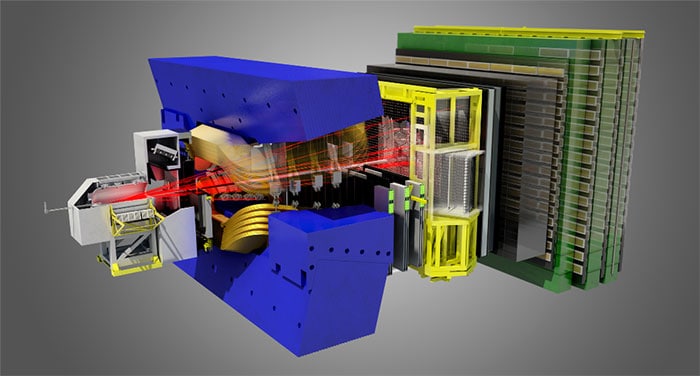
Diagram showing the various particle detectors that make up LHCb

A study of the production of b quarks at the Large Hadron Collider (LHC) at CERN suggests that more b quarks are being produced by 13 TeV proton–proton collisions than predicted by theoretical calculations. The measurements were made by physicists working on the LHCb experiment on the LHC, who compared b-quark production during 13 TeV and 7 TeV collisions. They found that at relatively low values of pseudorapidity (a measure of the angle between the direction of the proton beams and the momentum of the detected particle), about 66% more b quarks were produced by 13 TeV collisions than calculated by the “fixed order plus next-to-leading log” (FONLL) framework for predicting the production of heavy quarks. The excess has a statistical significance of 5σ, which counts as a discovery in particle physics. However, FONLL was able to predict b-quark production at 7 TeV, and the discrepancy at higher energy could point researchers to new physics beyond the Standard Model of particle physics. The study is described in Physical Review Letters.

New electron microscope makes movies of molecular rotation

4D electron microscope images of gold dimers taken over tens of nanoseconds

A new 4D electron microscope can acquire a series of nanometre-resolution images of tiny gold nanoparticles with nanosecond time resolution. Developed by researchers at Caltech in the US, the instrument has been used to make movies of gold dimers – comprising two gold nanoparticles measuring about 60–90 nm – as the dimers rotate in an aqueous solution. Jau Tang and colleagues used the microscope to study the rotation of dimers made from two same-sized nanoparticles and found the rotation process to be diffusive. However, when one of the nanoparticles is slightly larger than its partner, the rotation becomes “super diffusive” and as the size asymmetry becomes larger, the rotation becomes ballistic in nature. Writing in Science, the researchers say the 4D microscope should provide important insights into how nanocrystals and biological molecules behave in aqueous environments.


  • You can find all our daily Flash Physics posts in the website’s news section, as well as on Twitter and Facebook using #FlashPhysics. Tune in to physicsworld.com later today to read today’s extensive news story on a new source of electrical energy.

China forges ahead in space science

After years of detailed study and a highly competitive selection process, space scientists in China have officially told the government of the five space missions they want to launch between 2020 and 2022. From the observation of the Sun to the detection of black holes, the five proposed missions would require over 5 billion yuan ($725m) of government investment. Speaking at a press conference in Beijing in December 2016, Ji Wu, director-general of the National Space Science Center at the Chinese Academy of Sciences (NSSC-CAS), said that the projects have a high technical readiness. “We are already in the process of getting government approval and once given the green light, they will be entering the engineering development phase early [in 2017],” adds Wu.

The five missions, which were shortlisted from 21 proposals, include the Einstein Probe (EP) that will perform deep time-domain astronomy surveys to discover cosmic events and monitor variable sources in the soft X-ray-regime at around 0.4–5 keV. Weimin Yuan from the National Astronomical Observatories, who is chief scientist of the EP mission, says that the probe will search for X-ray signals associated with normally quiescent black holes and gravitational waves, which are both predictions of Einstein’s theory of general relativity. Yuan told Physics World that the satellite will combine a wide-field X-ray monitor with a “follow-up” X-ray telescope to enhance its scientific capability for the discovery and characterization of X-ray transients. The team has been making steady progress in developing “challenging” key technologies such as the “micro-pore” optics, the large-format focal plane detector and onboard data analysis.

“The EP will provide new insights into the energetic processes occurring beyond the solar system,” says astrophysicist Richard de Grijs at the Kavli Institute for Astronomy and Astrophysics at Peking University. “I have great faith in a successful outcome of this mission if it’s given the go-ahead.”

We are eager to make fundamental contributions to the international solar physics community

Another mission selected is the $100m Advanced Space-based Solar Observatory (ASO-S), which will study the connections between the solar magnetic field, solar flares and coronal mass ejections. ASO-S is planned to launch in 2021 or 2022 before the next solar maximum and would become China’s first solar space observatory. According to Weiqun Gan, a researcher at Purple Mountain Observatory in Nanjing and ASO-S’s chief scientist, the craft will be a “dream come true” for generations of solar physicists in the country. “We are eager to make fundamental contributions to the international solar physics community,” he adds.

The other three missions given the go-ahead are the Water Cycle Observation Mission to understand how the Earth’s water cycle is related to climate change; the Magnetosphere-Ionosphere-Thermosphere Coupling Exploration mission, which comprises four spacecraft to simultaneously traverse the Earth’s polar regions at three different altitudes and investigate the interaction of the Earth’s atmospheric layers; as well as the Solar Wind Magnetosphere Ionosphere Link Explorer – a CAS-European Space Agency (ESA) collaboration to explore the interactions between the Earth’s magnetosphere and the solar wind, including space-weather science.

While China is a latecomer to launching dedicated space-science missions, it is quickly catching up thanks to generous government funding. That began in 2011 at the start of the nation’s 12th five-year plan, which aimed to boost scientific and technological innovation at the national scale. Researchers received around $550m for the first batch of missions during 2011–2015 that resulted in CAS’s strategic priority programme in space science. These missions included the Dark Matter Particle Explorer, which launched in late 2015; Shijian-10, a microgravity experiment platform that was sent into orbit in April 2016; and the Quantum Experiments at Space Scale that was launched in August 2016. The last of these – the Hard X-ray Modulation Telescope – is set to take off later this year.

“In China, we used to be followers in many fields in science for way too long. This has to be changed,” says Yuan. “The good sign is that innovation is now greatly encouraged by CAS as well as the government at an unprecedented level.” Wu told Physics World that they are expecting a flat or slight increase in the budget over the next five years. “It is clear that space science, as an emerging area, has earned the recognition of the Chinese government,” he adds. Yet Wu warns that the way such missions are funded needs to be improved, including the requirement of a more steady “annual government budget”. Indeed, since there is no dedicated agency similar to NASA or ESA for space activities in China, projects tend to be approved in a case-by-case manner by the government.

China is already looking for international collaboration to compensate for the country’s lack of experience. Maurizio Falanga, project manager at the International Space Science Institute (ISSI) in Bern and founding director of ISSI-Beijing, who has been strongly involved in the assessment of these candidate projects, says that the second batch of projects will be “more open for international collaboration or contribution”. “Space science is one major area which engenders international co-operation,” he adds. “We can avoid duplicate projects, share high costs and make common discoveries.”

The need for partners is backed by de Grijs. “As a mature science nation, China would be well advised to act as a senior partner and consider inputs from a wide variety of stakeholders, partners and even competitors,” he says. “This will ultimately benefit us all, anywhere in the world.”


3D neutrinos on your phone, Hamiltonian: an Irish Musical, is a March for Science a good idea?


By Hamish Johnston

How would you like to explore a giant neutrino detector in 3D from the comfort of your mobile phone? VENu is a new smartphone app that allows you explore the physics underlying the MicroBooNE neutrino detector at Fermilab. Developed by Alistair McLean of New Mexico State University and an international team of physicists, the app is used in conjunction with the Google Cardboard headset to provide users with a virtual-reality experience of MicroBooNE. VENu includes games that offer “brain teasing challenges” including working out how to spot a neutrino event in a busy background of cosmic-ray events. The app can be downloaded free of charge from the Apple Store and the Google Android Marketplace.

(more…)

Boosting innovation in a Brexit Britain

By Michael Banks

I headed to London yesterday for an event on the future of UK science and innovation funding and policy that was organized by the Westminster Higher Education Forum.

Held at the Royal Society of Medicine, the meeting was attended by representatives from government, business and academia. It was impeccably timed given that the “Brexit bill” is currently going through parliament and the UK government recently published an industrial strategy together with the announcement of an additional £4.7bn for R&D.

While it is safe to say that the UK is a scientific powerhouse, the same cannot be said of its ability to translate research into products and services, something that the new industrial strategy aims to tackle.

(more…)

Flash Physics: Stray black hole spotted, new urban wind turbine, Mark Walport to lead new UK science agency

Cosmic bullet may be a stray black hole

A stray black hole is thought to be bursting out of a supernova remnant. While studying supernova remnant SNR W44, scientists at Keio University in Japan may have stumbled across a wandering black hole. SNR W44 is 10,000 light-years away from Earth and surrounded by an expanding cloud of molecular gas. Masaya Yamada and colleagues were examining the energy-transfer processes of W44’s supernova explosion when they observed an object at the cloud’s edge travelling 100 times faster than the speed of sound in interstellar space. The object, which they named the “Bullet”, is moving against the Milky Way’s rotation and appears to be shooting out of the SNR trailed by gas. Using data from the Nobeyama Radio Observatory and the Atacama Submillimeter Telescope Experiment, the researchers found the Bullet had immense kinetic energy that could not be accounted for by the supernova explosion. Writing in The Astrophysical Journal Letters, Yamada and colleagues propose two models involving a black hole to explain the unusual phenomenon. In their “explosion model” there is an additional explosion event near the expanding gas cloud. They propose that the SNR W44 passes a static black hole that pulls the gas closer and causes an explosion. The gas is then accelerated away once the cloud has passed the black hole. Alternatively, there is the “shooting model”. In this case a wandering, high-speed black hole travels through the dense cloud, pulling gas along behind it. The team hopes further analysis will make it clearer which scenario is occurring. The finding may also help to observe other stray black holes that have been predicted to exist within the Milky Way.

New wind turbine is designed for urban use

Photograph of the new wind turbine

A new wind turbine for domestic and small-scale commercial use has been developed by the European SWIP programme – which is funded by the European Union (EU) and involves companies, institutes and universities in 10 EU countries. According to SWIP, the turbine is up to 20% more efficient at generating electricity in wind conditions commonly found in urban environments. One important feature of the turbine’s blades is that their tips are wider than on those found on other small turbines. According to Fernando Aznar of Solute – a Spain-based wind-energy engineering firm – the wider tips improve the aerodynamic performance of the blades while reducing noise and vibrations. Making a quiet turbine is an important goal of SWIP because the systems will operate in populated areas. The turbine also has a new control system that adjusts the pitch of the blades to maximize efficiency. This system is passive – with changes being driven by the blades themselves – which Aznar says is decreases the total cost of the turbine and protects it from damage. Lin Ma of the University of Sheffield developed computer models of the turbine and says that “the new blade design takes consideration of the performance, noise, aesthetic aspect, the cost of manufacturing of the turbine and the long term operational and maintenance costs.” The turbine’s electrical generator was developed by the Spanish company 4fores. “The challenge was to obtain a permanent magnet synchronous generator that operates at lower rotational speeds than currently used generators, while maintaining benchmark size, power and efficiency, and keeping cost at a low level,” says Jorge Herrero Ciudad of 4fores. One problem that plagues the low-speed operation common in urban areas is “cogging torque”. This is caused by magnetic interactions within the generator and results in the jerking of blade rotation. The SWIP generator was designed to minimize cogging torque, which allows it to produce energy even while running at low speeds. The turbines are also 50% lighter than conventional design because aluminium is used in place of steel. This reduces the cost of installing the turbines because the supporting tower does not have to be as substantial. There is more about the SWIP turbine in “Wind turbines head for homes again“.

Mark Walport to lead new UK science agency

Photograph of Mark Walport

Mark Walport, the UK government’s chief scientific adviser, has been appointed the first chief executive of UK Research and Innovation – a new umbrella organization that will oversee the country’s seven research councils. The UKRI, which will be responsible for £6bn in research grants and funding each year, is expected to be created when the higher-education and research bill passes through parliament later this year. In addition to the seven research councils, which include the Science and Technology Facilities Council and the Engineering and Physical Sciences Research Council, the UKRI will also include Innovate UK – a public body that works with companies to boost innovation – as well as some functions of the Higher Education Funding Council for England. “My ambition is to make UKRI the world’s leading research-and-innovation public funding agency,” says Walport. If the UKRI gets the go ahead it is expected to begin operation in early-2018.


  • You can find all our daily Flash Physics posts in the website’s news section, as well as on Twitter and Facebook using #FlashPhysics.

Heat-gated transistor could boost medical imaging

A heat-gated transistor in which an electric current can be modulated by changing the temperature of the gate electrode has been developed by researchers in Sweden. The device combines two developing scientific fields – ionic thermoelectrics and polymer electronics – and could have a wide range of potential applications, from medical imaging to night vision.

Temperature is a key physical quantity that is measured in many fields of science and technology. Infrared binoculars and cameras measure temperature differences and are used for night vision, whereas mapping the temperature of tissue can provide important medical information. Despite its importance, mapping temperature changes in space and time can be very challenging.

One option is to use thermoelectric sensors called thermocouples, in which two different materials develop a potential difference in response to a temperature difference. The voltage produced in traditional thermoelectric materials is usually small, however, which limits the sensitivity of the detectors. Multiple thermocouples connected in series are required to provide the gate voltage for a transistor, which would then convert a small heat signal to a signal that could be displayed in a device. This makes the circuitry in imaging devices complex and bulky.

Researchers at Linköping University in Sweden have overcome this problem using an ionic thermoelectric polymer electrolyte. Traditional thermoelectric materials – which conduct electricity through the temperature-induced motion of either electrons or holes – usually achieve a maximum potential difference of a few hundred microvolts per degree kelvin. In contrast, the Linköping group is developing electrolytes in which charge separation is achieved by the motion of ions.

Mobile ions

In 2016, the team developed an electrolyte containing a solution of the polymer polyethyleneoxide. When sodium hydroxide is added to the solution, the hydroxide ions combine with protons from alcohol groups on the polymer chains to create a solution of mobile sodium ions and relatively stationary, negatively charged polymer chains. When one end of the electrolyte heats up, the positive sodium ions diffuse away from the heat faster than the polymer chains, creating a negative charge at the hot end. The thermoelectric effect in these ionic electrolytes can be much stronger than in conventional materials – as much as 11,000 μV K–1. The researchers injected this solution between two electrodes to produce a thermoelectric “supercapacitor” that could charge up during the day and produce electricity at night.

In the new research, the team has integrated the supercapacitor into a polymer transistor so that one of the supercapacitor electrodes functions as the transistor’s gate electrode. Team member Simone Fabiano explains that the second key innovation lies here: “The transistor we are using is an electrolyte-gated transistor,” he explains, “And the beauty is that you can have a modulation of the current on a gate-voltage range which is much smaller than typical transistors.”

Applying heat to the back electrode of the supercapacitor changes the voltage on the gate electrode and alters the resistance between the source and drain electrodes of the transistor. By combining a thermoelectric sensor that can produce much larger voltages than usual with a transistor that can operate at much smaller voltages, the researchers removed the need for multiple thermocouples. Instead, a detectable change in the current is produced simply by changing the temperature of one electrode by one degree. This could make it much easier to produce arrays of detectors for imaging, for example.

Robot skin

As a bonus, polymer transistors can be made flexible and stretchable and can easily be printed on skin and a variety of other substrates. This could prove useful for making “electronic skin” – networks of tiny sensors that can wrap around objects such as human skin and map temperature variations. “You could get clinically relevant medical information,” explains Fabiano. “You could track a healing process or get information about pathological conditions that are directly related to variations in body temperature.” Electronic skin could also be useful in robotics.

“It’s enabling for a lot of applications,” says engineer George Malliaras of MINES Saint-Etienne in France. He adds: “The researchers produced something that can easily be microfabricated and placed on large areas. It’s early stage work and the limits need to be explored, but I see this as a very promising technology that can take many forms. I look forward to seeing what they will cook up next!”

The research is published in Nature Communications.

Copyright © 2026 by IOP Publishing Ltd and individual contributors