February in the UK is LGBT History Month, an annual event to promote equality and diversity for the benefit of the public. This year, three engineering organizations have got involved by producing a series of online videos profiling lesbian, gay, bisexual and transgender (LGBT) engineers. According to the Royal Academy of Engineering, InterEngineering and the engineering firm Mott MacDonald, the ‘What’s it Like?’ video series is designed to “inspire prospective engineers who are LGBT, as well as existing engineers who may wish to come out or transition at work”.
The video above features a medley of quotes from people profiled in the films, including Mark McBride-Wright, who is the chair and co-founder of InterEngineering and a gay man. A not-for-profit outfit, InterEngineering seeks a more inclusive profession by running panel discussions and providing career development opportunities for LGBT engineers. “As a profession, we are at the beginning of a journey creating an inclusive industry for everyone and I hope these videos will play a part in attracting LGBT+ students to the engineering industry,” says McBride-Wright.
A possible braking system has been devised for the tiny, ultrafast spacecraft being developed as part of Breakthrough Starshot. In 2015, billionaire Yuri Milner began funding space-exploration research. The Starshot project is one of his three Breakthrough Initiatives and aims to develop and demonstrate ultralight, miniature spacecraft and send them to the closest star system, Alpha Centauri. The proposed “nanocraft”, which are currently in the theoretical stage, will consist of extremely small electronic cargo attached to a large, very thin sail. Once launched into space, a powerful laser on Earth will be fired at the sail causing it to accelerate to 20% the speed of light. Although this would mean the unmanned spacecraft could travel the 40 trillion km to Alpha Centauri in only 20 years, one of the many questions is how to stop the nanocraft from shooting past its destination. René Heller of the Max Planck Institute for Solar System Research in Germany and his colleague Michael Hippke have calculated a possible solution. In their simulation, the nanocraft weighs less than 100 g and the sail is a massive 100,000 m2. They propose redeploying the sail as is approaches Alpha Centauri, which would allow incoming radiation from the star system to slow the small probe. The stars’ gravitational fields would also attract the spacecraft and deflect it in a swing-by manoeuvre often used by space probes in the solar system. Although this feat requires precise positioning and approach speeds, it could allow the small, unmanned probe to reroute to the nearby red-dwarf star Proxima Centauri and the Earth-like planet Proxima Centauri b. Heller and Hippke present their findings in The Astrophysical Journal Letters.
Graphene-based thermometer combines pyroelectricy with bolometry
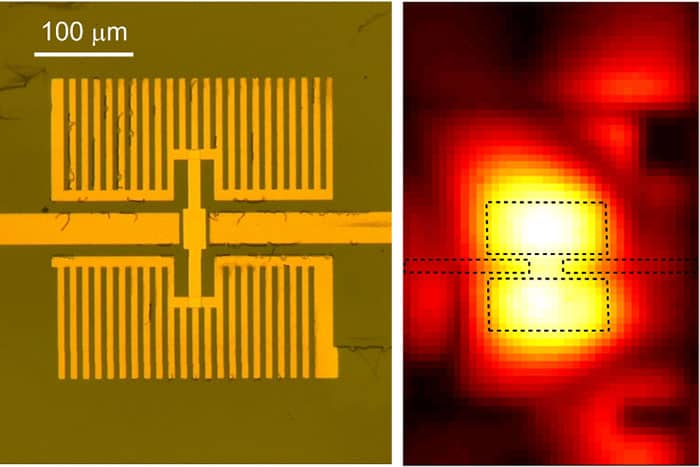
The graphene-based thermometer (left), where the graphene channel (not visible) runs horizontally under the cross at the centre of the device. The image on the right shows the device illuminated with infrared light. (Courtesy: Graphene Flagship)
A new type of infrared thermometer that is based on graphene has been unveiled by an international team of researchers working under the European Union’s Graphene Flagship research initiative. The highly sensitive device operates at room temperature (unlike some other infrared detectors) and combines two infrared detection techniques – pyroelectricity and bolometry. Pyroelectric materials experience a change in electrical polarization with tiny changes in temperature, whereas bolometric materials experience a change in electrical resistance. The team fabricated an electrical circuit that is sensitive to changes in both polarization and resistance and used graphene – a sheet of carbon just one atom thick – to amplify the temperature-dependent signal. According to the researchers, the high electrical conductivity of graphene meant that the device could be built without the need for external transistors – which they say reduced both losses and noise in the system. The device can measure changes in temperature as small as 15 μK and is described in Nature Communications.
New cooling method could boost atomic-clock accuracy
A new way of improving the accuracy of atomic clocks by further cooling trapped ions has been developed by Jwo-Sy Chen and colleagues at NIST in Boulder, Colorado. Ions in the world’s best atomic clocks are cooled to very low temperatures, which allows the clocks to have accuracies of 10–18. However, when laser light is shone on these ions to measure the clock frequency, the ions will heat up – and this makes it very difficult to cool the ions further to boost clock performance. Now, Chen and colleagues have worked out a way to use the well-established “resolved sideband” cooling techniques to solve this problem. By creating a new ion trap, they have been able to reduce the laser heating of the trapped ions by a factor of 100. According to their measurements and computer simulations, their technique should make it possible to create a clock that is accurate to within 10–19. The new cooling technique is described in Physical Review Letters.
You can find all our daily Flash Physics posts in the website’s news section, as well as on Twitter and Facebook using #FlashPhysics. Tune in to physicsworld.com later today to read today’s extensive news story on a new heat transistor.
Jurassic Park and its sequels are best thought of as monster movies. But they do make dinosaurs look and act like real animals – which, of course, they were. For more than 100 million years, various groups of dinosaur were the largest predators and herbivores on the planet. There were many smaller species too, though we only know about a fraction of them, since fossils of them are rare, and we’re aware of many only through fragments.
Scientists have been able to answer the biggest scientific question posed by Jurassic Park in one of its most tense chase scenes: could a Tyrannosaurus rex outrun a Jeep? (Answer: no.) Knowing the top speed of an apex predator is vital as it tells us what sorts of prey it could catch. To better understand these creatures, scientists also want to know if a Stegosaurus’ fearsome spike-wielding tail could be used as a weapon, and what damage it could do. Another question is how pterosaurs (cousins of the dinosaurs) could evolve to become the largest flying animals.
Answering all of these questions involves understanding what forces and torques these creatures’ skeletons could withstand. It also involves estimating the strength of their muscles and the mass of their flesh. While some bones, and muscle fragments, have survived the last 65 million years, unfortunately, flesh was not preserved. This means that while these questions come from palaeontology, they must be answered using physics, force diagrams and multi-body simulations.
“I have been described as a physicist in denial,” admits Michael Habib of the Natural History Museum of Los Angeles County, whose work on pterosaur flight is informed by his training in fluid mechanics.
Many palaeontologists also study living animals, since bones and muscles have a lot of common features across the animal kingdom. Birds are even technically dinosaurs, having descended from a sub-order called Therapoda. But analogy can only go so far. “What we have in a dinosaur is a cross between a mammal and a bird and a crocodile and a monitor lizard,” says Heinrich Mallison of the Museum für Naturkunde in Berlin. While it’s tempting to use modern animals as stand-ins, “there is no extant animal that is a perfect model”.
Evolutionary biomechanic John Hutchinson of the Royal Veterinary College, University of London, agrees. “I’d rather model a T. rex as a T. rex. That’s the benefit of computational models: you can model the physics of that animal with its own anatomy.”
All about mass
Consider the ostrich, the largest living dinosaur. It has hollow bones threaded with air sacs that are connected to its lungs, which help it to breathe and keep its skeleton light compared with a mammal of the same size. Many of their extinct dinosaur cousins also had hollow bones and air sacs, which helped them to grow huge. But how massive were dinosaurs when they were alive, and how was that mass distributed through the body?
Hutchinson explains that you have to be careful to draw appropriate analogies with today’s animals, when body mass dictates so much of what an animal’s biology can do. “Ostriches [which have a mass of about 100 kg] are orders of magnitude smaller than a T. rex,” he says. “If you’re looking at a 100 kg dinosaur and comparing it to a 100 kg living animal, however, it’s probably okay.”
Using data from living animals, palaeontologists can estimate how much mass was in each part of a dinosaur or pterosaur body. They can then construct a model to determine the location of its centre of mass, the forces and torques involved when the animal took a step, and the stresses on the wing bones of flying reptiles.
However, since muscles are never preserved enough to reconstruct the entire animal, dinosaur weight estimates often vary by a factor of two or more. Estimating how much muscle and the distribution of air sacs dinosaurs had depends on a lot of assumptions. For instance, a fully grown T. rex could have weighed 5 tonnes, or 11 tonnes or anything in-between. Since heftier animals move more slowly than the svelte ones featured in Jurassic Park, for example, the assumptions going into the physical models strongly affect the results.
Run, T. rex, run
We know that the T. rex stood and ran on two legs, holding its body nearly horizontally. To balance its huge head and anchor its leg muscles, it had a huge tail. That means it had to support all its weight balanced on a single leg during each step while it walked or ran. The faster it ran, the more stress that single leg would have to support.
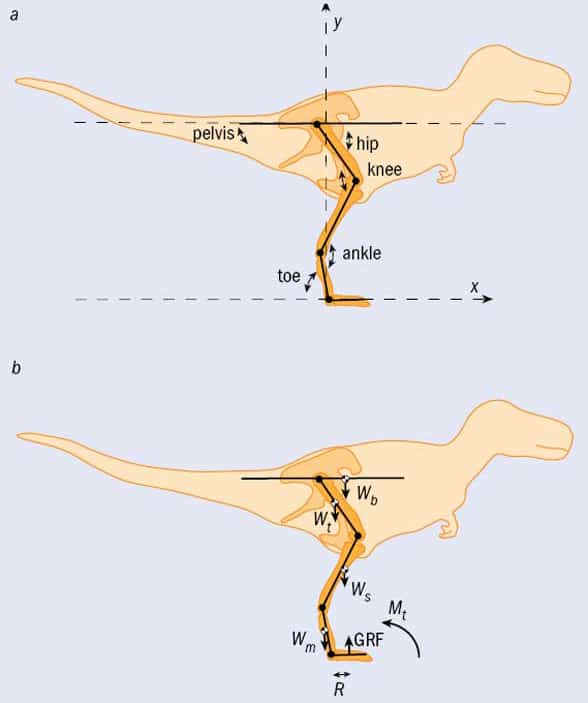
To model the mechanics of a running T. rex, Hutchinson and his colleagues examined the animal frozen in mid-stance, with its body supported on one leg (2002 Nature415 1018). They considered the vertical forces only, since the horizontal forces on the leg nearly balance out. Using Newton’s first law, they calculated the minimum required muscle mass in both legs as a percentage of total body mass: 43%. “We had to estimate the moment arms of different muscle groups acting against gravity around each joint of the limb,” Hutchinson says (figure 1).
1 Tyrannosaurus, run John Hutchinson of the Royal Veterinary College, University of London, and colleagues modelled the mechanics of a running Tyrannosaurus rex. Key factors included (a) the joint angles and (b) the weights of each segment – the trunk, thigh, shank and metatarsus (Wb, Wt, Ws, Wm). Also shown are the ground reaction force (GRF) at the foot (which passes through the whole body) and its moment arm about the toe (R), which were used to calculate the toe joint movement (Mt.). The model showed that the top speed of a Tyrannosaurus rex was around 40 km/h. (Reused from Hutchinson 2004 J. Morphology262 441 with permission of John Wiley & Sons)
The ground-reaction force on the animal while running is higher than the animal’s weight while standing still. Hutchinson explains, “When a typical human sprints, you would exert a vertical force of two-and-a-half times body weight or more at a 15 miles-per-hour [24 km/h] sprint. A really good sprinter might have to sustain four or five times their body weight [to achieve] an even faster speed.” In other words, the faster a T. rex ran, the more load each of its legs would have to bear, and that limits its top speed. “Whether you’re a fish or a salamander or an ostrich or an elephant, it’s pretty constant how much force you can get out of the muscles that act to resist gravity,” Hutchinson says. “You get about 300 kN per square metre at best out of muscle when it’s contracting isometrically: not lengthening or shortening.”
Since muscles do contract while running, the 300 kN estimate is a generous one, providing an upper limit on how hard a T. rex could push itself. Hutchinson and his colleagues found that – based on their assumptions such as treating horizontal forces as negligible – T. rex could reach a top speed of around 40 km/h. With a Jeep’s top speed being far above that, it turned out that the chase scene in Jurassic Park got it right: the Jeep’s passengers got safely away.
Sting in the tail
Like elephants, some dinosaurs couldn’t run. Instead, they compensated by being heavily armed and armoured. For instance, Stegosaurus and its relatives had heavy tails tipped with long horn-covered spikes. One skeleton of the predatory dinosaur Allosaurus has a badly healed injury from a Stegosaurus tail spike lodged in its bone. But to know how effective the Stegosaurus tails could have been, palaeontologists need to use physics.
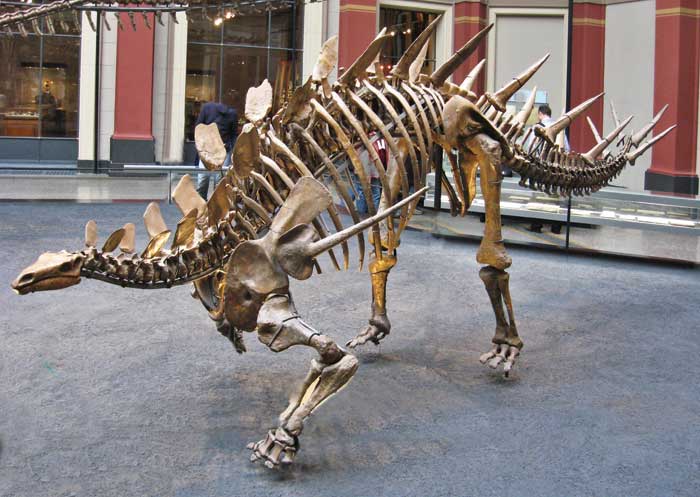
Mallison, of the Museum für Naturkunde, researched Kentrosaurus, a much smaller Stegosaurus relative from Tanzania that lived around 153 million years ago. The museum has a largely complete Kentrosaurus skeleton, which it reassembled in 2005 to reflect modern research on posture. Previously it had been assembled with sprawling limbs like a monitor lizard, but a correct construction showed it had upright, column-like hind legs and bandy front legs.
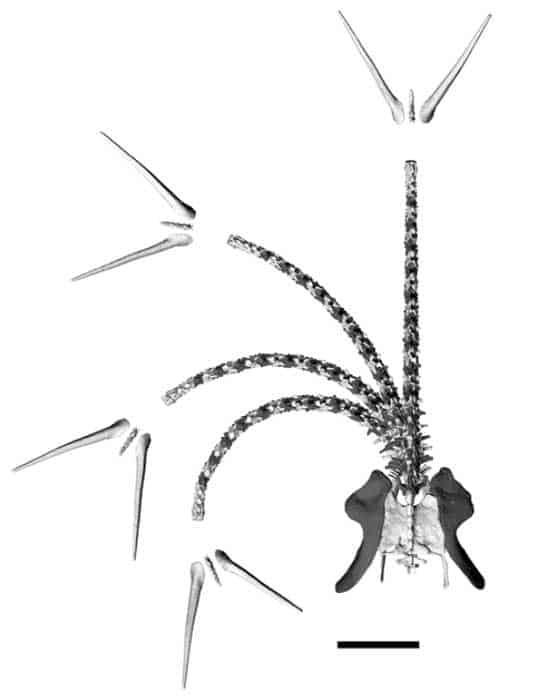
2 Kentrosaurus reassembled This CAD diagram is based on laser scans of the individual bone components from when the Kentrosaurus skeleton at the Museum für Naturkunde in Berlin was dismantled, combined with physics modelling. It shows how the tail could bend right round and so potentially bash predators that got too close. (Reused from Mallison 2010 Swiss J. Geosci.103 211 with permission of Springer)
During reassembly, the museum laser-scanned each bone to create a 3D digital file. Mallison used these to build a complete model of the animal in a computer-assisted drawing (CAD) multi-body dynamics program, which is also used in sports medicine for gymnasts (2010 Swiss J. Geosci.103 211). “[I]t’s kind of cumbersome to do that with real physical objects because they fall down and break,” he says. “If you do it in the computer, hey! no problem.” Another advantage to computer modelling is the ability to adjust parameters such as muscle mass, which – like the T. rex leg – tells us how strongly Kentrosaurus could whip its tail and how much inertia the whipping had (figure 2).
Mallison treated each tail bone as a separate mass body and strung them together to get the model of the entire tail, much the way physicists construct multi-body mechanical models for various systems. Using this model, he estimated that each joint between tail bones could only move about 4°, but together the joints allowed semi-circular swings. “The weight at the end of the tail was 8 kg, so the impulse that they can transfer is really huge,” he says. Even without using the tail spikes, they could crush the rib cage of a predator. Though it was smaller than Stegosaurus, “Kentrosaurus was a baseball hitter from hell.”
Staying aloft
Flight is another challenge for palaeontologists. Flying dinosaurs – birds, that is – can be understood through plenty of living examples (though even our understanding of the transition of modern-day animals to flight is contentious). Pterosaurs aren’t very bird- or bat-like, though, which means direct analogies with extant animals are of limited use to researchers who are trying to deduce how these animals achieved lift-off and maintained flight.
“[Pterosaurs] have a muscular skin-covered wing that is stretched between its giant fourth finger and the body,” says Habib of the Natural History Museum of Los Angeles County. “That kind of wing can generate a very high coefficient of lift.”
Coefficient of lift is a function of wing size and flight speed, neither of which we know precisely. However, Habib says, “the basic aerodynamic tricks required for staying aloft are not all that different from any other animal”. In other words: a wing is a wing to a certain extent, whether it’s on a bird or a hang glider. “A high lift coefficient helps them support their weight even at low speeds for a big flying animal,” says Habib. “The problem is getting going in the first place.”
Pterosaurs launched into the air differently than birds or bats, because on the ground they walked on their wings and hind legs. Habib and his colleagues think that means they also jumped into the air using all four limbs, “which gives you quite a bit more jumping power than if you just used your hind limbs”.
Strike a pose The Museum für Naturkunde mount of a Kentrosaurus composite skeleton was re-posed in 2005 after research revealed a more realistic walking stance. (CC BY 3.0/LoKiLeCh)
Pterosaurs were a diverse group, with some species living far inland and others hunting fish in the ocean. The different lifestyles were reflected in their flight abilities. The wing membranes aren’t preserved in many specimens, so we do not have precise wing shapes, but researchers have determined some had extremely long skinny wings, “like a super albatross”, as Habib puts it. These animals, like albatrosses, soared over open water. Others had shorter, wider wings, which made them able to manoeuvre at high speed.
Unlike birds, pterosaurs probably flew with their wings swept forward, a design only seen in a few rare aircraft. That’s because pterosaur heads were huge, in some cases several times the lengths of their bodies. The giant Quetzalcoatlus, for example, stood as tall as a giraffe with a wingspan of 11 m, but its body was only about 75 cm long. Its head, in contrast, was about 3 m long. As a result, “the centre of mass is a little forward of the shoulder,” says Habib.
Prehistoric flight Pterosaurs such as Moganopterus (left) walked on four limbs, including their wings, which means they would have jumped into the air differently from birds or bats. Their heads were huge compared with their bodies. The Quetzalcoatlus (right) was one of the largest ever flying animals, with a 3 m long head and a 75 cm long body. (Courtesy: Nemo Ramjet/Science Photo Library; Joe Tucciarone/Science Photo Library)
Another type of pterosaur, the Pteranodon, had a long snout and a long crest on the back of its skull, which is impressive but looks tame when compared with many of its relatives. Some had gigantic axe-like crests or protrusions like old-fashioned TV antennas. However, these appendages had only a minor effect on flight, based on physical models. “A lot of these crests are really big, but they’re really flat side-to-side,” says Habib. “They add a bunch of drag mostly, but not a whole lot else, oddly enough.” They probably couldn’t turn their heads in flight, but neither do large modern birds, and it’s easy to see why. “These are animals that are travelling at speeds that are lethal upon contact with a surface, so it’s best to look where you’re going.”
Success story
When looking at prehistoric animal motion, it’s fascinating how little we know. For instance, how did they lie down to sleep? “We know pretty much nothing about how [living] animals lie down and stand up,” says Hutchinson. For that reason, he and his colleagues have been collecting data on living animals, which they haven’t published yet. Until they do, we won’t know much about how T. rex got down – except very slowly and carefully.
Despite the stereotypes of dinosaurs as failures, they and pterosaurs were remarkably successful animals, dominating the planet for more than 100 million years. No evolutionary failure could endure that long, and the way they lived had to be part of the secret to their success. The glory of physical models of extinct animals is that, with refinement and testing, researchers can fill in gaps in our knowledge to recreate some of the biggest and most interesting creatures that ever lived.
Frogs capture prey using shear-thinning saliva that spreads over insects when the tongue hits and then thickens and sticks when the tongue retracts – according to researchers in the US. In combination with the tongue’s unique material properties, this two-phase, viscoelastic fluid makes the tongue extremely sticky, allowing frogs to capture and swallow prey heavier than themselves in the blink of an eye. The research could lead to the development of new types of adhesives and material-handling technologies, say the scientists.
Frogs can capture flying insects at astonishing speeds with a flick of their whip-like tongues. But it is not just lightweight insects that they can grab. Research has shown that a frog tongue can pull up to 1.4 times the frog’s body weight. And frogs have been recorded capturing larger animals such as mice and birds.
At the start of the latest study, Alexis Noel, at the Georgia Institute of Technology in Atlanta, and colleagues, filmed common leopard frogs, Rana pipiens and other species capturing crickets with a high-speed camera at 1400 frames per second. They found that a leopard-frog’s tongue can capture an insect in less than 0.07 s – five times faster than humans can blink.
Honey trap
The team’s calculations show that when the tongue is retracting, the force on the insect can reach 12 times that of gravity. The tongue is able to adhere to prey under such forces because it is extremely soft and viscoelastic, and coated in a non-Newtonian, shear thinning saliva, according to the researchers. Shear thinning is the property of some fluids whereby a shear force on the fluid reduces its viscosity. At low shear rates the saliva is very thick and more viscous than honey. But when subjected to high shear forces, for example when the tongue is accelerating in to prey, the saliva thins, becoming around 50 times less viscous, the researchers found.
“During prey impact, the saliva experiences high shear rates, resulting in the saliva becoming thin and liquidy, penetrating insect cracks,” explains Noel. “During insect retraction, the saliva experiences low shear rates, firming up and maintaining grip on the insect.”
“Frog saliva is much like paint, another shear-thinning fluid,” says Noel. “Paint is easy to spread on walls with a brush. Once the brush is removed, the paint then remains firmly adhered to the wall. This is because paint viscosity changes with applied shear rate.”
Soft material
The researchers also found that the frog tongue is one of the softest known biological materials. It is as soft as brain tissue and 10 times softer than the human tongue. The extreme softness allows the tongue to deform and wrap around the prey during impact, creating a large contact area, aiding capture and adhesion.
The tongue’s softness and viscoelastic nature also helps it maintain contact with the insect as it retracts back into the mouth. According to the researchers, the tongue is highly dampened and as the insect is yanked towards the frog it acts like a shock absorber, storing energy in its soft tissue and reducing separation forces between saliva and insect. Noel uses the analogy of a bungee cord. “If the tongue were stiffer, it would be like a human jumping off a bridge with a stiff rope wrapped around the ankle.”
Once the insect is inside the frog’s mouth the shear thinning saliva comes in to play again. The frog retracts its eyeballs into the mouth cavity to push the insect down its throat. This motion produces a shearing force parallel to the tongue that is high enough to turn the saliva thin and watery, and the insect is released and swallowed. The two-phase saliva helps in all phases of prey capture: low viscosity assists during impact and release, while high viscosity assists in prey adhesion.
Reversible adhesives
The researchers believe that these mechanisms could inspire the design of synthetic reversible adhesives for high-speed applications. Noel told Physics World that she could imagine such an adhesive “being used for a fast object collection mechanism in drones” or as a way to grab delicate objects off a conveyer belt in a manufacturing plant.
Pascal Damman of the University of Mons in Belgium told Physics World: “This study confirms what we showed in our work on chameleons, the combination of elastic deformation of the tongue together with the viscous mucus ensure efficient prey capture. I’m however surprised to see that the adhesion force observed for the frogs are much smaller than the adhesion strength observed for chameleons.”
A new low-cost terahertz wave source could lead to the development of portable, non-invasive screening devices. A team of engineers led by Yang Hyunsoo of the National University of Singapore (NUS) has developed a new flexible device that emits terahertz (THz) electromagnetic radiation. THz waves lie in between infrared and microwaves on the electromagnetic spectrum. As non-ionizing and non-destructive radiation, the waves can travel through materials including semiconductor wafers, woods and clothes. This makes them ideal for screening processes such as cancer diagnosis, detecting explosives and safety surveillance. However, current devices producing THz waves are bulky, multi-component systems. In contrast, the NUS team has developed a thin, flexible source. The device is made of non-magnetic and ferromagnetic metallic films that are 12 nm in thickness. The THz emission is driven by a laser beam. The laser excites spin currents, causing the inverse spin Hall effect to generate transient charge currents. This results in THz emission. The waves can be produced by a low-power laser and the system has higher power output than standard THz devices. The group has also demonstrated a low-cost fabrication method and hopes the finding could lead to new portable and low-cost scanning devices. The work is presented in Advanced Materials.
The push and pull of galaxy voids and groups
The Milky Way is being repelled by an extragalactic region nearly devoid of galaxies. A team of scientists led by Yehuda Hoffman of the Hebrew University of Jerusalem in Israel has confirmed that the motion of the Local Group of galaxies – which includes the Milky Way – is partly determined by the concentration of galaxies in other regions. The Milky Way and neighbouring galaxies have a peculiar velocity, which is not explained by the universe’s rate of expansion. In the past it has been suggested that this velocity is due to areas of space having different densities of galaxies. A high-density region is thought to attract galaxies, while a low-density region repels. Previously, studies of the Shapley concentration – a nearby region with a high galaxy density – have confirmed an attractive force on the Local Group. However, confirming whether a galaxy deficiency is repulsive has proved challenging because such voids are dark and difficult to study. Now, Hoffman’s team has been able to create a 3D model of galaxy flow using data from various powerful telescopes, including the Hubble Space Telescope. They were specifically interested in a void on the opposite side of the Local Group to the Shapley concentration. The research confirmed that the Local Group and other neighbouring galaxy clusters are flowing away from the void. The combination of this so-called dipole repeller and the Shapley attractor explains the direction and value of the peculiar velocities exhibited by Milky Way and neighbouring galaxies. The finding is presented in Nature Astronomy.
Bevelled edges confound topological protection
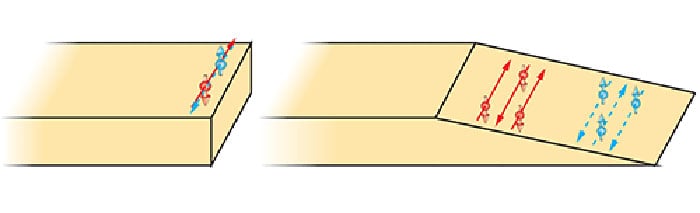
On the edge: spin-up and spin-down electrons travel in opposite directions in an ideal topological insulator (left). In a bevelled material (right), however, electrons can move in both directions regardless of their spin. (Courtesy: J Wang et al./Phys. Rev. Lett.)
The much vaunted protection from backscattering afforded by topological materials could be diminished by the real-world effects. That is the conclusion of Jianhui Wang and Yigal Meir of Ben-Gurion University and Yuval Gefen of the Weizmann Institute of Science in Israel, who have calculated how bevelled edges affect the flow of electrons in a quantum spin-Hall phase 2D topological insulator. Electrons in one spin state will only flow clockwise around the edges of such a material, while electrons in the opposite spin state will only flow anticlockwise. For an electron to backscatter from a defect in its path and flow in the opposite direction, it must flip the direction of its spin. However, spin flips are forbidden by symmetry considerations and therefore electrical currents flowing around the edge of the material are “topologically protected” from backscattering. This protection means that such materials have very high electron mobility and could be used to create high-speed electronic devices. In practice, however, 2D topological insulators have a finite thickness and this means that the edges could be bevelled rather than abrupt. Wang, Meir and Gefen looked at what happens when the electrical potential of the atomic lattice drops off at the edge of a topological insulator. When the drop-off is gradual, they found that electrons in a specific spin state can flow in both directions – which means that backscattering is possible. Writing in Physical Review Letters, the researchers say: “This calculation underpins the fragility of the topological protection in realistic systems, which is of crucial importance in proposed applications.”
Societies call on Trump to rescind visa ban
More than 150 scientific societies and institutions, including the American Physical Society and the American Institute of Physics, have published an open letter calling on US president Donald Trump to reverse his 27 January executive order on visas and immigration. Last week, Trump signed an order that suspends the US Refugee Admissions Programme by 120 days with anyone arriving in the US from seven Muslim-majority countries – Iraq, Syria, Iran, Libya, Somalia, Sudan and Yemen – facing a 90 day visa ban. Drafted by the American Association for the Advancement of Science, the letter says that the order will “have a negative impact on the ability of scientists and engineers in industry and academia to enter, leave from and return to, the United States”, adding that the move will “discourage many of the best and brightest international students, scholars, engineers and scientists from studying and working in the United States”. The societies add that they are ready to assist the administration with formulating an immigration and visa policy.
You can find all our daily Flash Physics posts in the website’s news section, as well as on Twitter and Facebook using #FlashPhysics.
San Francisco’s Golden Gate Bridge welcomes scientific visitors to Photonics West – except for those banned from travelling to the US.
By Margaret Harris at Photonics West in San Francisco
“I’m an immigrant. I stole one American job. I helped create hundreds of thousands of others.”
Deepak Kamra’s words caused a stir among listeners at Photonics West, the massive industry trade show and scientific conference that descends on San Francisco, California each winter. Speaking at a panel discussion on “Brexit, US Policy, EU and China,” the Delhi-born veteran of the Silicon Valley venture capital scene said that he expected the new US administration – which recently imposed a travel ban on visitors from seven majority-Muslim countries – to target Asian and South Asian technology workers next. Restrictions on the number of foreign-born students studying science, technology, engineering or mathematics (STEM) at US universities could follow. Ultimately, Kamra concluded, “We are going to lose a lot of qualified people.”
Simulations suggest that magnetic skyrmions could form the basis of ultra-low-power-consumption devices that mimic the memory and learning functions of neural synapses.
Despite advances in computer power, there are still tasks that are best done by biological brains. Efforts to emulate the way the brain is wired have led to work on “artificial synapses” as connections for use in “neuromorphic” computers that try to emulate the functionality of a biological brain. Researchers in China have now demonstrated that the skyrmion – a type of magnetic quasiparticle – could be used to create energy-efficient synaptic devices.
New challenges are not always best met with old tools, and as challenges go, emulating synaptic connections in a scalable system – the human brain contains hundreds of trillions of synapses – is no mean feat. Synapses do more than connect neurons, they weigh how well neurons are connected through signal spiking and modulation processes that are thought to be the basis of human learning and cognition. While some progress in the development of synaptic devices has been made using phase-change memories, Ag-Si memories and resistive memories, studies of magnetic skyrmions suggest they may be a promising alternative.
Collective excitations
Skyrmions are particle-like regions within a field where all of the field vectors point either towards or away from a single point in space. They were originally proposed in the 1950s by British physicist Tony Skyrme to explain aspects of particle physics. Researchers have since discovered that some collective excitations of electron spins in solids behave much like skyrmions, and the first observation of a magnetic skyrmion lattice was reported in 2009. These solid-state skyrmions could be potentially useful in next-generation electronics and spintronics.
“My supervisor Weisheng Zhao told me to investigate applications of skyrmions,” says Yangqi Huang, a researcher at Beihang University in China. He came upon the idea of using skyrmions in synaptic devices through discussions with members of his research group, which includes spintronics theorists – people who design devices and specialists in fabrication and circuit design – as well as people working in neuromorphic computing. “A skyrmion is a particle-like structure, so I thought it’s very similar to a neurotransmitter.”
Huang and his colleagues at Beihang University and the Chinese University of Hong Kong, Shenzhen, simulated their skyrmions as 2D discs 50–60 nm in diameter. The circumferential edge and centre of the discs are opposite magnetic poles separated by a chiral domain wall. The skyrmions are incorporated within a device comprising a ferromagnetic layer that has perpendicular magnetic anisotropy, modelled as cobalt, and a heavy-metal layer modelled as platinum. Together, the two components comprise a “racetrack” that magnetic skyrmions can move along.
Energy barrier
Skyrmion racetracks have been studied before as possible electronic memory components. However, by adding an energy barrier at the centre of the racetrack, the researchers simulated the presynaptic and postsynaptic regions where neurons connect to a synapse. Current flow through the heavy-metal layer from one end of the device to the other injects a vertical spin current into the ferromagnetic layer, which drives skyrmions between the pre and post-synaptic regions.
In a biological synapse, prior signal activity causes changes in the number of neurotransmitter receptors, leading to “depression” or “potentiation” – which is the weakening or strengthening of the synaptic connection. In the proposed skyrmion synaptic device, the change in magnetoresistive properties that occurs as skyrmions move either side of the energy barrier mimics this depression and potentiation. Huang and colleagues showed that their system has both short-term plasticity and long-term potentiation. These are synapse-like behaviours that are linked to long- and short-term memory.
The simulations suggest that the skyrmion synaptic devices operate with very low energy dissipation, explains Huang. In addition, the electrical current density needed to drive the skyrmions is very low, as has already been shown for skyrmions in previous theoretical and experimental studies. The result is a power consumption of just 1 pJ per synaptic event, making it a contender for making practical synaptic devices.
“Only a simulation”
“But it is only a simulation,” adds Huang, emphasising that most other synaptic devices have already been built and demonstrated. While the racetrack can be readily fabricated from metals with a capping layer to produce the energy barrier, an effective way of detecting skyrmions based on electrical signals is still a challenge. So far, other groups have used the Kerr effect – an optical phenomenon – to observe skyrmions. Huang has also begun experimental work on skyrmions in germanium thin films using Lorentz transmission electron microscopy, but this is limited to very thin films and work in this area is ongoing.
“Skyrmions have unusual topological properties,” says James Gimzewski, director of the UCLA CNSI Nano & Pico Characterization Core Facility, who was not involved with the current research. As one of the pioneers in artificial synapses based on nanostructures he adds: “It is interesting to see that they can now be used to mimic synaptic excitation and depression opening a new avenue for neuromorphic devices.”
A new artificial skin can sense temperature changes like a pit viper senses its prey. Researchers from Caltech in the US and ETH Zürich in Switzerland have developed a flexible skin-like material out of pectin and water. The film generates an electrical response to temperature changes in a manner similar to the way pit vipers sense warm prey. The snakes’ pit organs contain ion channels in the cell membrane of its sensory nerve fibres. These expand with temperature increase, allowing the flow of calcium ions and therefore triggering electrical impulses. In comparison, the artificial skin releases calcium ions that are within the weakly bonded structure of pectin molecules. Chiara Daraio and colleagues suggest that the combination of increased ion concentration and increased ion mobility causes a decrease in electrical resistance. By testing over a range of 5–50 °C, the researchers found the skin could sense temperature changes of a mere 0.01 °C – almost 10 times more sensitive than existing electronic skins. The new skin can be as little as 20 μm thick and has many potential applications. It could be used on prosthetic limbs allowing amputees to sense temperature changes and, if included in first aid bandages, it could alert health professionals to temperature changes caused by wound infections. The team also plans to increase the functional temperature range so the skin can have industrial applications such as robotic skins and thermal sensors. However, this requires a new fabrication process because the water within the material bubbles and evaporates at high temperatures. The research will be published in Science Robotics on 1 February.
Earth’s footprint on the Moon
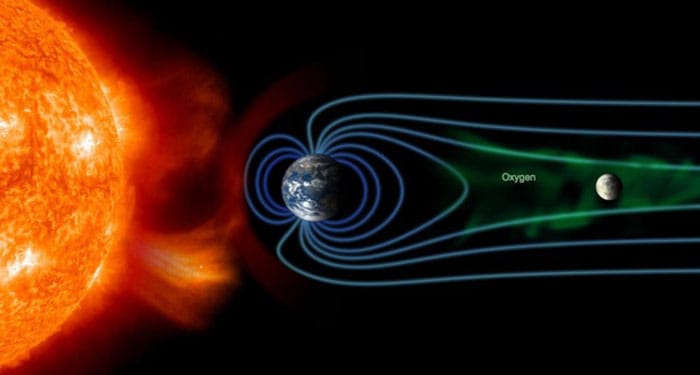
Oxygen from Earth found on the Moon’s surface. (Courtesy: Osaka Univ./ NASA)
Oxygen from Earth’s atmosphere has been detected on the Moon’s surface. Scientists in Japan have analysed data from the lunar orbiter Kaguya taken when the spacecraft and the Moon were sheltered from solar winds by the Earth’s magnetosphere. For all but five days of the lunar orbit, the Moon is bombarded by solar wind. For those other five days, when the Earth lies between the Moon and Sun, the Earth’s magnetic field deflects the solar wind away from the Moon and ions from the Earth are able to reach the lunar surface. Previous studies analysing the Moon’s soils have shown the presence of terrestrial nitrogen and noble gases. Now, Kentaro Terada and colleagues have found evidence that oxygen from Earth’s biosphere also reaches the Moon. The orbiter Kaguya measured the mass and energy of oxygen ions reaching the Moon while it was sheltered from solar wind. It measured a significant number of oxygen ions when the Moon was within the Earth’s plasma sheet (the region of reduced magnetic field between the north and south lobes). The energy of the ions combined with the depth of oxygen in the lunar soil implies that the gas from Earth’s lower atmosphere has been depositing on the Moon since oxygen became abundant on Earth about 2.5 billion years ago. The findings, reported in Nature Astronomy, suggest that the lunar soil could provide a footprint of our planet’s ancient atmosphere, although Kentaro Terada and team stress that differentiating between solar and Earth winds will complicate the investigations.
Matter–antimatter asymmetry glimpsed in baryon decay
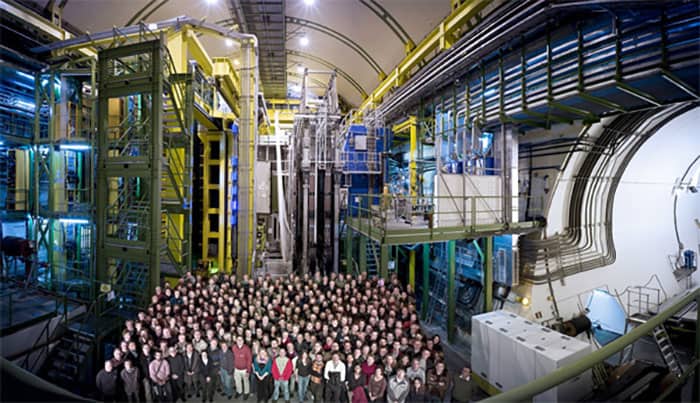
Physicists on the LHCb collaboration have spied CP violation in lambda baryon decay. (Courtesy: CERN)
The first sighting of matter–antimatter asymmetry in the decay of a baryon has been reported by physicists working on the LHCb experiment at the Large Hadron Collider (LHC) at CERN. The finding is the first potential observation of the violation of charge-parity (CP) symmetry in a particle comprising three quarks and, if verified, could provide important clues about why there is much more matter than antimatter in the universe. The study looked at how bottom lambda baryons (comprising up, down and bottom quarks) and their antimatter counterparts decay after being created by collisions in the LHC. The team looked at about 6600 events in which the baryons (or antibaryons) decayed to create a proton and three pions (or corresponding antiparticles). It found that the spatial distribution of the matter and antimatter decay products was different at a statistical significance of 3.3σ. A similar measurement of about 1000 baryon (or antibaryon) decays that created a proton, pion and two kaons (or corresponding antiparticles) found no evidence for a matter–antimatter asymmetry. While 3.3σ is smaller than the 5σ required for a discovery in particle physics, this is the first measurement of these two decays and the statistics will improve as more data are collected – making it clearer with time if the asymmetry exists or not. CP violation was first seen in the decay of kaons in 1964 and more recently in B-meson decays – with both particles containing two quarks. In the Standard Model of particle physics, CP violation is explained by the Cabibbo–Kobayashi–Maskawa (CKM) mechanism. However, the CKM is not able to explain why there is more matter than antimatter, and therefore studies of CP violation in baryons could provide important clues towards solving this mystery. The study is described in Nature Physics.
You can find all our daily Flash Physics posts in the website’s news section, as well as on Twitter and Facebook using #FlashPhysics. Tune in to physicsworld.com later today to read today’s extensive news story on later today to read today’s extensive news story on how skyrmions can be used to create artificial synapses.
To the critics, a working fusion power plant is always 30 years away.
But in the past decade, progress has been made at the construction site of the ITER fusion reactor in Saint-Paul-lez-Durance, France.
Ten years ago – on 29 January 2007 – preparation work began on ITER’s home in the large stretch of national forest. Within two years, more than three million cubic metres of rocks and soil had been removed to level the site ready for the behemoth.
An analogue to the creation of Hawking radiation at the event horizon of a black hole could be made by firing an intense laser pulse at specially designed targets. That’s the conclusion of physicists in Taiwan and France, who say that the “plasma mirror” created in the proposed experiment could be used to study the relationship between quantum particles inside and outside a black hole. The researchers have calculated that the experiment could be done using existing technology and that it could shed important light on the black-hole information-loss paradox.
The idea of Hawking radiation has been around since the 1970s when Stephen Hawking considered what would happen to pairs of “virtual particles” created near the event horizon of a black hole – the region beyond which not even light can escape the tug of gravity. Quantum mechanics dictates that pairs of such particles can pop into and out of existence within a vacuum, and Hawking reasoned that one particle from each pair would be swallowed up by the black hole, while the other would be emitted to form “Hawking radiation”. This process would remove energy from the black hole, making it evaporate and eventually disappear in the absence of any other nearby sources of matter.
Because the emitted radiation is generated at the edge of a black hole, it tells us no more than an external observer can learn about the black hole – its mass, charge and angular momentum. All other information regarding individual objects that have been sucked into the black hole would be lost forever. The problem with this loss of information is that it violates a principle of quantum mechanics that says that the complete information about a physical system at one point in time will dictate its quantum state at any point of time in the future.
Thought experiments
Research into the information-loss paradox has been mostly theoretical as it is hard to make the appropriate measurements on real black holes. Physicists are therefore keen to create systems in the lab that are analogous to black holes, with the Hawking-like radiation associated with these analogues potentially providing important clues to resolving the information paradox.
Now, Pisin Chen of National Taiwan University and Gerard Mourou of Ecole Polytechnique in Paris have proposed a way of using a plasma mirror to create a black-hole-like system. Plasma mirrors are created when an intense pulse of radiation strikes a solid material, such as glass, and separates electrons from the atoms to make a plasma. When this occurs, the material changes from being transparent to being highly reflective.
To mimic Hawking radiation at the event horizon of a black hole, Chen and Mourou propose creating a plasma mirror that accelerates rapidly and then stops abruptly. This, they say, could be done by firing an intense laser pulse at a solid target to create an intense pulse of X-rays. This X-ray pulse would then be directed at a second solid target that has a density varying on the nanometre scale. A plasma would be created in this second target and the density gradient would make the plasma accelerate in the direction of the X-ray pulse.
Imperfect mirror
The plasma acts as an imperfect mirror, reflecting one half of a virtual photon pair created at its surface and allowing the other photon to pass through. These reflected photons are analogous to Hawking radiation. The un-reflected photons become trapped in the plasma and are analogous to photons within a black hole.
According to Chen and Mourou, the trapped photons should be released when the mirror stops as it reaches the end of the second target. The reflected and trapped photons would then be detected and physicists could look for correlations between the photons to determine if the photons are quantum-mechanically entangled. The virtual pairs are entangled when they are created, and a measurement of entanglement between the reflected and trapped photons could provide important information about the information-loss paradox.
Chen and Mourou say it should not only be possible using advanced laser and nanofabrication techniques to do the experiment but also measure correlations between the photons of interest, despite the presence of a large background of other photons created in the experiment.