A new way of producing structural colours – inspired by the nanoporous feathers of a brightly coloured South American bird – has been developed by researchers in the US, Switzerland and Saudi Arabia. The technique relies on a self-assembling, random network of sub-wavelength pores in a metallic alloy to produce a wide-range of colours. According to the researchers, their technique is more robust and easier to scale up for commercial fabrication, and could be used in a range of applications including lightweight coatings for cars and aircraft.
Animals use colours for a range of functions, from courtship displays to camouflage. While many of these colours are produced by pigments, others are produced by surface structures that interact with light and reflect specific wavelengths. Researchers have long been interested in such structural colouration because of its durability and many potential applications.
“Pigments fade away over relatively short times, while structural colouration can persist over time, as it is based on a structure,” explains Andrea Fratalocchi, an engineer at the King Abdullah University of Science and Technology in Saudi Arabia. “Beetle fossils from millions of years ago still preserve the colours.” He adds that as structural colours can be dynamically changed via structural alterations, they could be used for novel smart materials with adaptive camouflage properties. So far, the real-world applicability of surfaces engineered with photonic crystals or metamaterials to produce structural colours has been limited, however, due to issues with robustness, cost and scalability.
Vibrant feathers
Much of the structural colour in nature is also produced by photonic crystals or highly ordered arrays of nanofibres, but the plum-throated cotinga (Cotinga maynana), is different. The tropical bird’s vibrant blue feathers are produced by a disordered nanoporous network of keratin. The network of pores, which are typical smaller than 200 nm, interacts with light in such a way that only certain wavelengths of blue light are reflected.
To create a similar nanoporous network in a platinum–aluminium-based alloy, Fratalocchi and colleagues at ETH Zürich and Harvard University used a de-alloying process. They placed the alloy on a suitable substrate and then immersed it in a sodium-hydroxide solution. This removed most of the aluminium, leaving the platinum to form a porous network.
Lead researcher Henning Galinski, a physicist at ETH Zürich and Harvard University, told Physics World that the feathers and the porous metallic alloy share “the same design idea”, featuring sub-wavelength structures and being “achieved by self-assembly”. He adds, “The main difference is that the continga feather barbs are made of keratin.”
Yellow to blue
To control the colour produced, the porous alloy was coated with an ultra-thin, transparent layer of aluminium oxide. Without this covering, the material appears dark. But when the coating was added and increased in thickness, the colour changed, transitioning from yellow to orange, red and, finally, blue.
“Our networks seem disordered and random, but from a network perspective, they are pretty regular, meaning that each nanowire or strut in the network is, on average, connected to the same number of nanowires,” explains Galinski. “The connectivity can be controlled by changing the fabrication process. In this work, we decided to keep the connectivity constant and alter the interaction of light with the material by adding an ultra-thin ceramic layer.” He adds: “Increasing this layer step-wise from 7 nm to 53 nm, allowed us to enhance the coupling for a specific wavelength of light, resulting in the formation of vibrant structural colour.”
The researchers found that when light hits the surface of their material, it couples with surface plasmons – collective excitations of electrons – that then become trapped in the disordered surface. This creates regions where the electrical permittivity is near zero, separated by areas of high refractive index. The aluminium-oxide film changes these dynamics and increases the reflection of different wavelengths of light, depending on its thickness.
Simple chemistry
Galinski explains that because the technique is “based on simple wet-chemistry and coating technologies”, it can “produce robust colours on large spatial scales”. Fratalocchi adds: “Previous approaches focus on creating structural colours by assembling arrays of identical building blocks, or unit cells. This approach works only on very small scales, and is totally unsuitable for industrial and large-scale applications. Our material, conversely, is based on disorder, and at is totally scalable, opening this technology to real-world, commercial applications.”
Galinski says that structural colours have “wide potential as a future printing technology for various applications, ranging from bio-mimetic tissues to adaptive camouflage materials”. He adds that as the described technique is mechanically robust and extremely lightweight, it is “suitable for real-world industrial applications, such as automotive vehicles or airplanes, for which the weight is directly related to the fuel economy”.
Vibrots are tiny devices that convert linear vibrations into rotational motion and are of great interest to scientists studying the collective motions of particles in physics, biology and chemistry. In this latest study, Christian Scholz, Sean D’Silva and Thorsten Pöschel of Friedrich-Alexander-Universität Erlangen-Nürnberg in Germany have created a vibrot that is powered by a vibrating floor – something that is common in the processing of granular materials, where collective motion can emerge. The cylindrical device is about 1 cm in diameter and is supported by seven legs, which are all bent at the same angle (see figure). The legs are springy and this causes the vibrot to rotate when subjected to vertical vibrations. In this latest work, Scholz and colleagues identified two distinct ways in which this motion occurs: “ratcheting” and “tumbling”. The ratcheting mode occurs at relatively low amplitudes of vibration. The legs of the vibrot move in synchrony as the floor vibrates up and down, with the device getting a rotational kick once every vibrational cycle – much like a ratchet. The tumbling mode occurs at higher vibrational amplitudes and does not involve the synchronous motion of the legs. In this mode, the legs tend to remain in the air for longer than one cycle of the vibration. Although the vibrot does rotate in tumbling mode, it does so in a very irregular manner with chaotic fluctuations. The research is described in New Journal of Physics.
String theorists bag 2017 Breakthrough Prize
The 2017 Breakthrough Prize in Fundamental Physics has been awarded to Joseph Polchinski of the University of California, Santa Barbara and Harvard University’s Andrew Strominger and Cumrun Vafa. The trio won for making “transformative advances in quantum field theory, string theory, and quantum gravity”. The three physicists share £3m in prize money. The Breakthrough Prize was inaugurated in 2012 by the Russian venture-capitalist Yuri Milner, who had studied theoretical physics. This is the third year that the prize has been awarded to string theorists. The award was presented yesterday at a gala ceremony at the NASA Ames Research Center in California, where celebrities such as actor Morgan Freeman rubbed shoulders with Breakthrough Prize funders including Facebook founder Mark Zuckerberg. A special prize was also given to LIGO founders Ronald Drever and Kip Thorne of Caltech and Rainer Weiss of the Massachusetts Institute of Technology. This prize was shared with more than 1000 physicists who worked on LIGO when it made the first-ever detection of a gravitational wave in 2015. Also awarded was the 2017 New Horizons in Physics Prize, which was given to five early career physicists.
Fully integrated microwave communications device is a first
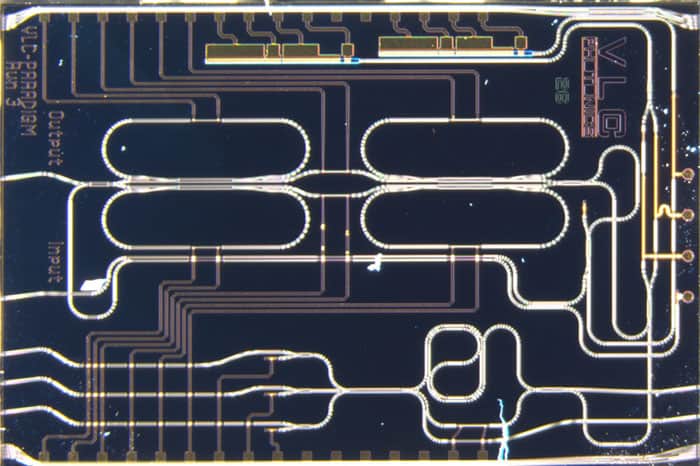
The integrated microwave chip, which measures 6 mm across. (Courtesy: Javier Fandiño et al./Nature Photonics)
The first photonic device for microwave signals with all of the necessary components fully integrated on a single chip has been produced by researchers in Spain. The design could have important implications for the next generation of wireless communication technology, where the increased requirements for data capacity will require the use of higher-frequency, multiplexed signals that traditional electronics cannot process effectively at the speeds required. Optical signal processing provides an obvious solution, but the cost of the components required has so far proved prohibitive to telecommunications applications. Researchers have attempted to bring down the costs, as well as the physical size and power requirements, by integrating more and more components onto single chips, although this has proved challenging. Now, José Capmany Francoy and colleagues at the Polytechnic University of Valencia have squeezed all of the components necessary for a microwave filter onto a single piece of indium phosphide – including a laser, a tunable optical filter and photodetectors. The optical filter is tuned by changing its temperature – which can be achieved by applying voltages to specific pins of the chip to power an internal heater. The device suffered severe problems: for example, the researchers had to measure the output optically because of interference when measuring the output as an electrical signal. Nevertheless, they believe technical design improvements and elimination of manufacturing imperfections should correct these problems, allowing the researchers to push on towards their goal of a fully integrated, programmable photonic microwave signal processor. The chip is described in Nature Photonics.
Radium-dial painters, mostly young working-class women, haunt the history of health physics. These young women with untreatable symptoms – whom the contemporary press and they themselves described as “the walking dead” – walk or more often hobble through Kate Moore’s book The Radium Girls. Their cases inspired the development of the field of radiation safety. The infamous photos of gross tumours overtaking the faces of pretty young women triggered a serious re-examination of the dangers of man-made radioactive isotopes in the 1920s, a time when merchants promoted radium as a miracle cure for whatever ails you. The case also led to the development of the first methods to detect radioactivity in living bodies. Indeed, the radium dial workers’ bodies became the raw material around which early health physicists created the notion of “permissible dose”.
Moore – a Sunday Times bestselling author – seeks to retrieve the life stories of the radium-dial painters in portraits of several dozen radium-dial workers who pursued lawsuits against watch companies in New Jersey and Illinois. In the 1910s and 1920s, the demand for glowing radium watch-faces grew yearly. Company managers advised their young female employees, paid by the piece, to work with paintbrushes, dipping the points in their mouth to sharpen them. Their counterpart painters in Germany used glass-pointed brushes that held their shape because scientists knew that radium was harmful. Moore shows that the US companies were aware that dipping brushes into one’s mouth was risky, but it was also the cheapest and fastest way to paint watch dials. As the desire for glow in the dark watches was insatiable during and after the First World War, the women painted and dipped all day long, rushing to keep up with the work.
The book makes for uncomfortable reading. Moore seeks to draw out the full effect of young lives painfully cut down in their prime. She swings between passages describing happy, pretty, dancing workers delighted to have cash in their pockets; to graphic details of the assault of radium accumulated in their bodies. The “girls” first started feeling aches and pains in their hips, knees and their jaws – their teeth wobbled painfully and when removed by dentists, the lesions did not heal. The young women developed anaemia, lost weight and felt chronically fatigued. As the ingested radium decayed, it broke down their bones into “honeycomb” configurations and ate into joints. Whole sections of the young women’s jaw bones gave way. Femurs snapped. Hip joints froze in place. Confused doctors treated the women, usually with casts and metal braces, measures that only increased their pain.
In the second half of The Radium Girls, Moore carefully replays the law suits against the Radium Dial Company in Ottawa, Illinois, and the US Radium Corporation in Orange, New Jersey. She shows the managers’ attempts to evade responsibility for damage, as they drew on a playbook of strategies deployed subsequently in the field of industrial hygiene. The radium-dial companies initially ignored their employees’ complaints of painful symptoms and the first early deaths. They claimed the women’s doses of radium were too low to cause problems, though male workers in labs and loading docks were provided leather aprons, gloves and a set of safety restrictions.
Glossing over the radium epidemic was easy. Until 1922 the industrial hygiene department at Harvard University was entirely funded by business, while regional public health offices bowed before the power of local industry. After several more young women died and many others became invalids, the rumours of the dangerous radium factories became a public-relations problem. When medical experts, hired by the companies themselves, ruled unexpectedly that radium poisoning could well be a factor, the reports were manipulated and hidden, and other more malleable specialists were found to vouch for radium’s supposed safety. As the lawsuits got under way, the companies courted public-health officials, lobbied for restricted workmen’s compensation laws, produced their own misleading public-health statements and did their best to sow confusion and stall legal rulings. As the years of court battles wore on, the plaintiffs increasingly had to turn over their bodies to use as evidence.
Moore spotlights Harrison Martland, the young and brash new chief medical examiner for Orange, New Jersey, who took the workers’ health complaints seriously. He collaborated to devise a way to ash the bones of a recently deceased radium worker and test the ash with an electrometer. These were the first measurements of radioactivity in the human body. Later, Martland came up with ways to count gamma rays coming from live patients and from radon in expired air from their lungs. Martland surmised that radium settling inside painters’ mouths produced bacteria that led to chronic infections and loss of teeth. He guessed that radium damaged blood-forming cells in bone marrow, leading to deadly anaemias. Radium, he reasoned, also settled in bones, made them brittle and produced sarcomas. He exhumed the body of a painter to make his point. The bone fragments, buried six years earlier, glowed in the dark grave.
At the time, toxicology demanded not just that statisticians show a significant increase in disease among radium-dial employees, but that the offending toxin be found in the bodies of the patients themselves. Martland’s measurements made a rare, lucid case in the history of what came to be known as “health physics”; radium known to be in the paint was also found in the workers’ bodies. Even with this clear-cut evidence, it took 14 years for the women to win their case in court.
Moore provides a happy ending for this story as she concludes that the “radium girls” drew attention to the dangers of the material, which spawned safe practices in the burgeoning Manhattan Project. She points to the Argonne Center for Human Radiobiology as a laboratory that promoted progress in radiation safety, with a “moral obligation to future generations”.
Unfortunately, I feel these are somewhat dubious claims. As the media attention about the dial-painters’ pain and death grew, scientists began to purposefully expose human subjects to man-made radioactive isotopes. Between 1931 and 1933, scientists at the Elgin State Hospital in Illinois injected half a dozen patients with 70 to 450 mg of radium-226. Later the Argonne lab located those patients, not to treat them, but to continue the experiment and measure retention of radium in their bodies. Scientists in the Manhattan Project began in 1943 to inject patients with the first micrograms of plutonium that they produced. In subsequent decades, the US Atomic Energy Commission funded hundreds of studies using human subjects exposed to internal and external radiation. Happy endings are nice, but I am not sure this sad tale deserves one.
On Tuesday I was rushing to finish writing a news story about quantum superposition and got a phone call out of the blue from Roger Sawyer, who is deputy editor on BBC Radio 4’s afternoon news and current affairs programme PM. He had the brilliant idea that the meme of “having your Brexit cake and eating it too” had some sort of connection to quantum superposition – and wanted some advice from Physics World.
Physicists should finally be able to rid themselves of the cumbersome and inaccurate definition of the ampere. That is the claim of metrologists in Germany, who have measured electrical current by counting single electrons travelling along a microscopic wire. The researchers say that their technique will allow scientists in a number of different disciplines to make better measurements of tiny currents.
The move to revamp the ampere is part of a more general overhaul of the SI system of units. It is envisaged that all seven base units – the ampere, second, metre, kilogram, kelvin, mole and candela – will be anchored to unvarying constants of nature. In particular, scientists are eager to redefine the kilogram, which is currently based on the mass of a specific lump of platinum-iridium sitting in a Paris safe and slowly shedding atoms.
It is partly to sever its link with the kilogram that metrologists are keen to redefine the unit of electrical current. At the moment, one ampere is defined as the current flowing in two narrow, infinitely long parallel conductors placed one metre apart in a vacuum that generate between them a force of 2 ×10⁻⁷ N for every metre of length. This formulation is a problem because it means that the ampere is defined in terms of the kilogram (as well as the metre and the second) because force is equal to mass times acceleration. Also, nothing can be infinitely long, so this requirement must be approximated somehow.
Transistor-like device
This latest work was carried out by Frank Hohls and colleagues at the German National Metrology Institute (PTB) in Braunschweig and aims to define the ampere in terms of a certain (large) number of single electrons passing through a conducting channel in unit time. Central to the proposal is the construction of a “single-electron pump”, a transistor-like device that transmits just one electron when activated by a gate voltage. With the voltage oscillating perhaps several billion times a second, the device would generate a current that is large enough to calibrate an ammeter – thus revealing how accurate the instrument is.
The team made single-electron pumps from quantum dots – sub-micron sized conducting areas etched on to semiconductor substrates. Operating the pumps at millikelvin temperatures, they apply a roughly 0.5 GHz gate voltage and a second, fixed voltage across each dot to set up a time-varying potential well that briefly captures and then ejects single electrons. To establish the accuracy of their devices, the researchers use a specially developed amplifier that converts the current flowing through it into a voltage, which is measured by a voltmeter calibrated using two other quantum phenomena – the quantum Hall effect and the Josephson effect.
The researchers were able to measure the current transmitted by the pumps with an accuracy of 0.16 parts per million. This is fractionally better than they achieved with an earlier version of their device last year, which matched the accuracy of measurements that can be carried out using the existing force-based definition of the ampere – 0.2 parts per million. The new measurements were also done more quickly – requiring just 21 hours, rather than the several days employed a year ago. “The measurement set-up used in this experiment represents the state-of-the-art in small-current metrology,” says group member Hansjörg Scherer.
Aerosol counting
According to Scherer, who led the PTB effort to design the new amplifier, more accurate measurements made possible by the pumps could prove useful in a number of areas. Among them, he says, are the determination of radioactivity levels in ionization chambers and counting aerosol particles in the air.
Ian Mills, a metrology expert at the University of Reading in the UK, praises the “valuable and excellent work” being done on electron counting at the PTB. But he believes that a better definition of the ampere can be obtained simply by using the most accurate value for the electron charge available today – which is based on other measurements including that of the fine structure constant. That value of the ampere has an accuracy of about 20 parts in a billion and is, he says, most likely to be used in the new definition of the ampere that should be approved by the General Conference on Weights and Measures – the body that will authorize changes to the SI system. “I think the electron-counting experiments are fascinating,” he says, “but they are not yet sufficiently precise to compete.”
François Piquemal of the National Metrology and Testing Laboratory (LNE) in Paris, takes a slightly different view, arguing that electron counting offers a way of realizing the ampere in practice, rather than defining it. He maintains that single-electron pumps are best suited to measuring currents up to about a nanoamp, while an alternative approach – involving the combination of quantum Hall and Josephson standards through Ohm’s law – is best for larger currents. “In my opinion, these two methods are complementary for the future mise en pratique of the ampere,” he says.
The research is described in a paper that will be published in Metrologia.
Earthquake-aftershock puzzle solved, say physicists
The idea that smaller earthquakes (aftershocks) follow major earthquakes is a well-established concept in geophysics. However, aftershocks are not explained by the avalanche model that is used to describe earthquakes and similar phenomena such as the cracking of solid materials. The model dictates that events such as earthquakes are random and therefore there should be no correlation between successive earthquakes. Now, Sanja Janićević, Lasse Laurson and colleagues at Aalto University in Finland have shown that this discrepancy could simply be a result of how aftershocks are measured. Writing in Physical Review Letters, the physicists describe experiments in which they monitored the cracking of a solid material. They found that when they set the detection threshold of their apparatus at high values – to avoid measuring noise – an individual avalanche event appeared as a sequence of seemingly unrelated events. However, when they reduced the detection threshold, what had previously appeared to be aftershocks were actually part of the main avalanche event.
Scientists post open letter to incoming Trump administration
More than 2300 scientists, including 22 Nobel laureates, have published an open letter calling on president-elect Donald Trump, his administration and Congress to “support and rely on science as a key input for crafting public policy”. The signatories, including the physics laureates Wolfgang Ketterle and Daniel Kleppner, say that federal agencies need to be led by officials with “demonstrated track records of respecting science as a critical component of decision making” and that the country’s public health and environmental laws must retain “a strong scientific foundation”. The letter also calls for the administration to “adhere to high standards of scientific integrity and independence in responding to current and emerging public-health and environmental threats”, as well as provide “adequate resources” to let scientists conduct their research. The letter remains open for signatures.
Nuclear pasta boosts supernova neutrino emission
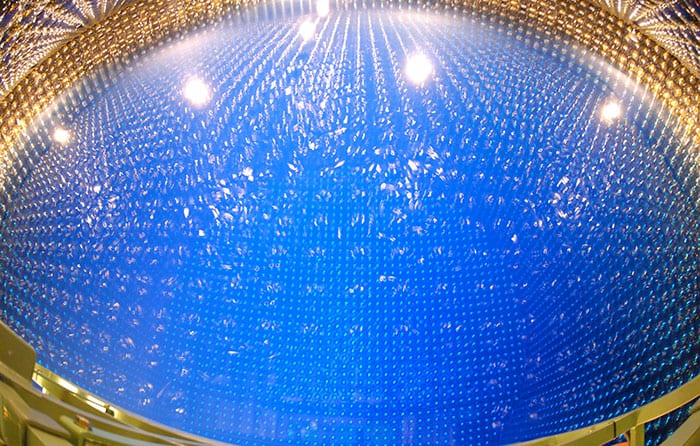
The SuperKamiokande detector could detect late-time neutrinos from galactic supernovae. (Courtesy: Kamioka Observatory, ICRR (Institute for Cosmic Ray Research), The University of Tokyo)
The nuclear pasta that forms in supernovae should boost the numbers of late-time neutrinos emitted by the exploding stars – making it more likely that such events could be seen by neutrino detectors on Earth. Forming just before the core of a collapsing star reaches nuclear density, nuclear pasta comprises tubes, sheets and other pasta-like structures made from neutrons and protons. Charles Horowitz of Indiana University and colleagues used molecular-dynamics simulations to calculate how neutrinos produced in a supernovae scatter from nuclear pasta, and found that the pasta greatly increases the number of neutrinos emitted 10 or more seconds after core collapse occurs. Writing in an arXiv preprint, the team says that late-time neutrinos from a supernova in the Milky Way should be clearly visible to neutrino detectors such as SuperKamiokande in Japan. Detecting these neutrinos could provide important information about how stars collapse to form supernovae.
You can find all our daily Flash Physics posts in the website’s news section, as well as on Twitter and Facebook using #FlashPhysics. Tune in to physicsworld.com later today to read today’s extensive news story on a single-electron pump.
UK industry should increase its level of investment in quantum technologies, according to a report compiled by the country’s chief scientific adviser, Mark Walport. The publication – The Quantum Age: technological opportunities – makes 11 recommendations to boost quantum technology in the UK, including a call for the five-year £270m National Quantum Technologies Programme to continue beyond 2018.
The report, which features contributions from government, industry and academic experts, says that increased investment from industry would boost the level of commitment to the programme and help to accelerate commercialization.
Early investor
The UK is among the world leaders in quantum research and technology, currently investing around £60m annually in the field – the fourth largest funder after China, the US and Germany. The National Quantum Technologies Programme, which was launched in 2013, is based around four university-led “hubs”, and is one of the earliest and largest investments in the world.
“The UK is playing a leading role in the research and development of quantum technologies,” says Walport, adding: “Quantum timekeeping, imaging, sensing, communications and computing have the potential to generate a large array of valuable new products and services.”
We cannot afford to fall at the last hurdle – new business creation
Jeremy O’Brien, University of Bristol
“Internationally, other governments and companies are becoming interested in the technology,” Richard Murray, lead technologist for emerging technologies and industries at Innovate UK, who contributed to the report, told Physics World. “So the time is right for the UK to really push forward with the innovation and commercial side of the quantum-technologies programme, as well as continuing to support the science underpinning it, so that we stay ahead of this important new industry.”
In addition to increased industry investment and the continuation of the programme, the report also recommends the setting up of innovation centres, similar to the Fraunhofer institutes in Germany and the Battelle institutes in the US, and improved co-ordination of activities at a national level.
Favourable market
Jeremy O’Brien, director of the Centre for Quantum Photonics at the University of Bristol, who was not involved with the review, told Physics World he is “very pleased” with the report’s findings and recommendations. He adds that if the UK is to remain world-leading, then as well as increasing investment, the government “needs to ensure that legislation and an accessible free market remain favourable” for companies.
“We cannot afford to fall at the last hurdle – new business creation,” says O’Brien. “The government must encourage a new culture among UK venture-capital firms that is welcoming of larger-scale investments in high-risk hardware companies, particularly in quantum technologies. Otherwise we risk falling foul of the old story of invented here and exploited elsewhere.”
Thumbs up – Institute of Physics president Roy Sambles at the 2016 annual awards ceremony
By Matin Durrani
With the winter sun dipping over the horizon late on Tuesday afternoon, I caught the train from Bristol up to London to attend the annual awards dinner of the Institute of Physics (IOP), which publishes Physics World.
The event was held at the Lancaster London hotel a few minutes’ walk from Paddington station. Now, I’m not sure if it was a coincidence, but I found myself seated at dinner next to Farideh Honary, a space physicist from Lancaster University.
On the eighth floor of the psychology department, in a small room with a light-proof door, I’ve spent hours in darkness testing a sensitive instrument – my own eye. During those hours I’ve fallen asleep, forgotten the time of day and found that total darkness doesn’t always look dark. I sometimes see phantom flashes like faraway fireflies, or the static of a television tuned to a vacant station. These are distractions from what I’m looking for: a flash of just a few photons – individual particles of light.
Next door, in a dark room of its own, a delicate apparatus generates the light my eyes are trying to see. This strange light is unlike any natural light source, and it can do things that normal light could never do. To understand how unusual this device is, think of as many different “normal” light sources as you can: light bulbs, light-emitting diodes, lasers, the Sun, the Moon, glowing embers, weird deep-sea fish, the Northern Lights. All emit photons randomly. It’s possible to make them extremely dim, so that on average they emit one photon every second, but there’s always a chance of getting two or three photons instead. There’s no reliable way to get just one photon every time.
But one photon is exactly what I need. The research project I’m working on is a collaboration between psychology and physics, and we’re using the technology of quantum optics to study how the human visual system responds to extremely small amounts of light. In particular, can the eye detect a single photon? If not, how many photons does it need?
Early experiments
Some of the most reliable early experiments on this question were conducted at Columbia University, US, in the 1940s. Austrian-born biophysicist Selig Hecht and his colleagues presented people with dim flashes of light calibrated to different intensities, and asked them if the flashes were visible or not. They determined how often people would say “yes” for each intensity, and with some assumptions about how the number of photons in each flash varied, they estimated that 5–7 photons needed to be detected by the retina for an observer to perceive light. These just-visible flashes actually contained many more than 5–7 photons, because about 90% of the light that hits the human eye is lost before it can be detected, for example via reflections from the cornea.
About 90% of the light that hits the human eye is lost before it can be detected, for example via reflections from the cornea
Across the Atlantic, H A van der Velden and Maarten Bouman were conducting similar experiments in the Netherlands under German occupation, and they estimated that humans could see 1–2 photons. Bouman is said to have jokingly mentioned later that this lower threshold was perhaps due to “the special opportunities for long dark adaptations (thanks to the precautions taken against air raids)”.
These early experiments couldn’t directly measure light detection in retinal photoreceptor cells – something that is possible today. However, they did hint that photoreceptor cells were sensitive to single photons. Hecht knew that his 5–7 photons were spread over an area of the retina containing about 500 photoreceptors, so the cells were probably able to detect single photons, even if it seemed that the observers themselves couldn’t.
By the 1970s, studies of individual photoreceptor cells proved Hecht right. There are two types of these cells: cone cells, responsible for colour vision in daylight, and the more sensitive rod cells, which are used for night vision. In the lab, researchers learned how to extract an individual rod cell from a toad and connect it to an electric circuit. (The toad killing and cell extraction has to happen in darkness – like a grim darkroom photography class – since the dark adaptation necessary to optimize rod cells to function well in low lighting only happens in living animals. This is one reason I prefer working with living human volunteers.)
Humans, toads and other vertebrates have similar rod cells. When light hits a rod, it activates a molecule called rhodopsin, which sets off a chain reaction that changes the current of ions moving in and out of the cell. In the retina, this current alters the release of neurotransmitter chemicals from the cell, allowing it to pass the signal on to other cells. In the lab, researchers were able to show in toad rod cells that this same current creates measurable electric pulses down to the single-photon level.
Now it was certain that rod cells on a lab bench were able to sense single photons. The question remained, however, of whether these tiny signals could make it through the rest of the visual pathway to the brain – in other words, whether humans can perceive individual photons.
Singular source
All the studies of human vision at that time had a fundamental limitation: they weren’t able to make just one photon. It wasn’t until the late 1980s that researchers in the new field of quantum optics invented a way of producing very unusual light: a single-photon source. These devices were developed to research the quantum properties of light, including applications such as quantum cryptography and quantum computers. However, they’re also the perfect tool to finally answer the question of whether humans can see single photons.
About eight years ago, the pieces started to come together. Tony Leggett, a Nobel-prize-winning physicist at the University of Illinois in the US, was interested in one of the great mysteries of physics: why the strange rules of quantum mechanics don’t seem to apply in everyday life. He thought that if humans could see single photons, which are quantum particles, then studying how we perceive them could help to solve the mystery. So he brought together Frances Wang, an interested psychologist, and Paul Kwiat, a pioneer in the field of quantum optics who could design the necessary apparatus.
After they designed the experiment on paper, it was my job to build it. As a new graduate student, I knew little about optics or the human visual system. Quantum mechanics had been my favourite college physics class, so I had joined Kwiat’s quantum information research group – despite not really knowing what to expect. (“What’s it like doing quantum information research?” I remember asking him on the phone before I arrived. “Really cool,” he’d replied.)
1 A single-photon source
(Courtesy: IOP Publishing)
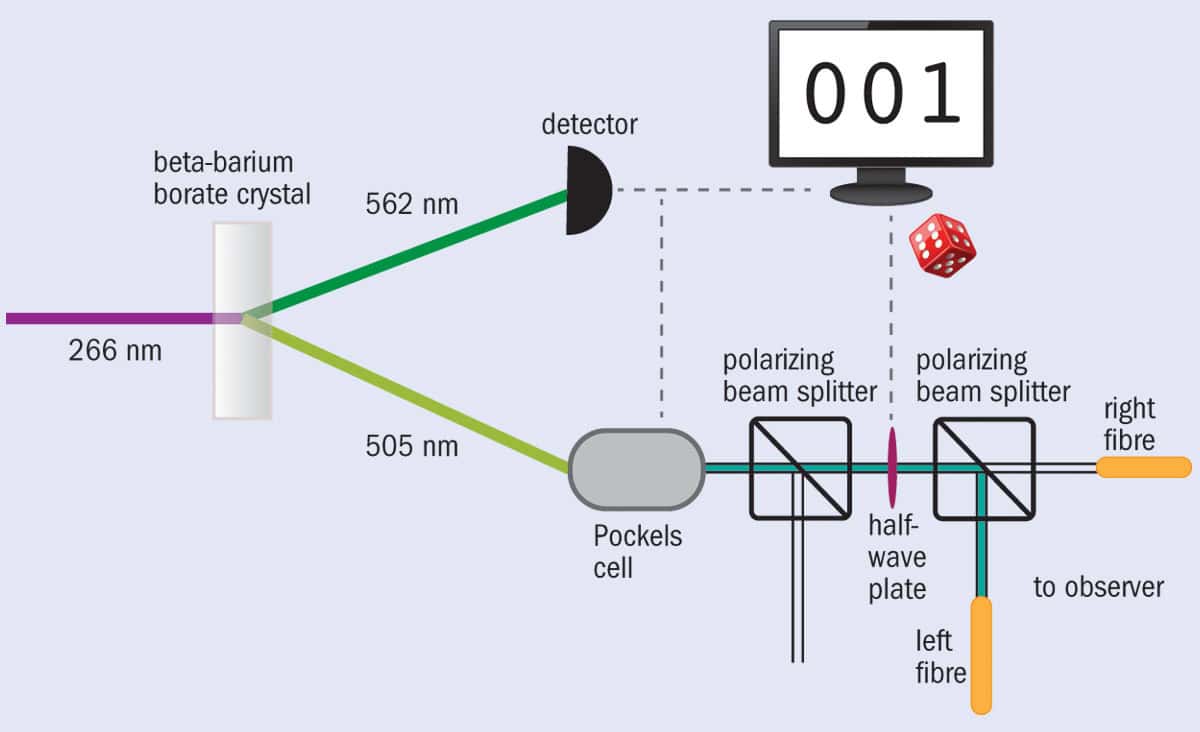
An ultraviolet laser creates pairs of green photons inside a beta-barium borate crystal. When a 562 nm “herald” photon is counted by a single-photon detector, its 505 nm partner must be there on the other side. In case the herald photon is lost (scattered by an optical component or just not detected), a Pockels cell and polarizing beam splitter act as a fast switch that only opens when a herald photon is actually detected. This prevents photons from going to the observer without being counted. By turning the laser off immediately after one cycle, this source can produce exactly one photon. After passing through the switch, the 505 nm photon is directed to either the left or the right optical fibre (the choice is made randomly by a computer) using a half-wave plate and a second polarizing beam splitter, and the fibre carries it to a human observer.
I learned that there’s a simple trick to making just one photon: first make two. Our single-photon source (see figure 1) relies on a crystal of beta-barium borate, which can split one photon into two “daughter” photons through a nonlinear optical effect called spontaneous parametric down-conversion. The split is triggered by quantum vacuum fluctuations, and it only happens for about one in a billion photons. That doesn’t sound like a lot, but when a laser beam with 1016 photons per second passes through the crystal, a stream of photon pairs comes out. The two photons in a pair travel in slightly different directions, so we can collect them into separate optical fibres. One fibre goes straight to a single-photon detector and when it measures a photon, we know that its undetected partner, created at exactly the same time, is there too – in fact, we can send it to a human observer. Rod cells are most sensitive to green light, so we use an ultraviolet laser to create single photons with a wavelength of about 505 nm – a luminous bright green like a traffic signal on a dark road.
Although the crystal is small, the entire single-photon source fills an optical breadboard the size of a workbench and weighs more than 90 kg. Building it required months of carefully placing lenses, tilting mirrors and turning knobs in the dark while watching dim red numbers go up or down. When it was ready, we moved it from the second floor of the physics department to the eighth floor of the psychology department with the help of a pickup truck and my strongest lab mates. I realigned the components and got ready to begin tests with actual human observers.
Each session requires about two hours in total darkness. (I’m lucky to have an endless supply of undergraduate physics student volunteers who will do anything in the name of science.) First, there’s a 30-minute period of dark adaptation to optimize the observer’s night vision. For the first 15 minutes the volunteers just relax in the dark, and for the second 15 they do practice trials. During this time, pupil dilation and chemical changes in the retina make the observer’s eyes at least a million times more sensitive than they are in daylight.
When the observer is fully dark-adapted, they position their head in a chin rest and look straight ahead at a dim red cross hairs. The single-photon source sends a flash of light to one of their eyes, and the light is randomly assigned to appear on either the left or the right side of the cross hairs. The observer’s job is to correctly choose which side the light appeared on – left or right – in 300 repetitions of this task. It does get boring, so we make it a (still pretty boring) game by playing a sound after each trial to tell the observer whether they got the answer right or not: a happy “ta-da!” sound for a correct answer, and a disappointing buzz for an incorrect answer.
Asking the observer to choose left or right instead of just asking “did you see it or not?” is an important feature of our experiment. With random noise in the visual system that can create distracting phantom flashes even in total darkness, it’s hard to be sure you’re seeing the real thing. Single-photon detection might not even be conscious – sometimes I have a hunch that the flash was on the right, without knowing why (and sometimes I’m sure I saw it on the left and I get the “wrong” buzzer – argh!).
But the data don’t lie – if an observer is able to choose left or right with better than 50-50 accuracy and the effect is statistically significant, we know they must have been able to see the light (either that or they’re psychic). We’re still working on collecting enough data, but we plan to use this technique to test once and for all whether humans can see single photons.
We’ve already found that people can see flashes of about 30 photons, and we think only three of those photons actually make it to the retina on average. Like Hecht back in the 1940s, we have to average and estimate with multiple photons, but with single photons we’ll know for sure – either one photon or zero will be detected each time.
In the dark
We’re not the only ones working on experiments like this. In 2016 a Vienna-based group, led by physicist Alipasha Vaziri from Rockefeller University in the US, reported they had demonstrated single-photon vision using a similar single-photon source (Nature Comms7 12172). It was an interesting study that used a clever technique – observers had to judge accurately when a photon arrived instead of where. However, my colleagues and I are concerned that the reported results are ambiguous. That’s because in a key subset of trials (rated “high confidence” by the observers), the average accuracy was so high that it didn’t seem to fit with the rest of the data, and weaker statistical tests were used. We think more convincing proof of single-photon vision is still needed. Whether our concerns turn out to be valid or not, we feel that independent replication is important for a question that has been so challenging to answer.
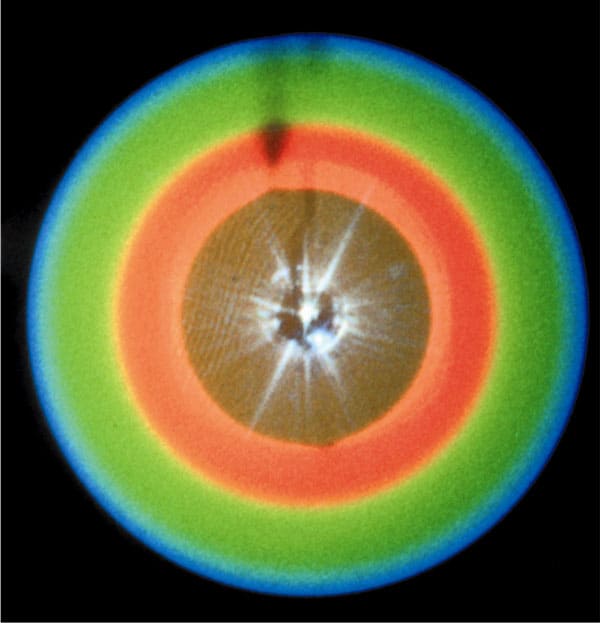
Crystal light A photograph of light generated by spontaneous parametric downconversion. The camera is looking towards the crystal. (Courtesy: NIST/Alan Migdall)
In the meantime, my colleagues and I have studied other aspects of the visual system. By varying the length of very dim flashes of light and the number of photons they contain, we have measured the equivalent of “exposure time” in the eye – the time window during which photons are added up into one larger signal. This is similar to the time that a camera shutter is open, but it’s more complex in the eye – the exposure is adjusted dynamically for different conditions, and can even be affected by a memory of a previous image. For flashes of light that are relatively easy to see, the exposure time is typically one tenth of a second. We found that when only a few photons are present, the eye adds up signals for almost a full second (probably in retinal processing after the photoreceptors), dramatically improving its ability to detect weak flashes.
If the research community does prove that humans are able to see single photons, we might be able to fulfil Leggett’s dream of testing quantum effects through the visual system. Instead of sending a photon to either the left or the right side of the eye, we could send a photon in a quantum superposition of both left and right! How would that look to an observer? Standard quantum mechanics predicts that the photon should collapse to one side or the other too quickly to notice, but no-one knows for sure. We could even use a human observer as a “detector” in a test of nonlocality, the instantaneous “spooky” action at a distance of entangled photons. More than 100 years after Albert Einstein suggested that light was made of particles, we now have the chance to ask these strange new questions.
The Laser Interferometer Gravitational-wave Observatory (LIGO) – a pair of gravitational-wave detectors in Hanford, Washington, and Livingston, Louisiana – have been turned back on following almost a year of upgrades. On 11 February, the LIGO collaboration announced the first-ever direct observation of gravitational waves, which were generated by the collision of two black holes 1.3 billion light-years away. This was followed by the announcement of a second gravitational-wave detection on 15 June, also from merging black holes. The detections were made during LIGO’s first run from September 2015 to January 2016, and since then engineers have been making improvements to the facility’s lasers, electronics and optics. The Livingston detector now has about a 25% improvement in sensitivity, allowing it to spot black-hole mergers at greater distances. The sensitivity of the Hanford detector, meanwhile, is similar to the first run, however the power of the laser has been increased and the detector is more stable, increasing the time that the detector is operational. “Already LIGO has exceeded our expectations, and, like most of the scientific world and beyond, I am excited to see what a more sensitive, upgraded LIGO will detect next,” says National Science Foundation director France Córdova. The detectors are now expected to run for around six months before undergoing further maintenance and upgrades.
Sound could move magnetic domain walls
Sound waves could be used to move magnetic domain walls in ferromagnetic and antiferromagnetic materials – according to calculations done by Se Kwon Kim, Daniel Hill and Yaroslav Tserkovnyak at the University of California, Los Angeles. The effect, which has yet to be verified in the lab, could be used to generate magnetic solitons in insulators and could even find use in racetrack memories that store data in magnetic domain walls. The trio looked at a 1D magnetic wire in which the magnetization tends to point along the direction of the wire. The domain walls, therefore, are regions along the wire where the magnetization rotates out of the direction of the wire to achieve a reversal in the magnetization direction. The trio’s calculations focussed on quantized transverse vibrations – called phonons – that can travel along the wire. These phonons can be circularly polarized (and carry angular momentum) or linearly polarized (carrying no angular momentum). The calculations show that a domain wall can be moved by circularly polarized phonons, which exert a torque on the wall when they encounter it. More surprisingly, the research also suggests that linearly polarized phonons will move a domain wall in an antiferromagnetic wire by simply transferring linear momentum to the wall. The research is described in Physical Review Letters.
Smallest known asteroid is also one of the brightest
Asteroid spotter: the NASA Infrared Telescope Facility was used to study 2015 TC25. (CC BY 2.0/Afshin Darian)
The smallest known asteroid measures just 2 m across and is also one of the brightest near-Earth asteroids ever discovered – reflecting 60% of the sunlight that strikes its surface. Dubbed 2015 TC25, the asteroid was discovered in 2015 by the University of Arizona’s Catalina Sky Survey and has now been studied in great detail by a team led by Arizona’s Vishnu Reddy. The researchers used four Earth-based telescopes to characterize the asteroid and they report their findings in The Astrophysical Journal. Reddy believes that the surface of 2015 TC25 is similar to an aubrite, which is a rare type of highly reflective meteorite. Aubrites consist of very bright minerals, mostly silicates, which formed in an oxygen-free environment at very high temperatures. “You can think of it as a meteorite floating in space that hasn’t hit the atmosphere and made it to the ground – yet,” says Reddy. “It’s especially important to study the physical properties of small near-Earth asteroids because of the threats these objects pose to us,” adds Stephen Tegler of Northern Arizona University, who was also involved with the research.
You can find all our daily Flash Physics posts in the website’s news section, as well as on Twitter and Facebook using #FlashPhysics.